

Tokenized Commodities: How to Trade Gold and Oil Onchain

Tokenized commodities bring gold, silver, and oil onchain for 24/7 trading. Learn how gold-backed tokens and commodity perps work, and the risks.

Written by

Read Time

5 min read

Posted on

A tokenized commodity is a blockchain token that represents exposure to a real-world commodity, so it can be held and traded onchain, 24/7.

Traditional commodity exposure means futures accounts, ETFs, or physical storage, each with friction, limited hours, and gatekeeping. Onchain, the same exposure settles in seconds, trades around the clock, and can be used as collateral in DeFi. When geopolitical stress hits over a weekend, tokenized commodities let traders react immediately rather than waiting for traditional markets to open.

Gold has been the anchor of the category by a wide margin, with silver and oil growing around it.


The Two Ways to Trade Tokenized Commodities

As with all tokenized assets, the most important distinction is backed spot versus synthetic perpetual. Confusing them is the costliest mistake.

1. Backed (spot) commodity tokens

A backed token holds the real commodity 1:1. Tokenized gold is the clearest example: each token represents one troy ounce of physical gold held in a vault, with periodic attestations. You own commodity exposure, with no leverage and no liquidation. This is spot ownership.

2. Commodity perpetuals

A commodity perp tracks a commodity's price with leverage and hourly funding, without holding the physical asset. On Hyperliquid, through HIP-3, builders have deployed gold and silver perps benchmarked to COMEX front-month futures, among others. These are leveraged synthetic contracts that can be liquidated. See how stock and asset perps work for the shared mechanics.

Own the exposure, or trade the price with leverage. Decide which before you start.


The Leading Tokenized Commodities

Tokenized gold leads the category, and two tokens dominate it:

Token

Backing

Issuer

Notes

XAUT (Tether Gold)

1 troy oz gold, Swiss vaults

TG Commodities (Tether subsidiary)

Largest tokenized gold by market cap; multi-chain via XAUT0

PAXG (Pax Gold)

1 troy oz gold, London vaults (Brink's)

Paxos

Serial-numbered bars, monthly attestations, NYDFS oversight

Together these two have made up roughly 89 to 97 percent of the tokenized gold segment. Smaller precious-metals tokens include Kinesis Silver (KAG) and Matrixdock Gold (XAUM), and yield-bearing variants such as thGOLD have emerged that combine gold backing with an income structure.

The numbers show real adoption. Tokenized gold's market capitalization grew into the multiple-billions through 2026, and spot trading of tokenized gold reached roughly $90 billion in the first quarter of 2026 alone, surpassing the total for all of 2025. Tokenized commodities as a whole climbed to occupy a large and growing slice of the real-world-asset market.


Why Trade Commodities Onchain?

  • 24/7 access. Physical and futures markets have hours and holidays. Tokenized commodities trade continuously, and onchain activity increasingly contributes to weekend price discovery for gold.

  • Fractional exposure. Own a fraction of an ounce rather than a whole bar or a full futures contract.

  • Self-custody. Hold commodity exposure in a wallet you control, without a vault account or a futures broker.

  • DeFi utility. Tokenized gold can be used as collateral and, in some products, to earn yield.

  • Transparency. Backed tokens publish attestations; onchain flows are publicly visible.

Risks to Understand

  • Spot versus perp confusion. A backed gold token is ownership; a gold perp is a leveraged bet that can be liquidated. Know which you hold.

  • Issuer and custody dependence. Backed tokens rely on the issuer holding the metal and honoring redemptions. Issuer structures differ, and so do the legal protections behind your claim.

  • Off-hours price gaps. When reference markets are closed, tokenized commodity prices can diverge from where they will reopen.

  • Oracle risk (perps). Commodity perps depend on the deployer's price feed quality.

  • Leverage risk (perps). Perpetuals can be liquidated, and funding is an ongoing cost.

  • Regulatory and jurisdictional limits. Availability varies by product and region. Check what applies to you.


Reading the Onchain Signal Behind Commodities

Since tokenized commodities settle onchain, the flows behind them are visible in a way traditional commodity markets are not.
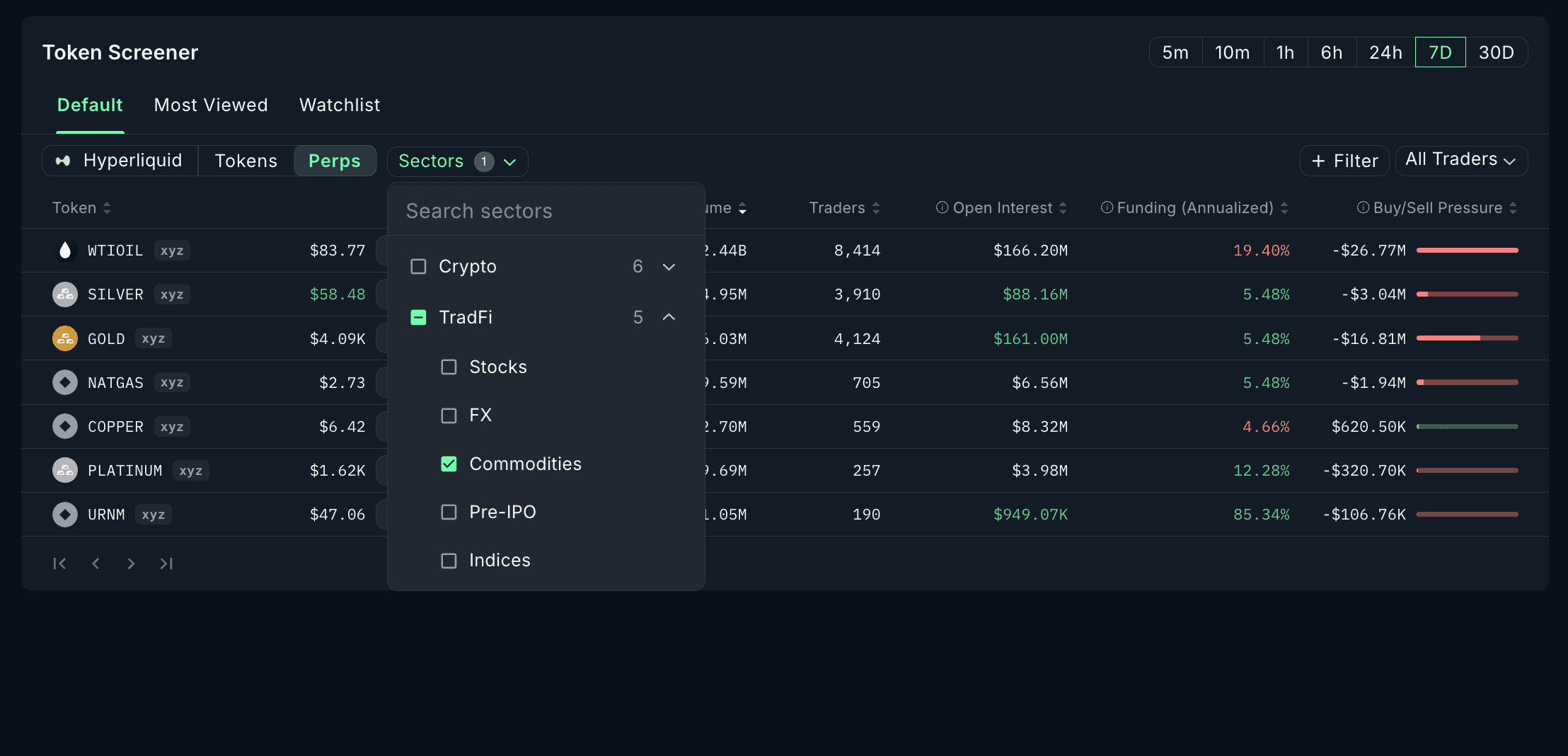
With Nansen, you can see whether Smart Money, wallets with verified track records across 500M+ labeled addresses, is accumulating tokenized gold, how holdings are shifting during a macro move, and how commodity-perp positioning is skewed. During a gold rally driven by geopolitical stress, seeing who is actually buying, rather than just watching price, is a meaningful edge.


FAQ: Tokenized Commodities

  • What are tokenized commodities? Blockchain tokens giving exposure to physical commodities like gold, silver, and oil, tradable and settled onchain 24/7. They exist as backed spot tokens and as leveraged commodity perpetuals.

  • What is tokenized gold? A token backed 1:1 by physical gold in a vault, redeemable and independently attested. The largest examples are Tether Gold (XAUT) and Pax Gold (PAXG), which together dominate the segment.

  • How do I trade gold onchain? For ownership, hold a backed token like XAUT or PAXG. For leveraged price exposure, trade a gold perpetual, for example via HIP-3 markets on Hyperliquid. The two are different products.

  • Is tokenized gold backed by real gold? For the major tokens, yes: each is backed by physical bullion in custody, with periodic attestations. Always verify the issuer's attestations and custody structure.

  • Can I trade tokenized oil or silver? Yes. Silver has backed tokens such as Kinesis Silver, and commodities including silver and oil are available as perpetuals through builders on Hyperliquid. Availability varies.

  • Do tokenized commodities trade 24/7? Onchain settlement runs continuously. Because reference markets have set hours, prices can gap when those markets are closed.


Conclusion

Tokenized commodities bring gold, silver, and oil onchain, tradable 24/7, self-custodial, and usable in DeFi. Gold leads by a wide margin, with billions in market value and spot volumes that have outpaced entire prior years.

As always with tokenized assets, the one rule that matters most: know whether you are holding a backed spot token or trading a leveraged perp. They track the same price and behave completely differently in your account.

Tokenized Commodities: How to Trade Gold and Oil Onchain

Written by

Read Time

5 min read

Posted on

A tokenized commodity is a blockchain token that represents exposure to a real-world commodity, so it can be held and traded onchain, 24/7.

Traditional commodity exposure means futures accounts, ETFs, or physical storage, each with friction, limited hours, and gatekeeping. Onchain, the same exposure settles in seconds, trades around the clock, and can be used as collateral in DeFi. When geopolitical stress hits over a weekend, tokenized commodities let traders react immediately rather than waiting for traditional markets to open.

Gold has been the anchor of the category by a wide margin, with silver and oil growing around it.


The Two Ways to Trade Tokenized Commodities

As with all tokenized assets, the most important distinction is backed spot versus synthetic perpetual. Confusing them is the costliest mistake.

1. Backed (spot) commodity tokens

A backed token holds the real commodity 1:1. Tokenized gold is the clearest example: each token represents one troy ounce of physical gold held in a vault, with periodic attestations. You own commodity exposure, with no leverage and no liquidation. This is spot ownership.

2. Commodity perpetuals

A commodity perp tracks a commodity's price with leverage and hourly funding, without holding the physical asset. On Hyperliquid, through HIP-3, builders have deployed gold and silver perps benchmarked to COMEX front-month futures, among others. These are leveraged synthetic contracts that can be liquidated. See how stock and asset perps work for the shared mechanics.

Own the exposure, or trade the price with leverage. Decide which before you start.


The Leading Tokenized Commodities

Tokenized gold leads the category, and two tokens dominate it:

Token

Backing

Issuer

Notes

XAUT (Tether Gold)

1 troy oz gold, Swiss vaults

TG Commodities (Tether subsidiary)

Largest tokenized gold by market cap; multi-chain via XAUT0

PAXG (Pax Gold)

1 troy oz gold, London vaults (Brink's)

Paxos

Serial-numbered bars, monthly attestations, NYDFS oversight

Together these two have made up roughly 89 to 97 percent of the tokenized gold segment. Smaller precious-metals tokens include Kinesis Silver (KAG) and Matrixdock Gold (XAUM), and yield-bearing variants such as thGOLD have emerged that combine gold backing with an income structure.

The numbers show real adoption. Tokenized gold's market capitalization grew into the multiple-billions through 2026, and spot trading of tokenized gold reached roughly $90 billion in the first quarter of 2026 alone, surpassing the total for all of 2025. Tokenized commodities as a whole climbed to occupy a large and growing slice of the real-world-asset market.


Why Trade Commodities Onchain?

  • 24/7 access. Physical and futures markets have hours and holidays. Tokenized commodities trade continuously, and onchain activity increasingly contributes to weekend price discovery for gold.

  • Fractional exposure. Own a fraction of an ounce rather than a whole bar or a full futures contract.

  • Self-custody. Hold commodity exposure in a wallet you control, without a vault account or a futures broker.

  • DeFi utility. Tokenized gold can be used as collateral and, in some products, to earn yield.

  • Transparency. Backed tokens publish attestations; onchain flows are publicly visible.

Risks to Understand

  • Spot versus perp confusion. A backed gold token is ownership; a gold perp is a leveraged bet that can be liquidated. Know which you hold.

  • Issuer and custody dependence. Backed tokens rely on the issuer holding the metal and honoring redemptions. Issuer structures differ, and so do the legal protections behind your claim.

  • Off-hours price gaps. When reference markets are closed, tokenized commodity prices can diverge from where they will reopen.

  • Oracle risk (perps). Commodity perps depend on the deployer's price feed quality.

  • Leverage risk (perps). Perpetuals can be liquidated, and funding is an ongoing cost.

  • Regulatory and jurisdictional limits. Availability varies by product and region. Check what applies to you.


Reading the Onchain Signal Behind Commodities

Since tokenized commodities settle onchain, the flows behind them are visible in a way traditional commodity markets are not.

With Nansen, you can see whether Smart Money, wallets with verified track records across 500M+ labeled addresses, is accumulating tokenized gold, how holdings are shifting during a macro move, and how commodity-perp positioning is skewed. During a gold rally driven by geopolitical stress, seeing who is actually buying, rather than just watching price, is a meaningful edge.


FAQ: Tokenized Commodities

  • What are tokenized commodities? Blockchain tokens giving exposure to physical commodities like gold, silver, and oil, tradable and settled onchain 24/7. They exist as backed spot tokens and as leveraged commodity perpetuals.

  • What is tokenized gold? A token backed 1:1 by physical gold in a vault, redeemable and independently attested. The largest examples are Tether Gold (XAUT) and Pax Gold (PAXG), which together dominate the segment.

  • How do I trade gold onchain? For ownership, hold a backed token like XAUT or PAXG. For leveraged price exposure, trade a gold perpetual, for example via HIP-3 markets on Hyperliquid. The two are different products.

  • Is tokenized gold backed by real gold? For the major tokens, yes: each is backed by physical bullion in custody, with periodic attestations. Always verify the issuer's attestations and custody structure.

  • Can I trade tokenized oil or silver? Yes. Silver has backed tokens such as Kinesis Silver, and commodities including silver and oil are available as perpetuals through builders on Hyperliquid. Availability varies.

  • Do tokenized commodities trade 24/7? Onchain settlement runs continuously. Because reference markets have set hours, prices can gap when those markets are closed.


Conclusion

Tokenized commodities bring gold, silver, and oil onchain, tradable 24/7, self-custodial, and usable in DeFi. Gold leads by a wide margin, with billions in market value and spot volumes that have outpaced entire prior years.

As always with tokenized assets, the one rule that matters most: know whether you are holding a backed spot token or trading a leveraged perp. They track the same price and behave completely differently in your account.

About the Author

You may also like these

Related Posts

Tokenized Commodities: How to Trade Gold and Oil Onchain

Written by

Read Time

5 min read

Posted on

A tokenized commodity is a blockchain token that represents exposure to a real-world commodity, so it can be held and traded onchain, 24/7.

Traditional commodity exposure means futures accounts, ETFs, or physical storage, each with friction, limited hours, and gatekeeping. Onchain, the same exposure settles in seconds, trades around the clock, and can be used as collateral in DeFi. When geopolitical stress hits over a weekend, tokenized commodities let traders react immediately rather than waiting for traditional markets to open.

Gold has been the anchor of the category by a wide margin, with silver and oil growing around it.


The Two Ways to Trade Tokenized Commodities

As with all tokenized assets, the most important distinction is backed spot versus synthetic perpetual. Confusing them is the costliest mistake.

1. Backed (spot) commodity tokens

A backed token holds the real commodity 1:1. Tokenized gold is the clearest example: each token represents one troy ounce of physical gold held in a vault, with periodic attestations. You own commodity exposure, with no leverage and no liquidation. This is spot ownership.

2. Commodity perpetuals

A commodity perp tracks a commodity's price with leverage and hourly funding, without holding the physical asset. On Hyperliquid, through HIP-3, builders have deployed gold and silver perps benchmarked to COMEX front-month futures, among others. These are leveraged synthetic contracts that can be liquidated. See how stock and asset perps work for the shared mechanics.

Own the exposure, or trade the price with leverage. Decide which before you start.


The Leading Tokenized Commodities

Tokenized gold leads the category, and two tokens dominate it:

Token

Backing

Issuer

Notes

XAUT (Tether Gold)

1 troy oz gold, Swiss vaults

TG Commodities (Tether subsidiary)

Largest tokenized gold by market cap; multi-chain via XAUT0

PAXG (Pax Gold)

1 troy oz gold, London vaults (Brink's)

Paxos

Serial-numbered bars, monthly attestations, NYDFS oversight

Together these two have made up roughly 89 to 97 percent of the tokenized gold segment. Smaller precious-metals tokens include Kinesis Silver (KAG) and Matrixdock Gold (XAUM), and yield-bearing variants such as thGOLD have emerged that combine gold backing with an income structure.

The numbers show real adoption. Tokenized gold's market capitalization grew into the multiple-billions through 2026, and spot trading of tokenized gold reached roughly $90 billion in the first quarter of 2026 alone, surpassing the total for all of 2025. Tokenized commodities as a whole climbed to occupy a large and growing slice of the real-world-asset market.


Why Trade Commodities Onchain?

  • 24/7 access. Physical and futures markets have hours and holidays. Tokenized commodities trade continuously, and onchain activity increasingly contributes to weekend price discovery for gold.

  • Fractional exposure. Own a fraction of an ounce rather than a whole bar or a full futures contract.

  • Self-custody. Hold commodity exposure in a wallet you control, without a vault account or a futures broker.

  • DeFi utility. Tokenized gold can be used as collateral and, in some products, to earn yield.

  • Transparency. Backed tokens publish attestations; onchain flows are publicly visible.

Risks to Understand

  • Spot versus perp confusion. A backed gold token is ownership; a gold perp is a leveraged bet that can be liquidated. Know which you hold.

  • Issuer and custody dependence. Backed tokens rely on the issuer holding the metal and honoring redemptions. Issuer structures differ, and so do the legal protections behind your claim.

  • Off-hours price gaps. When reference markets are closed, tokenized commodity prices can diverge from where they will reopen.

  • Oracle risk (perps). Commodity perps depend on the deployer's price feed quality.

  • Leverage risk (perps). Perpetuals can be liquidated, and funding is an ongoing cost.

  • Regulatory and jurisdictional limits. Availability varies by product and region. Check what applies to you.


Reading the Onchain Signal Behind Commodities

Since tokenized commodities settle onchain, the flows behind them are visible in a way traditional commodity markets are not.

With Nansen, you can see whether Smart Money, wallets with verified track records across 500M+ labeled addresses, is accumulating tokenized gold, how holdings are shifting during a macro move, and how commodity-perp positioning is skewed. During a gold rally driven by geopolitical stress, seeing who is actually buying, rather than just watching price, is a meaningful edge.


FAQ: Tokenized Commodities

  • What are tokenized commodities? Blockchain tokens giving exposure to physical commodities like gold, silver, and oil, tradable and settled onchain 24/7. They exist as backed spot tokens and as leveraged commodity perpetuals.

  • What is tokenized gold? A token backed 1:1 by physical gold in a vault, redeemable and independently attested. The largest examples are Tether Gold (XAUT) and Pax Gold (PAXG), which together dominate the segment.

  • How do I trade gold onchain? For ownership, hold a backed token like XAUT or PAXG. For leveraged price exposure, trade a gold perpetual, for example via HIP-3 markets on Hyperliquid. The two are different products.

  • Is tokenized gold backed by real gold? For the major tokens, yes: each is backed by physical bullion in custody, with periodic attestations. Always verify the issuer's attestations and custody structure.

  • Can I trade tokenized oil or silver? Yes. Silver has backed tokens such as Kinesis Silver, and commodities including silver and oil are available as perpetuals through builders on Hyperliquid. Availability varies.

  • Do tokenized commodities trade 24/7? Onchain settlement runs continuously. Because reference markets have set hours, prices can gap when those markets are closed.


Conclusion

Tokenized commodities bring gold, silver, and oil onchain, tradable 24/7, self-custodial, and usable in DeFi. Gold leads by a wide margin, with billions in market value and spot volumes that have outpaced entire prior years.

As always with tokenized assets, the one rule that matters most: know whether you are holding a backed spot token or trading a leveraged perp. They track the same price and behave completely differently in your account.
About the Author

You may also like these

Related Posts