
Tokenized Assets Explained: Trading Real-World Assets Onchain

Tokenized assets bring stocks, gold, oil, and indices onchain for 24/7 trading. Learn the categories, how they trade, and where to track the flows.

Written by

Read Time

5 min read

Posted on

What Are Tokenized Assets?

A tokenized asset is a blockchain representation of something with real-world value, issued so it can be held, transferred, and traded onchain.

The appeal is structural. Traditional assets settle slowly, trade only during set hours, and live inside walled systems. Onchain, the same exposure settles in seconds, trades around the clock, and can plug into DeFi. When geopolitical news breaks on a Sunday night, a trader can act on gold or oil exposure immediately instead of waiting for Monday's open.

That "24/7 access to everything with a price" property is the core reason the category is growing.

The Main Categories of Tokenized Assets

Category

Examples

What it represents

Tokenized equities

AAPL, TSLA, NVDA tokens

Public company shares

Tokenized commodities

Gold, silver, oil

Physical or benchmark commodity exposure

Tokenized indices

S&P 500, Nasdaq-100

Baskets of equities

Tokenized treasuries / bonds

Short-term US Treasuries

Government debt yield

FX and macro

Currency pairs

Foreign exchange exposure

Different issuers and venues specialize in different categories. Some focus on backed spot tokens; others focus on synthetic derivatives. Which one you use depends on whether you want to own the exposure or trade its price.


The Two Ways Tokenized Assets Trade

Almost every tokenized asset falls into one of two models, and confusing them is the most common and costly mistake.


1. Backed (spot) tokens

A backed token holds the real asset 1:1 with a custodian. A tokenized stock backed by shares, or a gold token backed by bullion, is spot ownership. No leverage, no funding, no liquidation. You own a claim on the underlying. This is the model behind tokenized stocks from issuers like Backed, Ondo, and Dinari.

2. Synthetic (perpetual) contracts

A synthetic contract tracks an asset's price without holding it, usually as a perpetual future with leverage and hourly funding. Nothing is backed by the real asset; the contract references its price via an oracle. This is how you trade tokenized-asset prices with leverage, and it can be liquidated.

The largest venue for synthetic real-world-asset perps is Hyperliquid, which we cover next.


How Hyperliquid Turned RWAs Into a 24/7 Market

The synthetic side of tokenized assets scaled fast on Hyperliquid, the largest decentralized perpetuals venue.

Through a framework called HIP-3, launched in October 2025, builders can deploy their own perpetual markets. The result was a wave of real-world-asset perps: single stocks, equity indices like the S&P 500 and Nasdaq-100, gold, oil, and more, all trading 24/7 as perpetual contracts settled in stablecoin.

The scale is no longer a novelty. By mid-2026, HIP-3 open interest reached into the billions, tokenized assets occupied the majority of Hyperliquid's top markets by open interest, and on peak days these markets accounted for close to half of the platform's total volume. Non-crypto assets showed strong trader retention, a sign that people are using them for real exposure, not just to speculate on the launch.

For the full breakdown of the venue itself, see Why Smart Money is Trading on Hyperliquid.


Benefits and Risks of Tokenized Assets

Benefits:

  • 24/7 access. Trade macro exposure the moment news breaks, not when traditional markets open.

  • Fast settlement. Onchain settlement in seconds rather than days.

  • Global reach. Access via a wallet, subject to jurisdiction.

  • Composability. Tokens can be used as collateral and inside DeFi.

  • Transparency. Flows and positioning are visible onchain.

Risks:

  • Model confusion. Mistaking a leveraged synthetic perp for backed spot ownership is a serious and common error.

  • Issuer and oracle dependence. Backed tokens rely on the custodian; synthetic perps rely on the quality of the deployer's price oracle.

  • Off-hours price gaps. When the underlying market is closed, prices can diverge.

  • Regulatory uncertainty. Synthetic equity exposure in particular sits in an evolving legal landscape, and availability varies by jurisdiction.

  • Leverage risk. Perpetual contracts can be liquidated. Backed spot tokens cannot, but still carry market risk.


How to Read the Onchain Activity Behind Tokenized Assets
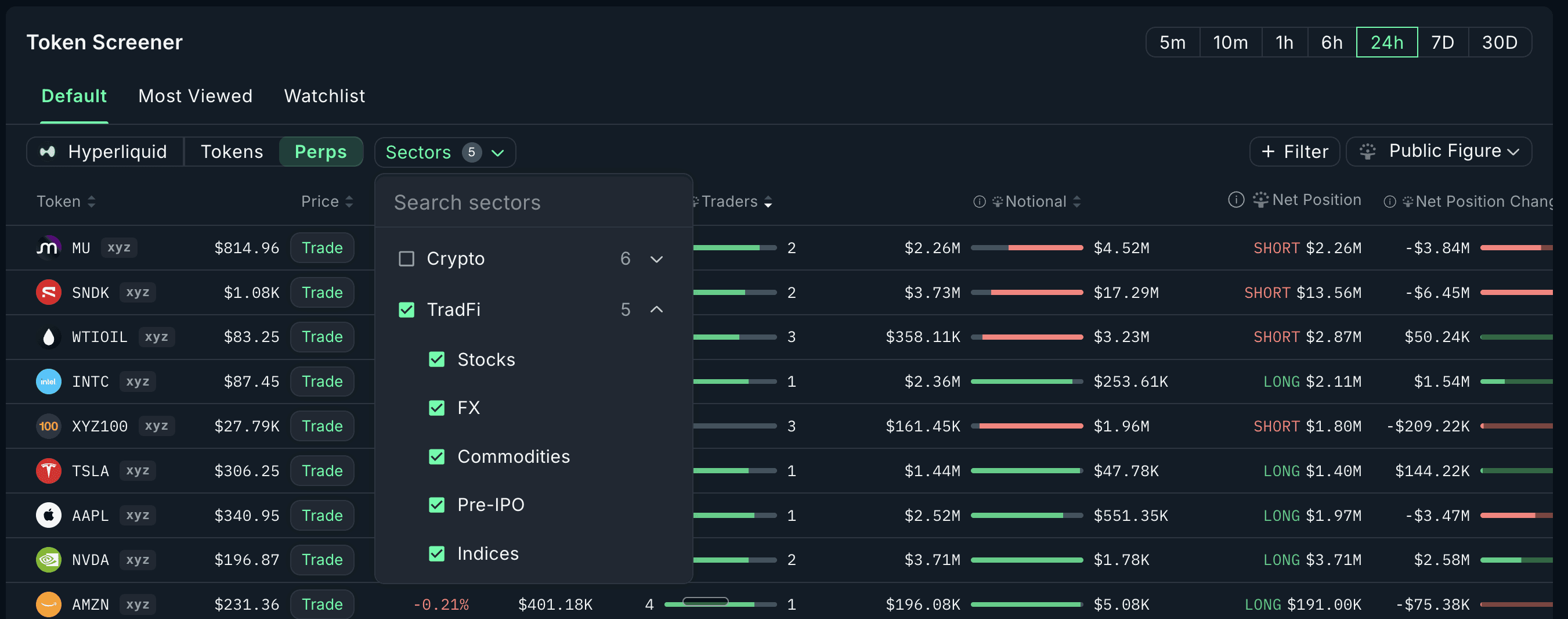
Because tokenized assets settle onchain, the market's positioning is public, unlike in traditional finance where it sits inside exchanges and brokers.

With Nansen, that raw data becomes legible. Activity is cross-referenced against 500M+ labeled addresses, so you can see whether Smart Money, wallets with verified track records, is building or reducing exposure, how positioning is skewed, and where capital is rotating across asset classes. That is an information layer traditional markets structurally cannot offer.


FAQ: Tokenized Assets

  • What are tokenized assets? Blockchain tokens representing real-world value, such as stocks, commodities, indices, or bonds, that can be traded and settled onchain around the clock.

  • What is the difference between tokenized assets and RWAs? They are largely the same idea. "Real-world assets" (RWAs) is the broader term for offchain value brought onchain; tokenized assets are the tokens that do it.

  • What is the difference between backed and synthetic tokenized assets? Backed (spot) tokens hold the real asset 1:1 with a custodian, giving ownership. Synthetic contracts, usually perpetual futures, only track the price using leverage and funding, and can be liquidated.

  • Can I trade tokenized stocks and commodities 24/7? Yes. Onchain settlement runs continuously. Note that when the underlying market is closed, the price can gap relative to where the asset will next open.

  • Where is the biggest market for tokenized-asset perps? Hyperliquid, through its HIP-3 framework, hosts the largest set of real-world-asset perpetuals, spanning single stocks, indices, and commodities.

  • Are tokenized assets regulated? It varies by asset, issuer, and jurisdiction. Backed equity tokens and synthetic equity perps face different and evolving regulatory treatment. Check what applies where you are.


Conclusion

Tokenized assets are breaking down the wall between traditional markets and onchain trading, bringing stocks, commodities, and indices into a 24/7, self-custodial, transparent environment.

The one rule that matters most: know whether you are holding backed spot exposure or trading a leveraged synthetic perp. They look similar on a price chart and behave completely differently in your account.

Tokenized Assets Explained: Trading Real-World Assets Onchain

Written by

Read Time

5 min read

Posted on

What Are Tokenized Assets?

A tokenized asset is a blockchain representation of something with real-world value, issued so it can be held, transferred, and traded onchain.

The appeal is structural. Traditional assets settle slowly, trade only during set hours, and live inside walled systems. Onchain, the same exposure settles in seconds, trades around the clock, and can plug into DeFi. When geopolitical news breaks on a Sunday night, a trader can act on gold or oil exposure immediately instead of waiting for Monday's open.

That "24/7 access to everything with a price" property is the core reason the category is growing.

The Main Categories of Tokenized Assets

Category

Examples

What it represents

Tokenized equities

AAPL, TSLA, NVDA tokens

Public company shares

Tokenized commodities

Gold, silver, oil

Physical or benchmark commodity exposure

Tokenized indices

S&P 500, Nasdaq-100

Baskets of equities

Tokenized treasuries / bonds

Short-term US Treasuries

Government debt yield

FX and macro

Currency pairs

Foreign exchange exposure

Different issuers and venues specialize in different categories. Some focus on backed spot tokens; others focus on synthetic derivatives. Which one you use depends on whether you want to own the exposure or trade its price.


The Two Ways Tokenized Assets Trade

Almost every tokenized asset falls into one of two models, and confusing them is the most common and costly mistake.


1. Backed (spot) tokens

A backed token holds the real asset 1:1 with a custodian. A tokenized stock backed by shares, or a gold token backed by bullion, is spot ownership. No leverage, no funding, no liquidation. You own a claim on the underlying. This is the model behind tokenized stocks from issuers like Backed, Ondo, and Dinari.

2. Synthetic (perpetual) contracts

A synthetic contract tracks an asset's price without holding it, usually as a perpetual future with leverage and hourly funding. Nothing is backed by the real asset; the contract references its price via an oracle. This is how you trade tokenized-asset prices with leverage, and it can be liquidated.

The largest venue for synthetic real-world-asset perps is Hyperliquid, which we cover next.


How Hyperliquid Turned RWAs Into a 24/7 Market

The synthetic side of tokenized assets scaled fast on Hyperliquid, the largest decentralized perpetuals venue.

Through a framework called HIP-3, launched in October 2025, builders can deploy their own perpetual markets. The result was a wave of real-world-asset perps: single stocks, equity indices like the S&P 500 and Nasdaq-100, gold, oil, and more, all trading 24/7 as perpetual contracts settled in stablecoin.

The scale is no longer a novelty. By mid-2026, HIP-3 open interest reached into the billions, tokenized assets occupied the majority of Hyperliquid's top markets by open interest, and on peak days these markets accounted for close to half of the platform's total volume. Non-crypto assets showed strong trader retention, a sign that people are using them for real exposure, not just to speculate on the launch.

For the full breakdown of the venue itself, see Why Smart Money is Trading on Hyperliquid.


Benefits and Risks of Tokenized Assets

Benefits:

  • 24/7 access. Trade macro exposure the moment news breaks, not when traditional markets open.

  • Fast settlement. Onchain settlement in seconds rather than days.

  • Global reach. Access via a wallet, subject to jurisdiction.

  • Composability. Tokens can be used as collateral and inside DeFi.

  • Transparency. Flows and positioning are visible onchain.

Risks:

  • Model confusion. Mistaking a leveraged synthetic perp for backed spot ownership is a serious and common error.

  • Issuer and oracle dependence. Backed tokens rely on the custodian; synthetic perps rely on the quality of the deployer's price oracle.

  • Off-hours price gaps. When the underlying market is closed, prices can diverge.

  • Regulatory uncertainty. Synthetic equity exposure in particular sits in an evolving legal landscape, and availability varies by jurisdiction.

  • Leverage risk. Perpetual contracts can be liquidated. Backed spot tokens cannot, but still carry market risk.


How to Read the Onchain Activity Behind Tokenized Assets

Because tokenized assets settle onchain, the market's positioning is public, unlike in traditional finance where it sits inside exchanges and brokers.

With Nansen, that raw data becomes legible. Activity is cross-referenced against 500M+ labeled addresses, so you can see whether Smart Money, wallets with verified track records, is building or reducing exposure, how positioning is skewed, and where capital is rotating across asset classes. That is an information layer traditional markets structurally cannot offer.


FAQ: Tokenized Assets

  • What are tokenized assets? Blockchain tokens representing real-world value, such as stocks, commodities, indices, or bonds, that can be traded and settled onchain around the clock.

  • What is the difference between tokenized assets and RWAs? They are largely the same idea. "Real-world assets" (RWAs) is the broader term for offchain value brought onchain; tokenized assets are the tokens that do it.

  • What is the difference between backed and synthetic tokenized assets? Backed (spot) tokens hold the real asset 1:1 with a custodian, giving ownership. Synthetic contracts, usually perpetual futures, only track the price using leverage and funding, and can be liquidated.

  • Can I trade tokenized stocks and commodities 24/7? Yes. Onchain settlement runs continuously. Note that when the underlying market is closed, the price can gap relative to where the asset will next open.

  • Where is the biggest market for tokenized-asset perps? Hyperliquid, through its HIP-3 framework, hosts the largest set of real-world-asset perpetuals, spanning single stocks, indices, and commodities.

  • Are tokenized assets regulated? It varies by asset, issuer, and jurisdiction. Backed equity tokens and synthetic equity perps face different and evolving regulatory treatment. Check what applies where you are.


Conclusion

Tokenized assets are breaking down the wall between traditional markets and onchain trading, bringing stocks, commodities, and indices into a 24/7, self-custodial, transparent environment.

The one rule that matters most: know whether you are holding backed spot exposure or trading a leveraged synthetic perp. They look similar on a price chart and behave completely differently in your account.

About the Author

You may also like these

Related Posts

Tokenized Assets Explained: Trading Real-World Assets Onchain

Written by

Read Time

5 min read

Posted on

What Are Tokenized Assets?

A tokenized asset is a blockchain representation of something with real-world value, issued so it can be held, transferred, and traded onchain.

The appeal is structural. Traditional assets settle slowly, trade only during set hours, and live inside walled systems. Onchain, the same exposure settles in seconds, trades around the clock, and can plug into DeFi. When geopolitical news breaks on a Sunday night, a trader can act on gold or oil exposure immediately instead of waiting for Monday's open.

That "24/7 access to everything with a price" property is the core reason the category is growing.

The Main Categories of Tokenized Assets

Category

Examples

What it represents

Tokenized equities

AAPL, TSLA, NVDA tokens

Public company shares

Tokenized commodities

Gold, silver, oil

Physical or benchmark commodity exposure

Tokenized indices

S&P 500, Nasdaq-100

Baskets of equities

Tokenized treasuries / bonds

Short-term US Treasuries

Government debt yield

FX and macro

Currency pairs

Foreign exchange exposure

Different issuers and venues specialize in different categories. Some focus on backed spot tokens; others focus on synthetic derivatives. Which one you use depends on whether you want to own the exposure or trade its price.


The Two Ways Tokenized Assets Trade

Almost every tokenized asset falls into one of two models, and confusing them is the most common and costly mistake.


1. Backed (spot) tokens

A backed token holds the real asset 1:1 with a custodian. A tokenized stock backed by shares, or a gold token backed by bullion, is spot ownership. No leverage, no funding, no liquidation. You own a claim on the underlying. This is the model behind tokenized stocks from issuers like Backed, Ondo, and Dinari.

2. Synthetic (perpetual) contracts

A synthetic contract tracks an asset's price without holding it, usually as a perpetual future with leverage and hourly funding. Nothing is backed by the real asset; the contract references its price via an oracle. This is how you trade tokenized-asset prices with leverage, and it can be liquidated.

The largest venue for synthetic real-world-asset perps is Hyperliquid, which we cover next.


How Hyperliquid Turned RWAs Into a 24/7 Market

The synthetic side of tokenized assets scaled fast on Hyperliquid, the largest decentralized perpetuals venue.

Through a framework called HIP-3, launched in October 2025, builders can deploy their own perpetual markets. The result was a wave of real-world-asset perps: single stocks, equity indices like the S&P 500 and Nasdaq-100, gold, oil, and more, all trading 24/7 as perpetual contracts settled in stablecoin.

The scale is no longer a novelty. By mid-2026, HIP-3 open interest reached into the billions, tokenized assets occupied the majority of Hyperliquid's top markets by open interest, and on peak days these markets accounted for close to half of the platform's total volume. Non-crypto assets showed strong trader retention, a sign that people are using them for real exposure, not just to speculate on the launch.

For the full breakdown of the venue itself, see Why Smart Money is Trading on Hyperliquid.


Benefits and Risks of Tokenized Assets

Benefits:

  • 24/7 access. Trade macro exposure the moment news breaks, not when traditional markets open.

  • Fast settlement. Onchain settlement in seconds rather than days.

  • Global reach. Access via a wallet, subject to jurisdiction.

  • Composability. Tokens can be used as collateral and inside DeFi.

  • Transparency. Flows and positioning are visible onchain.

Risks:

  • Model confusion. Mistaking a leveraged synthetic perp for backed spot ownership is a serious and common error.

  • Issuer and oracle dependence. Backed tokens rely on the custodian; synthetic perps rely on the quality of the deployer's price oracle.

  • Off-hours price gaps. When the underlying market is closed, prices can diverge.

  • Regulatory uncertainty. Synthetic equity exposure in particular sits in an evolving legal landscape, and availability varies by jurisdiction.

  • Leverage risk. Perpetual contracts can be liquidated. Backed spot tokens cannot, but still carry market risk.


How to Read the Onchain Activity Behind Tokenized Assets

Because tokenized assets settle onchain, the market's positioning is public, unlike in traditional finance where it sits inside exchanges and brokers.

With Nansen, that raw data becomes legible. Activity is cross-referenced against 500M+ labeled addresses, so you can see whether Smart Money, wallets with verified track records, is building or reducing exposure, how positioning is skewed, and where capital is rotating across asset classes. That is an information layer traditional markets structurally cannot offer.


FAQ: Tokenized Assets

  • What are tokenized assets? Blockchain tokens representing real-world value, such as stocks, commodities, indices, or bonds, that can be traded and settled onchain around the clock.

  • What is the difference between tokenized assets and RWAs? They are largely the same idea. "Real-world assets" (RWAs) is the broader term for offchain value brought onchain; tokenized assets are the tokens that do it.

  • What is the difference between backed and synthetic tokenized assets? Backed (spot) tokens hold the real asset 1:1 with a custodian, giving ownership. Synthetic contracts, usually perpetual futures, only track the price using leverage and funding, and can be liquidated.

  • Can I trade tokenized stocks and commodities 24/7? Yes. Onchain settlement runs continuously. Note that when the underlying market is closed, the price can gap relative to where the asset will next open.

  • Where is the biggest market for tokenized-asset perps? Hyperliquid, through its HIP-3 framework, hosts the largest set of real-world-asset perpetuals, spanning single stocks, indices, and commodities.

  • Are tokenized assets regulated? It varies by asset, issuer, and jurisdiction. Backed equity tokens and synthetic equity perps face different and evolving regulatory treatment. Check what applies where you are.


Conclusion

Tokenized assets are breaking down the wall between traditional markets and onchain trading, bringing stocks, commodities, and indices into a 24/7, self-custodial, transparent environment.

The one rule that matters most: know whether you are holding backed spot exposure or trading a leveraged synthetic perp. They look similar on a price chart and behave completely differently in your account.
About the Author

You may also like these

Related Posts