

If you've been tracking onchain activity lately, Hyperliquid keeps coming up and is making headlines in the news.
It's not hype - the data backs it.
Hyperliquid perps trading now accounts for a substantial share of total decentralized derivatives volume, and the wallets moving through the platform include some of the most sophisticated participants in crypto.
This post breaks down what Hyperliquid is, how it works, and why it's become the go-to venue for decentralized perps.
What is Hyperliquid?
Hyperliquid is a decentralized exchange focused on perpetual futures trading.
Unlike most DEXs that run on general-purpose chains like Ethereum or Solana, Hyperliquid operates on its own custom Layer 1 blockchain, HyperEVM, which was purpose-built for high-performance trading.
The result is a platform that can handle up to 200,000 orders per second with sub-second finality. Limit orders, cancellations, and fills happen at speeds that previously required a centralized exchange.
What makes Hyperliquid stand out is that it doesn't trade transparency for speed. The full order book, trade history, and liquidation data are all onchain and publicly accessible. Every trade is verifiable.
That combination - speed plus transparency - is the core reason traders have moved significant activity onto the platform.
Why Hyperliquid Perps Has Grown So Quickly
Hyperliquid launched its perps product in 2023 and has since grown into the largest decentralized perps venue by volume. In its early growth phase, the platform didn't rely on token incentives or subsidized liquidity mining programs to get there.
Several structural factors drove adoption:
Order book model, not AMM. Most decentralized exchanges use automated market makers, where prices are set by liquidity pools rather than direct buyer-seller matching. Hyperliquid runs a central limit order book - deterministic fills, tighter spreads, and a professional trading experience that AMMs simply can't replicate for anything beyond small spot trades.
No gas fees on trades. On Ethereum-based DEXs, every transaction costs gas. Hyperliquid's architecture eliminates per-trade gas fees entirely, which matters for high-frequency strategies and larger position management.
Cross-margining. Hyperliquid supports cross-margin across positions, letting traders manage capital more efficiently. This has been standard on centralized exchanges for years but was largely absent from decentralized alternatives before Hyperliquid.
Deep liquidity. For the most actively traded pairs, slippage on Hyperliquid is competitive with mid-tier centralized venues. The platform grew into that liquidity depth organically - its early growth came before the HYPE token launch and airdrop in late 2024.
The Broader Context: Why Decentralized Perps Are Growing
Hyperliquid's rise is part of a structural shift in how serious crypto traders approach derivatives.
Centralized exchanges remain dominant by volume, but they carry risks that have become difficult to ignore.
FTX's collapse in 2022 is the clearest example: billions in user funds vanished because traders didn't actually hold what they thought they held. That event accelerated interest in non-custodial alternatives.
Decentralized perps platforms let traders maintain control of their funds throughout the process.
You connect a wallet, post margin, and access the market without depositing into a counterparty's account. If the platform has issues, your funds aren't at risk in the same way they would be on a centralized exchange.
Hyperliquid took this further by making the non-custodial experience feel close to a professional centralized trading interface.
Alongside this, public onchain data has changed how investors trade.
With Nansen, traders can monitor Smart Money and top trader positioning on Hyperliquid in ways that simply aren't available on other platforms.
That information advantage is attracting a specific kind of data-driven 'smart trader.' .
Hyperliquid Analytics on Nansen
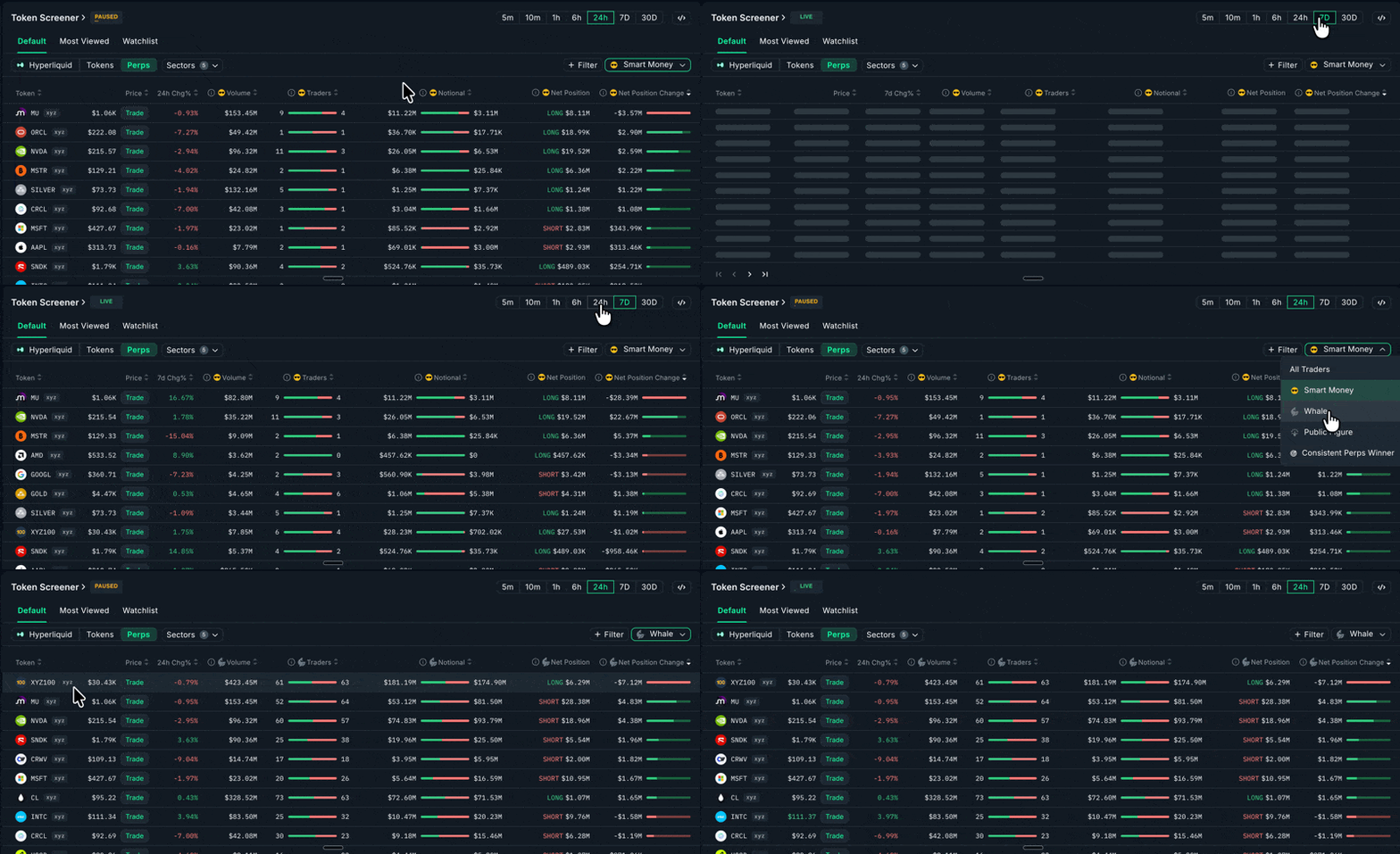
If you want to know whether large, experienced traders are building or reducing exposure before a move, Hyperliquid is now the clearest public signal you have.
Every position, every liquidation, every significant flow is onchain - and Nansen surfaces it against 500M+ labeled addresses so you can understand who is behind a wallet, not just what it did.
Nansen tracks Hyperliquid onchain data as part of its core intelligence.
You can see which labeled wallets are active, how positions are sizing across the market, and where notable capital is flowing across Smart Money, Whales, Public Figures, and top traders.
FAQ
What is Hyperliquid? Hyperliquid is a decentralized exchange for perpetual futures. It runs on its own Layer 1 blockchain built for high-throughput, low-latency trading. All order book and trade data is publicly visible onchain.
How does Hyperliquid perps trading work? Hyperliquid uses a central limit order book model, similar to centralized exchanges. Traders connect a wallet, post collateral, and open positions on crypto assets. Positions, liquidations, and funding rates are all recorded onchain and publicly accessible.
Is Hyperliquid a DEX or CEX? Hyperliquid is fully decentralized. Users maintain custody of their funds through non-custodial wallets. There's no central entity holding user deposits the way a centralized exchange does.
Why is Smart Money moving to Hyperliquid? The order book model provides tighter fills than AMM-based DEXs, there are no per-trade gas fees, cross-margining is available, and the platform's liquidity has grown deep enough to support large position sizes. The onchain transparency is also a draw for data-driven traders who want to monitor counterparty activity in real time.
What makes Hyperliquid different from other decentralized perps platforms? The main differentiators are its custom L1 (enabling speed that general-purpose chains can't match), the order book model (preferred by professional traders over AMMs), and the liquidity depth it built organically before its HYPE token launch in late 2024.
How does Nansen track Hyperliquid activity? Nansen monitors onchain data from Hyperliquid and cross-references wallet activity against its database of 500M+ labeled addresses. This lets users see whether significant positions or flows on Hyperliquid are coming from wallets Nansen has identified as Smart Money.
Can I access Hyperliquid perps data on Nansen? Yes. Nansen tracks onchain activity on Hyperliquid. Nansen users will also be able to trade on Hyperliquid perps directly within the platform.