

Here's a useful way to think about the future of onchain investing.
A decade ago, every engineer wrote code by hand, line by line.
Then vibe coding came along - you work with AI, prompt it, review the output, click to accept. Faster. But the engineer is still in the loop for every decision.
Now there's agentic engineering: you don't just vibe code, you orchestrate. The AI handles the execution. You set the direction.
Trading is following the same arc.
You started with manual trading - find a signal yourself, open a browser, place the trade.
Then as AI assistants became more powerful, you work with AI tools to surface information faster, but you're still clicking and deciding.
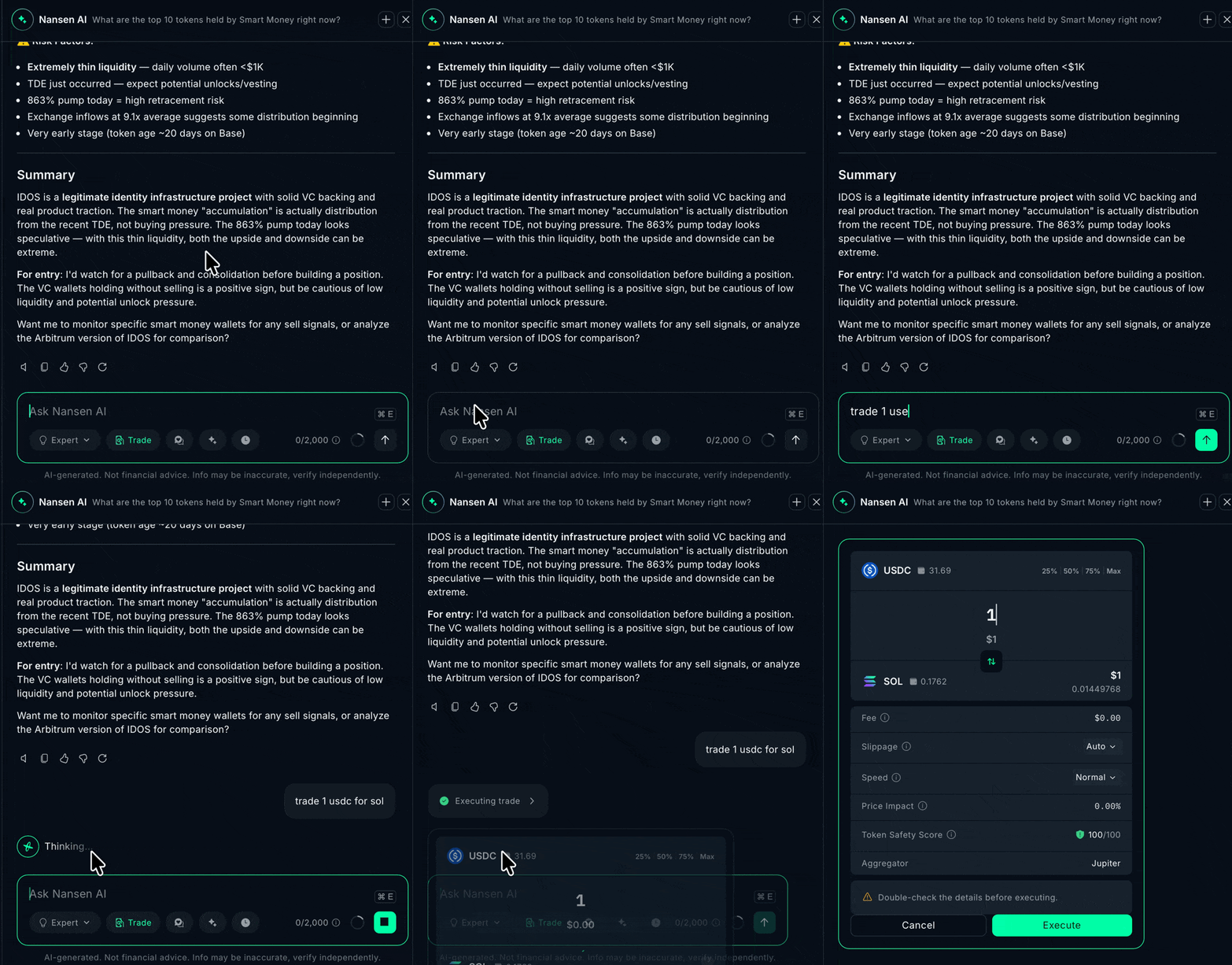
Soon enough, you'll see agentic trading take shape.
You're not picking every token yourself. Think of it as you setting the strategy, and the agent handles the rest.
That shift is happening right now.
What Is Agentic Trading?
Agentic trading is where an AI agent autonomously handles the full trading workflow on your behalf - surfacing signals from onchain data, researching opportunities, and executing positions - without you having to manually drive every step.
In practice, an agentic system can monitor hundreds of wallets for Smart Money activity, identify when a statistically significant move is happening, cross-reference token fundamentals and holder distribution, and execute a position - all before most traders have finished their morning coffee.
The key word is autonomy.
The Road to Agentic Trading Reality
Agentic trading won't happen overnight.
One thing people get wrong about agentic trading: they assume it's all-or-nothing.
It doesn't work like that. Agentic trading comes in steps.
You start by using the AI to surface information faster. You're still making the calls. Over time, as you see how the agent thinks - what signals it catches, how it evaluates them, how accurate it's been - you get comfortable delegating more.
This is no different from the AI assistant boom of tools like ChatGPT and Claude.
At first, you'd see a lot of hallucinations. But overtime, the LLMs got better, smarter, and more capable.
The same is happening with agentic trading right now.
Trust compounds. Right now, with 'vibe trading,' you lean on platforms like Nansen to let an agent do onchain research for you, cutting your analysis time by more than half.
As trust builds, eventually, the agent will given more responsibility the same way a new analyst would.
Traders need to see how the agent reasons before they'll let it act. The best agentic trading systems are designed around that - making the logic visible and gradual.
How Agentic Trading Is Different From Trading Bots
Crypto trading bots have existed for years.
Agentic trading is not the same thing.
Traditional trading bots are deterministic. A script or code runs (ex: if the price crosses this level, buy. If it drops below that threshold, sell) - the rules are fixed.
The bot does exactly what you told it to do, and nothing else. That's useful, but it's brittle. The market changes all the time, but the rules are seemingly fixed.
You can see agentic trading as more inference-based. Instead of running a fixed script, the agent reasons over a wide inventory of tools and data sources - onchain flows, wallet labels, holder distributions, market context - and makes judgment calls.
Because they're non-deterministic, you can't just review the code and know what the agent will do in every situation.
That's why evals are so important at Nansen; you run the agent across historical scenarios, test its outputs against known outcomes, and tune its behavior. It's more like training a junior trader than writing a scheduled job.
Feature | Traditional Bot | Agentic Trading |
|---|---|---|
Logic | Rule-based (if/then) | LLM-powered reasoning |
Input | Price feeds, technical indicators | Onchain data, wallet labels, AI signals |
Adaptability | Fixed logic | Adapts to new conditions |
Research | None | Context-aware, full-loop |
How Agentic Trading Works Onchain
Every transaction, wallet interaction, and token transfer on a blockchain is public, timestamped, and queryable in real time. That's the data layer agentic trading is built on.
Here's the basic loop:
Signal detection - The agent monitors onchain activity: Smart Money wallet movements, large token inflows to DEXs, unusual accumulation patterns.
Research and validation - The agent cross-checks who's behind the movement. What's their historical win rate? What does the token's holder distribution look like?
Decision - Based on configurable parameters - risk tolerance, position sizing, token filters - the agent determines whether to act.
Execution - The agent finds the best route for the trade through and executes.
Monitoring and exit - The agent tracks the position and closes when conditions are met.
The intelligence layer is what determines whether any of this is worth doing.
Agentic trading without high-quality data is just a fast guesser.
Where Smart Money Data Comes In
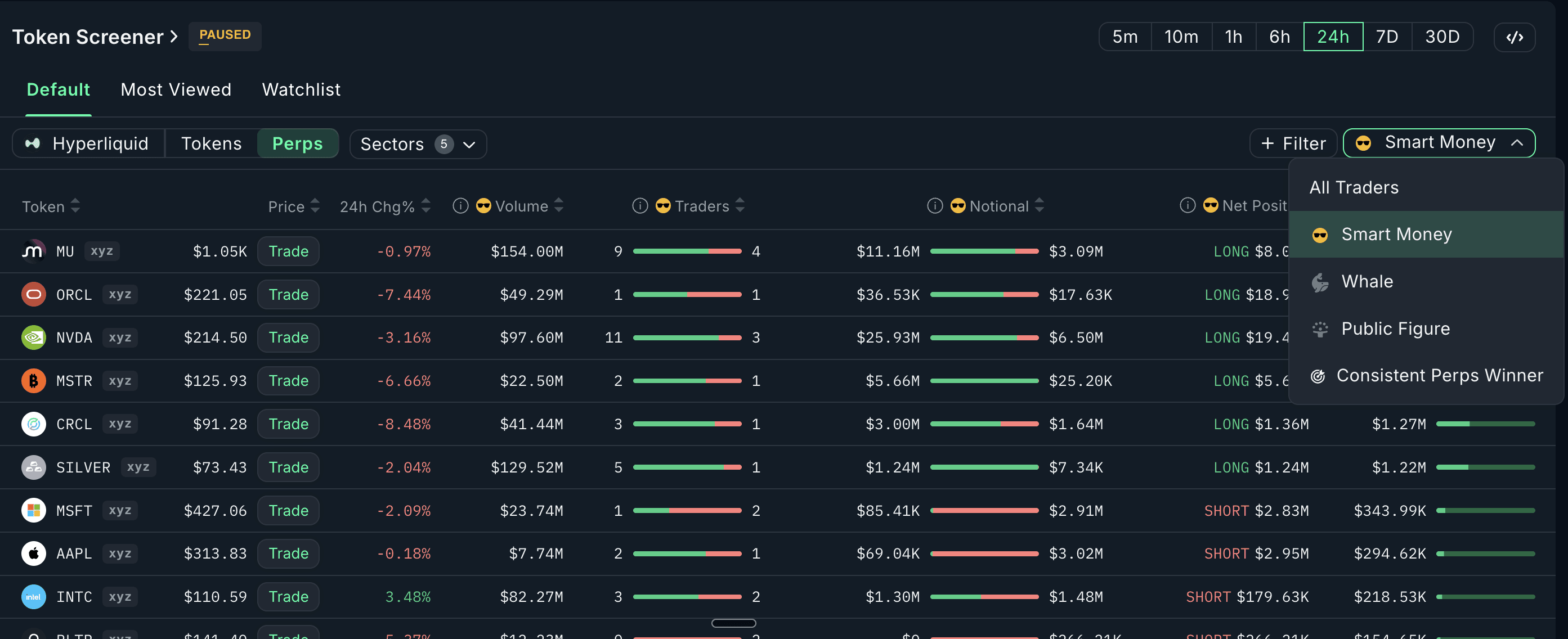
Smart Money refers to the wallets of crypto's most consistently profitable traders and investors. These wallets have demonstrated edge over time.
When they move, it means something.
Knowing that a wallet moved $5M into a token is noise without context.
Knowing that the wallet belongs to a trader with a documented track record of early entries - that's a signal.
This is where Nansen's 500M+ labeled addresses give AI agents the context to interpret onchain activity correctly.
Not just what happened, but who did it and what it likely means.
Why Retail Traders Stand to Benefit Most
Institutions already have research teams, data infrastructure, and execution desks. They've had an information advantage over retail traders for years.
Retail investors are often working alone.
No research team. No structured workflow.
Decisions made under pressure, with incomplete data, and the emotional weight of their own capital on the line.
Agentic trading changes that equation.
An AI agent doesn't panic. It doesn't miss a signal at 3am. It doesn't skip a step in the research process because it's tired. For the first time, retail traders can access a workflow that looks a lot closer to what institutional desks have always had - and do it inside a single platform.
In the next 24 to 36 months, most users will interact with markets through agents in some form.
Manual workflows simply won't remain competitive against systems that can monitor more wallets, process more data, and execute faster.
FAQ
What is agentic trading in crypto? Agentic trading is when an AI agent autonomously handles the full onchain workflow - surfacing signals from onchain data, discovering opportunities, and executing positions - with minimal manual input from the trader.
How is agentic trading different from a trading bot? Traditional trading bots execute trades based on fixed, deterministic rules. Agentic trading uses inference-based AI to reason over rich onchain context - wallet behavior, Smart Money flows, qualitative signals. Agents adapt; bots don't.
Is agentic trading safe? Agentic trading carries the same risks as any crypto strategy. AI agents can surface better information faster, but they do not eliminate market risk. Always conduct your own research before acting on any signal.
What data does an AI trading agent need? High-quality onchain data: labeled wallet addresses, token holder distributions, DEX flows, PnL histories, and real-time transaction feeds. The richer and more accurately labeled the data, the more reliable the agent's decisions.
Is agentic trading safe? Agentic trading carries the same risks as any crypto strategy. AI agents can surface better information faster, but they do not eliminate market risk.
Conclusion
Agentic trading isn't a feature.
t's a new way to trade for onchain investors.
The same shift that's happening in engineering will happen with crypto trading.
The edge in crypto has always been information and speed. An AI agent that reasons over rich onchain data and acts on it - without requiring you to drive every step - gives retail traders an edge that they would otherwise not have.
Nansen's data serves as the intelligence layer for agentic trading. Right now, it enables "vibe trading" - surfacing Smart Money signals and letting you execute on them manually in the same conversation.
As trust in agents grows, that workflow evolves further.
The future of onchain investing looks a lot different from today. And it's that future Nansen is building for.


