
What Are Pre-IPO Perps? Trading Private Companies Before They List

Pre-IPO perps are synthetic contracts that track a private company's value before it lists. Learn how they work on Hyperliquid, and the real risks.

Written by

Read Time

5 min read

Posted on

A pre-IPO perp is a perpetual futures contract whose reference is the market's estimate of a private company's value, before that company lists publicly.

Private companies like SpaceX, OpenAI, and Anthropic are largely inaccessible to retail. Accreditation rules and oversubscribed private rounds keep most people out.

There are, by some counts, over 1,700 unicorns representing trillions in value that ordinary investors cannot touch. Pre-IPO perps offer synthetic exposure to that price action without owning anything.

The key word is synthetic. You are not buying a share or a claim on one. You are taking a leveraged position on where a market thinks the company is valued.


How Do You Price a Company With No Public Price?

This is the clever and controversial part. A normal perp tracks an external price via an oracle. A private company has no continuous public price to track.

Pre-IPO perps solve this with a "hyperp" mechanism, where the market itself becomes the price reference. The contract's own trading, order flow, funding, positioning, sets the implied valuation, rather than importing a price from outside. In effect, the crowd's collective bet is the price.

When the company eventually goes public, contracts are designed to convert: if the listing happens before a set deadline, the pre-IPO perp automatically becomes a standard perp referenced to the now-public market price.


The Case That Put Pre-IPO Perps on the Map

The category's credibility rests on a concrete example: Cerebras, an AI chipmaker.

TradeXYZ launched a Cerebras pre-IPO perp as its first market in the category. When Cerebras listed on Nasdaq, the results were striking. One hour before the open, the pre-IPO perp was pricing Cerebras close to its actual Nasdaq opening price, within a few percent. Over the same window, a traditional secondary marketplace was pricing the shares far lower, off by a wide margin.

The takeaway that drew attention: an onchain, crowd-driven market produced faster and more accurate price discovery for a private company than an established offchain secondary venue. That is the bull case for the entire category.


Pre-IPO Perps vs Tokenized Stocks

These are easy to confuse and fundamentally different, a distinction that became very real in 2026:

  • A tokenized stock is backed by a real share held in custody. It is ownership.

  • A pre-IPO perp is a synthetic contract with nothing backing it but the market. It is a leveraged bet on price, with no ownership, no shares, no dividends, no voting.

This difference matters legally. When some tokenized pre-IPO share initiatives ran into trouble, including public warnings from companies such as OpenAI and Anthropic against trading in securities tied to them that they had not authorized, synthetic perps were affected differently precisely because they do not claim to represent shares.

That distinction is central to how the products are marketed and regulated. For the framework behind them, see what is HIP-3.

Why Traders Use Pre-IPO Perps

  • Access. Exposure to private-company valuations that accreditation rules otherwise block.

  • Timing. Position ahead of a major listing rather than after the first-day pop.

  • 24/7 markets. Trade around the clock, react to news immediately.

  • Long or short with leverage. Take either side, with capital efficiency.

  • Price discovery. As Cerebras showed, these markets can surface a credible real-time valuation signal.


The Risks Are Real and Substantial

Pre-IPO perps may be the highest-risk product in this whole category. Be clear-eyed:

  • Regulatory uncertainty. Analysts expect regulators to examine whether these function as unregistered securities exposure for retail. Major exchanges have reportedly asked the CFTC to review market-integrity concerns around Hyperliquid's pseudonymous environment. The regulatory picture could change quickly.

  • No external price anchor. The hyperp mechanism means the price is whatever the market says, which can detach sharply from any fundamental basis and move violently.

  • Settlement and conversion risk. What happens at or around a listing, delay, or cancellation depends on the contract's rules. There is no guaranteed clean settlement.

  • Leverage and liquidation. These are leveraged perpetuals. Positions can be liquidated fast.

  • Thin, reflexive markets. Newer markets can be illiquid and prone to sharp swings driven by positioning rather than information.

A widely repeated piece of practical advice for these markets: size small, set hard exit levels before the listing date, and do not assume you can hold cleanly through the listing event.


How to Read Pre-IPO Perp Markets with Onchain Data

Because these markets live on Hyperliquid's public order book, positioning is visible.
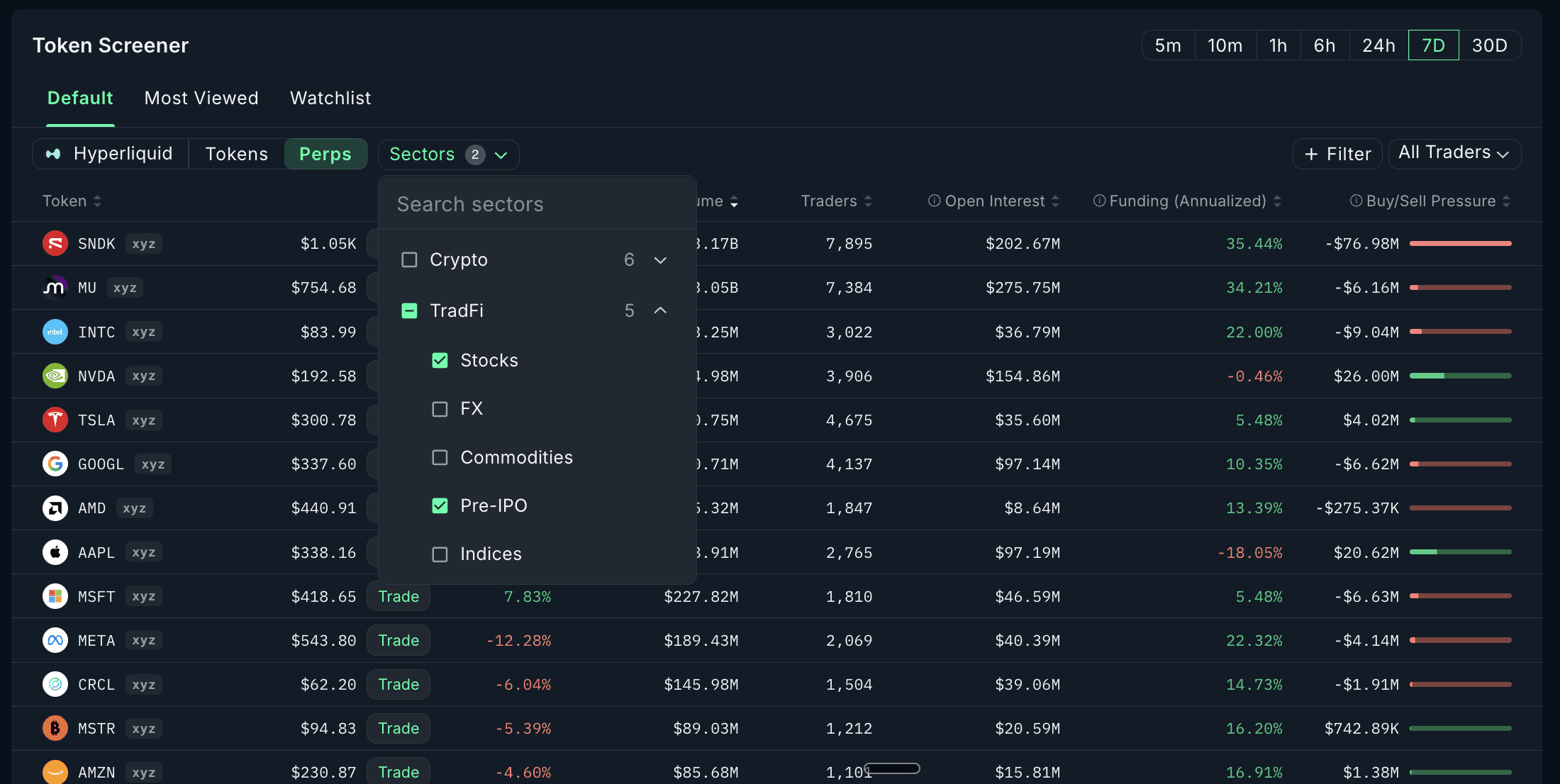
With Nansen, you can see how positioning is skewed in a pre-IPO market, whether Smart Money wallets are involved, and how open interest and funding are behaving, tracked against 500M+ labeled addresses. In a market where the crowd is the price, seeing who is actually positioned is especially valuable.


FAQ: Pre-IPO Perps

  • What are pre-IPO perps? Synthetic perpetual futures that track a private company's implied valuation before it goes public. They confer no ownership, shares, or dividends, and are leveraged and high-risk.

  • Do I own shares when I trade a pre-IPO perp? No. A pre-IPO perp is a synthetic contract that only references an implied price. There is no share, allocation, or ownership right of any kind.

  • How is a private company priced if it has no public price? Through a "hyperp" mechanism where the contract's own market activity sets the implied valuation, rather than importing an external oracle price.

  • What happens when the company goes public? Contracts are typically designed to convert into a standard perp referenced to the public market price if the listing occurs before a set deadline. Exact rules vary by market.

  • Where can I trade pre-IPO perps? On Hyperliquid, deployed via the HIP-3 framework by builders such as TradeXYZ and Ventuals. Availability varies by jurisdiction.

  • Are pre-IPO perps legal and safe? They sit in an evolving and uncertain regulatory landscape and carry substantial risk, including potential scrutiny as unregistered securities exposure. This is among the riskiest products in the tokenized-asset space.


Conclusion

Pre-IPO perps opened access to something retail traders were structurally locked out of: exposure to private-company valuations before they list. Cerebras showed the price-discovery thesis can work. But these are synthetic, leveraged, crowd-priced instruments sitting in an uncertain regulatory environment. They are not shares, and they are not for the risk-averse.

If you engage with them, understand exactly what you are holding, size accordingly, and watch the positioning, because in these markets the crowd is the price.

What Are Pre-IPO Perps? Trading Private Companies Before They List

Written by

Read Time

5 min read

Posted on

A pre-IPO perp is a perpetual futures contract whose reference is the market's estimate of a private company's value, before that company lists publicly.

Private companies like SpaceX, OpenAI, and Anthropic are largely inaccessible to retail. Accreditation rules and oversubscribed private rounds keep most people out.

There are, by some counts, over 1,700 unicorns representing trillions in value that ordinary investors cannot touch. Pre-IPO perps offer synthetic exposure to that price action without owning anything.

The key word is synthetic. You are not buying a share or a claim on one. You are taking a leveraged position on where a market thinks the company is valued.


How Do You Price a Company With No Public Price?

This is the clever and controversial part. A normal perp tracks an external price via an oracle. A private company has no continuous public price to track.

Pre-IPO perps solve this with a "hyperp" mechanism, where the market itself becomes the price reference. The contract's own trading, order flow, funding, positioning, sets the implied valuation, rather than importing a price from outside. In effect, the crowd's collective bet is the price.

When the company eventually goes public, contracts are designed to convert: if the listing happens before a set deadline, the pre-IPO perp automatically becomes a standard perp referenced to the now-public market price.


The Case That Put Pre-IPO Perps on the Map

The category's credibility rests on a concrete example: Cerebras, an AI chipmaker.

TradeXYZ launched a Cerebras pre-IPO perp as its first market in the category. When Cerebras listed on Nasdaq, the results were striking. One hour before the open, the pre-IPO perp was pricing Cerebras close to its actual Nasdaq opening price, within a few percent. Over the same window, a traditional secondary marketplace was pricing the shares far lower, off by a wide margin.

The takeaway that drew attention: an onchain, crowd-driven market produced faster and more accurate price discovery for a private company than an established offchain secondary venue. That is the bull case for the entire category.


Pre-IPO Perps vs Tokenized Stocks

These are easy to confuse and fundamentally different, a distinction that became very real in 2026:

  • A tokenized stock is backed by a real share held in custody. It is ownership.

  • A pre-IPO perp is a synthetic contract with nothing backing it but the market. It is a leveraged bet on price, with no ownership, no shares, no dividends, no voting.

This difference matters legally. When some tokenized pre-IPO share initiatives ran into trouble, including public warnings from companies such as OpenAI and Anthropic against trading in securities tied to them that they had not authorized, synthetic perps were affected differently precisely because they do not claim to represent shares.

That distinction is central to how the products are marketed and regulated. For the framework behind them, see what is HIP-3.

Why Traders Use Pre-IPO Perps

  • Access. Exposure to private-company valuations that accreditation rules otherwise block.

  • Timing. Position ahead of a major listing rather than after the first-day pop.

  • 24/7 markets. Trade around the clock, react to news immediately.

  • Long or short with leverage. Take either side, with capital efficiency.

  • Price discovery. As Cerebras showed, these markets can surface a credible real-time valuation signal.


The Risks Are Real and Substantial

Pre-IPO perps may be the highest-risk product in this whole category. Be clear-eyed:

  • Regulatory uncertainty. Analysts expect regulators to examine whether these function as unregistered securities exposure for retail. Major exchanges have reportedly asked the CFTC to review market-integrity concerns around Hyperliquid's pseudonymous environment. The regulatory picture could change quickly.

  • No external price anchor. The hyperp mechanism means the price is whatever the market says, which can detach sharply from any fundamental basis and move violently.

  • Settlement and conversion risk. What happens at or around a listing, delay, or cancellation depends on the contract's rules. There is no guaranteed clean settlement.

  • Leverage and liquidation. These are leveraged perpetuals. Positions can be liquidated fast.

  • Thin, reflexive markets. Newer markets can be illiquid and prone to sharp swings driven by positioning rather than information.

A widely repeated piece of practical advice for these markets: size small, set hard exit levels before the listing date, and do not assume you can hold cleanly through the listing event.


How to Read Pre-IPO Perp Markets with Onchain Data

Because these markets live on Hyperliquid's public order book, positioning is visible.

With Nansen, you can see how positioning is skewed in a pre-IPO market, whether Smart Money wallets are involved, and how open interest and funding are behaving, tracked against 500M+ labeled addresses. In a market where the crowd is the price, seeing who is actually positioned is especially valuable.


FAQ: Pre-IPO Perps

  • What are pre-IPO perps? Synthetic perpetual futures that track a private company's implied valuation before it goes public. They confer no ownership, shares, or dividends, and are leveraged and high-risk.

  • Do I own shares when I trade a pre-IPO perp? No. A pre-IPO perp is a synthetic contract that only references an implied price. There is no share, allocation, or ownership right of any kind.

  • How is a private company priced if it has no public price? Through a "hyperp" mechanism where the contract's own market activity sets the implied valuation, rather than importing an external oracle price.

  • What happens when the company goes public? Contracts are typically designed to convert into a standard perp referenced to the public market price if the listing occurs before a set deadline. Exact rules vary by market.

  • Where can I trade pre-IPO perps? On Hyperliquid, deployed via the HIP-3 framework by builders such as TradeXYZ and Ventuals. Availability varies by jurisdiction.

  • Are pre-IPO perps legal and safe? They sit in an evolving and uncertain regulatory landscape and carry substantial risk, including potential scrutiny as unregistered securities exposure. This is among the riskiest products in the tokenized-asset space.


Conclusion

Pre-IPO perps opened access to something retail traders were structurally locked out of: exposure to private-company valuations before they list. Cerebras showed the price-discovery thesis can work. But these are synthetic, leveraged, crowd-priced instruments sitting in an uncertain regulatory environment. They are not shares, and they are not for the risk-averse.

If you engage with them, understand exactly what you are holding, size accordingly, and watch the positioning, because in these markets the crowd is the price.

About the Author

You may also like these

Related Posts

What Are Pre-IPO Perps? Trading Private Companies Before They List

Written by

Read Time

5 min read

Posted on

A pre-IPO perp is a perpetual futures contract whose reference is the market's estimate of a private company's value, before that company lists publicly.

Private companies like SpaceX, OpenAI, and Anthropic are largely inaccessible to retail. Accreditation rules and oversubscribed private rounds keep most people out.

There are, by some counts, over 1,700 unicorns representing trillions in value that ordinary investors cannot touch. Pre-IPO perps offer synthetic exposure to that price action without owning anything.

The key word is synthetic. You are not buying a share or a claim on one. You are taking a leveraged position on where a market thinks the company is valued.


How Do You Price a Company With No Public Price?

This is the clever and controversial part. A normal perp tracks an external price via an oracle. A private company has no continuous public price to track.

Pre-IPO perps solve this with a "hyperp" mechanism, where the market itself becomes the price reference. The contract's own trading, order flow, funding, positioning, sets the implied valuation, rather than importing a price from outside. In effect, the crowd's collective bet is the price.

When the company eventually goes public, contracts are designed to convert: if the listing happens before a set deadline, the pre-IPO perp automatically becomes a standard perp referenced to the now-public market price.


The Case That Put Pre-IPO Perps on the Map

The category's credibility rests on a concrete example: Cerebras, an AI chipmaker.

TradeXYZ launched a Cerebras pre-IPO perp as its first market in the category. When Cerebras listed on Nasdaq, the results were striking. One hour before the open, the pre-IPO perp was pricing Cerebras close to its actual Nasdaq opening price, within a few percent. Over the same window, a traditional secondary marketplace was pricing the shares far lower, off by a wide margin.

The takeaway that drew attention: an onchain, crowd-driven market produced faster and more accurate price discovery for a private company than an established offchain secondary venue. That is the bull case for the entire category.


Pre-IPO Perps vs Tokenized Stocks

These are easy to confuse and fundamentally different, a distinction that became very real in 2026:

  • A tokenized stock is backed by a real share held in custody. It is ownership.

  • A pre-IPO perp is a synthetic contract with nothing backing it but the market. It is a leveraged bet on price, with no ownership, no shares, no dividends, no voting.

This difference matters legally. When some tokenized pre-IPO share initiatives ran into trouble, including public warnings from companies such as OpenAI and Anthropic against trading in securities tied to them that they had not authorized, synthetic perps were affected differently precisely because they do not claim to represent shares.

That distinction is central to how the products are marketed and regulated. For the framework behind them, see what is HIP-3.

Why Traders Use Pre-IPO Perps

  • Access. Exposure to private-company valuations that accreditation rules otherwise block.

  • Timing. Position ahead of a major listing rather than after the first-day pop.

  • 24/7 markets. Trade around the clock, react to news immediately.

  • Long or short with leverage. Take either side, with capital efficiency.

  • Price discovery. As Cerebras showed, these markets can surface a credible real-time valuation signal.


The Risks Are Real and Substantial

Pre-IPO perps may be the highest-risk product in this whole category. Be clear-eyed:

  • Regulatory uncertainty. Analysts expect regulators to examine whether these function as unregistered securities exposure for retail. Major exchanges have reportedly asked the CFTC to review market-integrity concerns around Hyperliquid's pseudonymous environment. The regulatory picture could change quickly.

  • No external price anchor. The hyperp mechanism means the price is whatever the market says, which can detach sharply from any fundamental basis and move violently.

  • Settlement and conversion risk. What happens at or around a listing, delay, or cancellation depends on the contract's rules. There is no guaranteed clean settlement.

  • Leverage and liquidation. These are leveraged perpetuals. Positions can be liquidated fast.

  • Thin, reflexive markets. Newer markets can be illiquid and prone to sharp swings driven by positioning rather than information.

A widely repeated piece of practical advice for these markets: size small, set hard exit levels before the listing date, and do not assume you can hold cleanly through the listing event.


How to Read Pre-IPO Perp Markets with Onchain Data

Because these markets live on Hyperliquid's public order book, positioning is visible.

With Nansen, you can see how positioning is skewed in a pre-IPO market, whether Smart Money wallets are involved, and how open interest and funding are behaving, tracked against 500M+ labeled addresses. In a market where the crowd is the price, seeing who is actually positioned is especially valuable.


FAQ: Pre-IPO Perps

  • What are pre-IPO perps? Synthetic perpetual futures that track a private company's implied valuation before it goes public. They confer no ownership, shares, or dividends, and are leveraged and high-risk.

  • Do I own shares when I trade a pre-IPO perp? No. A pre-IPO perp is a synthetic contract that only references an implied price. There is no share, allocation, or ownership right of any kind.

  • How is a private company priced if it has no public price? Through a "hyperp" mechanism where the contract's own market activity sets the implied valuation, rather than importing an external oracle price.

  • What happens when the company goes public? Contracts are typically designed to convert into a standard perp referenced to the public market price if the listing occurs before a set deadline. Exact rules vary by market.

  • Where can I trade pre-IPO perps? On Hyperliquid, deployed via the HIP-3 framework by builders such as TradeXYZ and Ventuals. Availability varies by jurisdiction.

  • Are pre-IPO perps legal and safe? They sit in an evolving and uncertain regulatory landscape and carry substantial risk, including potential scrutiny as unregistered securities exposure. This is among the riskiest products in the tokenized-asset space.


Conclusion

Pre-IPO perps opened access to something retail traders were structurally locked out of: exposure to private-company valuations before they list. Cerebras showed the price-discovery thesis can work. But these are synthetic, leveraged, crowd-priced instruments sitting in an uncertain regulatory environment. They are not shares, and they are not for the risk-averse.

If you engage with them, understand exactly what you are holding, size accordingly, and watch the positioning, because in these markets the crowd is the price.
About the Author

You may also like these

Related Posts