
Overview
TRON is a high-throughput, delegated proof-of-stake blockchain network founded in 2017 that has established itself as the dominant infrastructure layer for stablecoin transfers globally. With over 390 million total user accounts, more than 14 billion cumulative transactions, and approximately $89 billion in circulating USDT as of June 2026. The network’s low transaction fees (typically under $1 for USDT transfers) and throughput capacity of 2,000 TPS have made it the preferred rail for stablecoin settlement, cross-border payments, and increasingly, institutional asset tokenization.
Q2 2026 marked a pivotal quarter for TRON’s institutional legitimacy and ecosystem expansion.
Key Developments: Q2 2026
SEC case resolution catalyzes institutional engagement. The March 2026 dismissal with prejudice of all SEC fraud and market manipulation charges against Justin Sun, the Tron Foundation, and the BitTorrent Foundation (with Rainberry Inc. paying a $10 million civil penalty) removed a longstanding regulatory overhang. The resolution unlocked a rapid cascade of institutional integrations throughout Q2, including listings on Binance.US and Bitnomial, Anchorage Digital custody support, and the Securitize RWA deployment.
T3 Financial Crime Unit surpasses $450 million in frozen illicit assets. The joint initiative between Tether, TRON, and TRM Labs, established in September 2024, announced in May 2026 that it has frozen over $450 million in illicit assets across 23 jurisdictions — a 43.9% year-over-year increase. The unit was recognized by the Financial Action Task Force (FATF) as an “invaluable resource for law enforcement agencies worldwide” and supported Brazil’s Operation Lusocoin, which froze over R$3 billion in cryptocurrency assets tied to criminal networks. The T3 FCU can freeze suspicious assets within 24 hours during emergencies, combining TRM Labs’ real-time blockchain tracing with Tether’s issuer-level authority to freeze addresses on-chain.
TRON Academy expands university network. TRON’s educational initiative now spans partnerships with 22 leading institutions, including Duke University, Dartmouth College, and the University of Pennsylvania, the University of Chicago, Cornell Tech, Princeton, and Columbia. In Q2, the Academy hosted a community event at ETHGlobal New York with student blockchain clubs.Network metrics continue growth trajectory. TRON ended Q2 with approximately 390 million total user accounts (up from 373 million at the start of the quarter).
AI and agentic infrastructure positioning. Building on Q1 developments including the $1 billion AI Fund expansion and the AINFT Bank of AI launch, TRON continued positioning itself as infrastructure for autonomous AI agents throughout Q2. The network’s tagline shifted to “Infrastructure for Agentic AI Payments,” reflecting a strategic emphasis on serving AI agents that require fast, low-cost settlement rails for autonomous transactions.
Ecosystem
Regulatory & Market Access
Bitnomial, a Chicago-based CFTC-regulated exchange and clearinghouse, launched TRX spot trading in early June 2026 following self-certification of the TRXUSD physically settled spot contract with the CFTC on May 22. Bitnomial operates a designated contract market (DCM), derivatives clearing organization (DCO), and futures commission merchant (FCM), offering leveraged spot trading, perpetuals, futures, options, and prediction markets. The physically settled nature of the TRXUSD contract ensures actual asset delivery upon settlement, creating genuine demand rather than synthetic exposure. Concurrently, Anchorage Digital, the first federally chartered cryptocurrency bank in the United States, added custody support for TRX, providing institutional holders with a compliant storage option and reinforcing the infrastructure necessary for institutional participation in the TRON ecosystem.
Binance.US listed TRX in mid-April 2026 with TRX/USD and TRX/USDT trading pairs, marking another significant expansion of U.S. market access. With TRON hosting over $86 billion in circulating USDT and recording more than 376 million user accounts at the time of listing, the addition of a major U.S.-regulated platform broadened the addressable investor base for TRX. The listing came in the wake of TRON’s improved regulatory standing following the SEC case dismissal, which cleared the path for compliant U.S. platforms to integrate the asset with reduced legal risk.
OKX Europe Markets launched TRXUSD Expiry Perpetuals (X-Perps) in June, expanding regulated derivative access across 30 European Economic Area jurisdictions. The product is classified as a MiFID-regulated cryptocurrency derivative, available to both retail and institutional traders with up to 10x leverage and a fixed five-year cash settlement date. It offers a perpetual-style trading experience with a funding rate mechanism to maintain spot market alignment. This represents TRON’s first dedicated MiFID-compliant derivative product in Europe and broadens the network’s regulated footprint beyond U.S. exchanges.
Moscow Exchange launched the MOEXTRX index on May 13, alongside indexes for SOL, XRP, and BNB — the first time Russia’s leading securities exchange extended its regulated crypto benchmark suite beyond Bitcoin and Ether. The index weights price data from Binance (50%), Bybit (20%), OKX (15%), and Bitget (15%), with futures contracts expected once sufficient price history is established. This provides Russian institutional investors a regulated exposure pathway through exchange-listed index products.
RWA & Institutional Finance
Securitize deployed Hamilton Lane’s tokenized Senior Credit Opportunities Fund (HLSCOPE) on the TRON blockchain in early June, marking the first Securitize-issued asset to launch on the network. HLSCOPE is a tokenized feeder fund offering blockchain-based exposure to Hamilton Lane’s SCOPE strategy, an evergreen private credit fund focused on senior secured loans to premier borrowers across North America and Europe. The fund has approximately $4.28 million in AUM with a reported trailing 12-month net return of 5.87% and already operates on Ethereum, Polygon, Plume, and Optimism, with Wormhole providing cross-chain interoperability. Securitize manages over $4 billion in total assets under management and partners with Apollo, BlackRock, BNY, KKR, and VanEck, making its decision to deploy on TRON a meaningful signal of institutional confidence. Securitize is the only entity licensed to operate regulated digital-securities infrastructure across both the U.S. (SEC-registered) and EU markets.
RealOpen and TRON published results from their “Fast Moves, Fast Payments” holiday campaign in late April, reporting $9.4 million in USDT verified by new users for crypto-enabled real estate purchases. The campaign, running from November 2025 through February 2026, offered eligible U.S. homebuyers up to 50,000 USDT in rewards for purchasing properties using USDT on the TRON blockchain. Results included 343 user sign-ups, 27 completed KYC verifications, and 69 real estate agents onboarded through the 2025 TRON Real Estate Challenge. Pearl Homes’ Hunter’s Point net-zero master-planned community on Florida’s Gulf Coast was highlighted as a notable adoption example, demonstrating TRON’s utility as a settlement layer extending beyond traditional crypto-native use cases.
Infrastructure & Cross-Chain
Jumper, a DeFi aggregator supporting 63 blockchains, announced full integration with the TRON network in late April 2026, enabling users to bridge assets and perform stablecoin swaps via single transactions across 14 initially supported blockchains. Jumper’s aggregation engine compares routes across 29 integrated bridging protocols to find optimal transfer paths, and users can bridge USDT, USDC, and other assets into TRON’s DeFi ecosystem including JustLend and SunSwap. Jumper itself has processed over $35 billion in cumulative volume for more than 2 million wallets. Given that TRON settled $7.9 trillion in USDT transfer volume in 2025, the integration positions Jumper as a key entry point for cross-chain flows into one of the highest-volume stablecoin networks in production.
LI.FI Protocol, a cross-chain liquidity aggregation protocol with over 800 partners globally, integrated with the TRON network in late April 2026. The integration connects TRON’s high-throughput infrastructure to LI.FI’s universal liquidity layer across major EVM and non-EVM blockchain networks, enabling seamless bridging and swapping between TRON and other ecosystems. For developers, this reduces the complexity of managing stablecoin transfers, as applications gain direct access to USDT and other stablecoins without requiring separate bridge integrations. Coming one day before the Jumper integration (Jumper uses LI.FI under the hood), the pair of announcements underscored a concerted push to improve TRON’s interoperability with the broader multi-chain landscape.
Compliance & Security
The T3 Financial Crime Unit (T3 FCU), a joint initiative between Tether, TRON, and TRM Labs, announced in mid-May that it has frozen over $450 million in illicit digital assets globally since its establishment in September 2024, representing a 43.9% year-over-year increase in intercepted illicit proceeds. The unit operates across five continents and coordinates with law enforcement agencies in 23 jurisdictions, including the United States, Spain, Germany, the Netherlands, Bulgaria, Brazil, and the United Kingdom. Targeted crimes range from substance trafficking and exchange hacks to DPRK-linked activity, terrorist financing, and violent crimes including kidnappings and extortion. Notably, T3 FCU supported Brazil’s Operation Lusocoin, where federal police froze over R$3 billion in crypto assets including 4.3 million USDT linked to criminal networks. The FATF has recognized the unit as “an invaluable resource for law enforcement agencies worldwide,” and the unit can freeze suspicious assets within 24 hours during emergencies. Against the backdrop of record $158 billion in global illicit crypto flows, the T3 FCU represents TRON’s most tangible effort to address the compliance risks inherent in hosting the majority of global USDT circulation.
Community & Events
TRON DAO participated in ETHConf (June 8-10) organized by ETHGlobal in New York and hosted a TRON Academy Happy Hour during the ETHGlobal New York 2026 hackathon (June 12-14) alongside Princeton Blockchain Club, Blockchain at Emory, Blockchain at Columbia, Blockchain Chicago, Penn Blockchain, NYU Blockchain Lab, and Blockchain & Fintech at Fordham. The event drew over 70 participants from student and developer communities and featured a panel on “Campus to Mainnet: How Student Builders Will Shape the Future of Blockchain” with representatives from TRON Academy partner clubs. . The event reinforced TRON’s commitment to developer pipeline development through its 22 -university TRON Academy network.
TRON DAO and Securitize co-hosted “TRON Whale Night” on April 27th during the Bitcoin 2026 conference. The side event was held at OMNIA Nightclub and attracted hundreds of participants from institutional, developer, and industry communities. MetaMask, the Digital Sovereignty Alliance (DSA), and B.AI served as additional co-hosts. The gathering emphasized stablecoins, decentralized finance, and cross-chain interoperability, reflecting TRON’s growing network of institutional partnerships.
TRON DAO participated in “The Programmable Economy: AI & Blockchain Redefining Markets” conference at Cornell Tech on April 24, drawing over 1,000 attendees from AI, blockchain, finance, and government sectors. TRON Community Spokesperson Sam Elfarra joined the “CeFi & DeFi Markets” panel alongside representatives from Inception Capital, Monarq Asset Management, and Artemis Analytics, discussing how DeFi is “slowly integrating as part of the same financial fabric that institutions operate within.”
Network Milestones & AI Strategy
TRON was confirmed as a Platinum Sponsor of WebX 2026 in Tokyo (July 13-14), Asia’s flagship Web3 conference. The sponsorship reflects TRON’s continued push into the Asian institutional and developer market, with the event focusing on stablecoins, AI, and digital finance regulation.
Onchain Data
Daily Transactions

TRON averaged approximately 11.8 million daily transactions throughout Q2 2026, with a range spanning from 9.0 million to 14.6 million. The quarter showed generally consistent throughput, reflecting the network’s stable role as a high-volume settlement layer primarily driven by stablecoin transfers. Periodic spikes above the 13 million mark likely correspond to heightened USDT activity during periods of broader market volatility or increased cross-border payment flows. The sustained floor above 9 million transactions per day — even on weekends and low-activity periods — underscores the baseline demand for TRON as everyday payment infrastructure rather than speculative DeFi activity, consistent with the network’s positioning as the dominant USDT transfer rail.
Daily Active Addresses
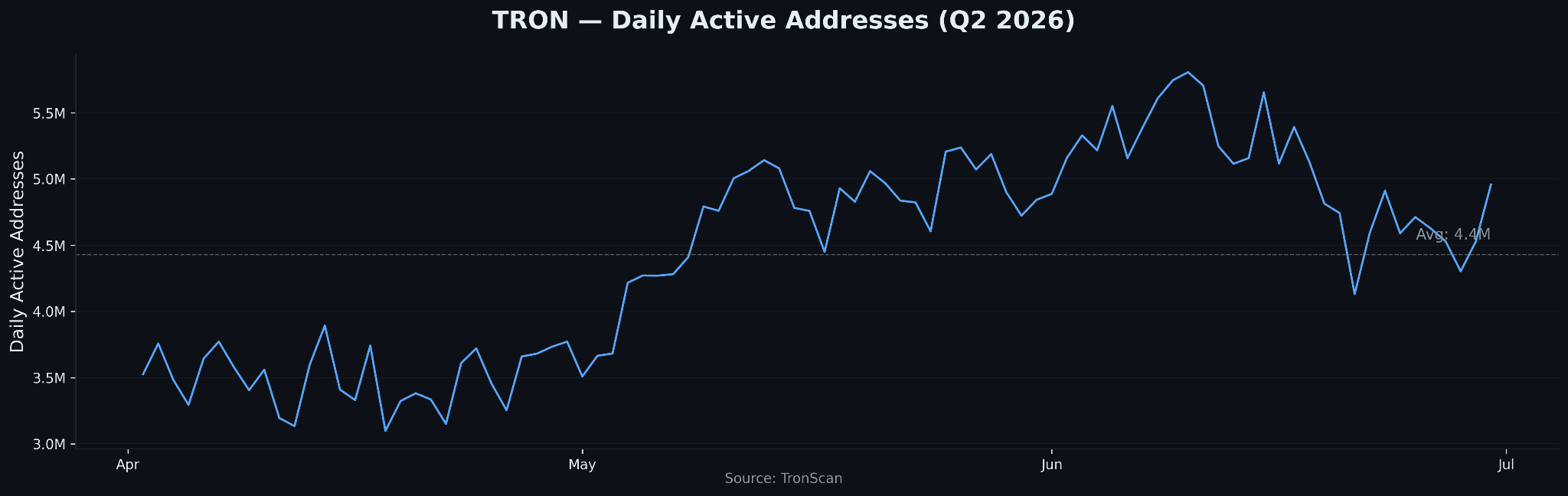
TRON averaged approximately 4.4 million daily active addresses in Q2 2026, ranging from 3.1 million to 5.8 million. This represents a significant acceleration from Q1, where daily active addresses averaged 3.2 million (up 37.5% QoQ). The quarter showed a clear upward trajectory — April averaged 3.5 million, May climbed to 4.7 million, and June averaged 5.0 million before moderating late in the month. The wide variance suggests periodic bursts of new-user onboarding or campaign-driven activity alongside a consistent base of returning users. The sustained multi-million address count supports TRON's narrative as one of the most actively used blockchain networks globally, with usage patterns reflecting real economic activity — predominantly stablecoin transfers and exchange-related operations — rather than ephemeral airdrop farming or short-lived incentive programs.
Top Entities by Transactions
Top Entities by Users
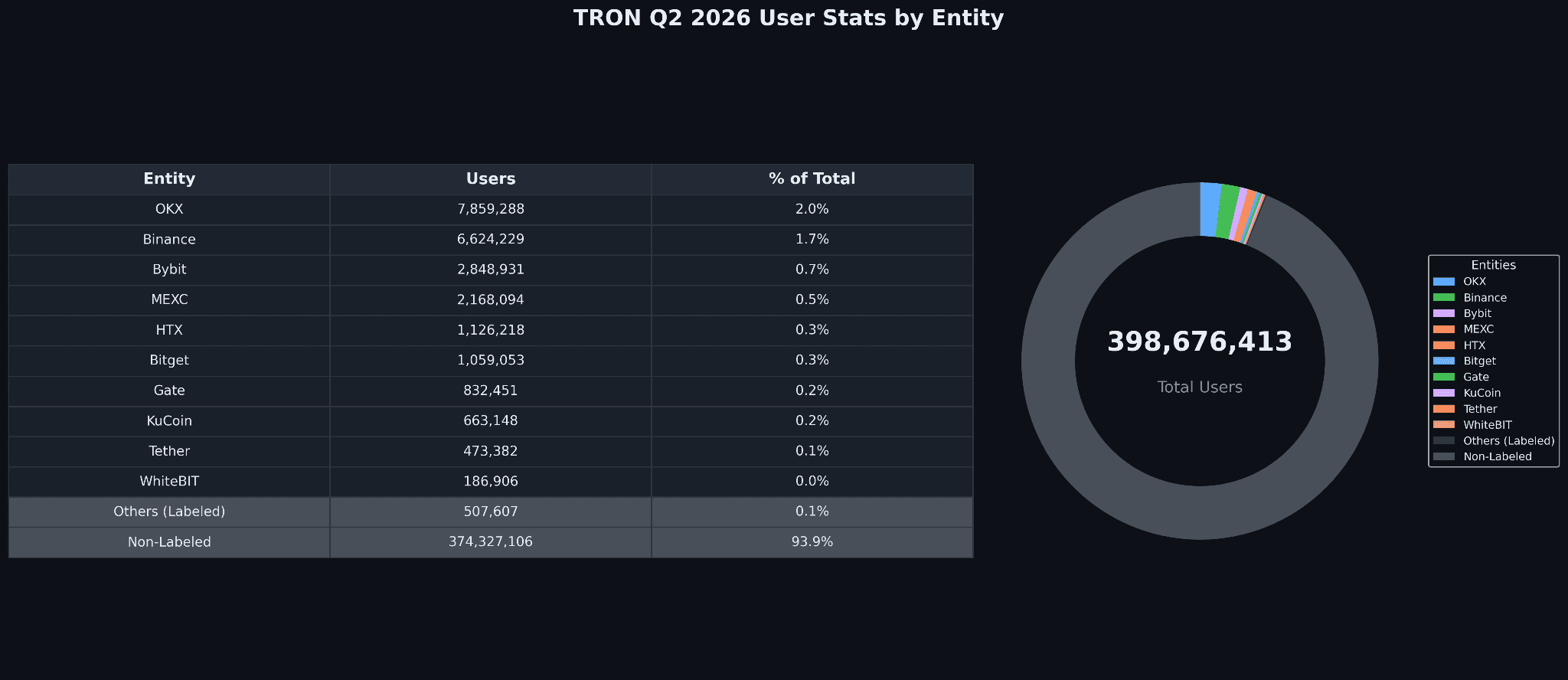
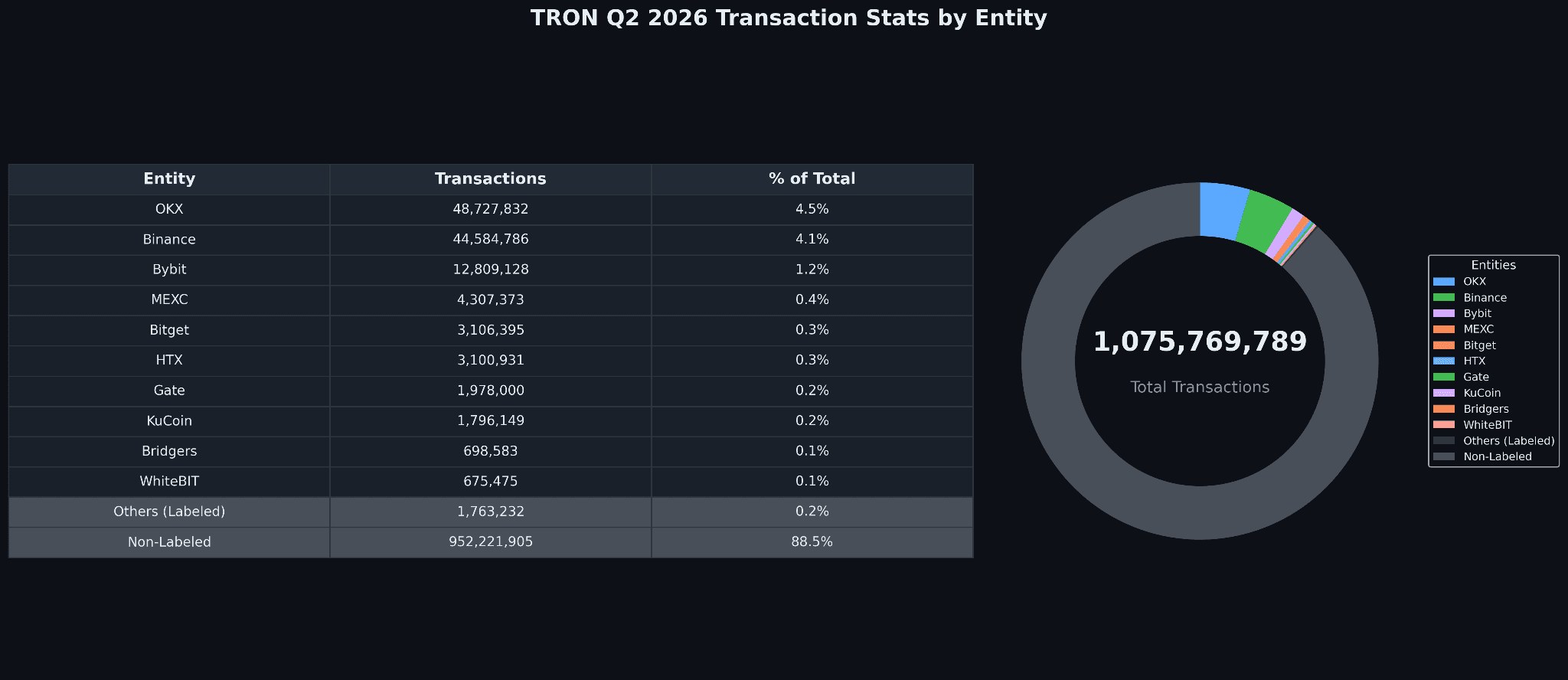
TRON processed over 1 billion transactions in Q2 2026. Nansen's entity labeling coverage attributes approximately 124 million to identified entities — the remaining 952 million transactions are non-labeled, reflecting the long tail of individual wallets, peer-to-peer transfers, and unlabeled smart contracts that constitute the bulk of TRON's onchain activity. Similarly, of the approximately 399 million cumulative daily active accounts across the quarter, 24 million transacted with labeled entities. Within the labeled subset, centralized exchanges dominate overwhelmingly. OKX led with 48.7 million transactions (+51.3% QoQ), followed by Binance at 44.6 million (+15.1% QoQ), Bybit at 12.8 million, MEXC at 4.3 million, and Bitget at 3.1 million. On the user side, OKX (7.9 million), Binance (6.6 million), and Bybit (2.8 million) account for the majority of labeled interactions. The heavy concentration among the top five CEXs underscores TRON's primary function as a low-cost USDT transfer corridor between exchanges and end users. OKX's outsized growth may reflect the exchange's expanding Asian market footprint, while Binance's consistent volume reflects its entrenched position routing USDT through TRON's network.
Closing Thoughts
Q2 2026 represented a maturation quarter for the TRON ecosystem, driven by the downstream effects of the SEC case resolution in March. The dismissal unlocked a wave of institutional integrations — from Bitnomial’s CFTC-regulated spot listing and Anchorage Digital’s federal custody support to Securitize deploying the first tokenized private credit fund on the network. These are not incremental additions; they represent a qualitative shift in the type of counterparties willing to build on TRON. A year ago, few U.S.-regulated entities would have deployed products on the network given the regulatory overhang. The speed at which Securitize, Bitnomial, and Binance.US moved to integrate TRX post-dismissal suggests latent institutional demand that was held back by legal uncertainty rather than technical limitations.
The cross-chain infrastructure buildout was equally significant. The LI.FI and Jumper integrations, arriving back-to-back in late April, meaningfully improved TRON’s interoperability with the broader multi-chain landscape. For a network that processes the majority of global USDT flow, the ability to seamlessly bridge assets from dozens of other chains into TRON’s ecosystem reduces friction for both retail users and developers. Combined with Wormhole’s role as Securitize’s interoperability partner for HLSCOPE, TRON is increasingly connected to cross-chain liquidity rather than operating as an isolated stablecoin silo.
The $1 billion AI Fund, AINFT’s Bank of AI, and the “Infrastructure for Agentic AI Payments” positioning signal the network’s ambition to capture the emerging autonomous-agent economy — but this thesis remains early-stage and largely prospective. The Securitize/Hamilton Lane deployment is a more tangible proof point that institutional-grade applications can coexist alongside TRON’s retail transfer dominance. Whether Q3 brings additional RWA deployments, meaningful DeFi growth, or progress on the quantum-resistant testnet will determine whether Q2’s momentum converts into a durable broadening of the ecosystem.