Overview
The TRON network is a high-performance Layer-1 blockchain platform designed to support decentralized applications, digital assets, and smart contracts with a focus on scalability, low transaction fees, and high throughput. Using a Delegated Proof-of-Stake (DPoS) consensus mechanism, TRON has become one of the most active blockchains globally, with over 373 million user accounts, more than 13 billion total transactions, and approximately $26 billion in total value locked as of March 2026. The network hosts over $86 billion in stablecoin supply, predominantly USDT, making it the dominant chain for stablecoin settlement.
Q1 2026 was a defining quarter for TRON’s institutional and mainstream payment ambitions. The network secured entry into the Mastercard Crypto Partner Program, establishing a collaboration framework to explore future integration of digital assets with Mastercard’s global payments and settlement infrastructure. Anchorage Digital, America’s first federally chartered crypto bank, added TRON custody support, while Zerohash expanded enterprise access to TRX and TRC-20 assets. The SEC’s dismissal of all claims against Justin Sun, the TRON Foundation, and the BitTorrent Foundation removed a significant legal overhang that had weighed on institutional credibility. Meanwhile, TRON DAO scaled its AI Fund from $100M to $1B, signaling a strategic bet on the convergence of AI and blockchain infrastructure. On the technical side, the Democritus mainnet upgrade aligned TRON’s VM with Ethereum’s evolving standards, and developer tooling improved substantially through Reown SDK and WalletConnect integrations connecting approximately 70,000 dApps to the ecosystem.
Key Developments: Q1 2026
TRON DAO scaled its AI Fund from $100 million to $1 billion, targeting investments in and acquisitions of early-stage companies building core infrastructure for the agentic economy. The fund specifically prioritizes agent identity systems, stablecoin-based payment rails, tokenized real-world assets, and developer tooling for autonomous financial systems. The expansion builds on the fund’s thesis, first outlined in 2023, that AI and blockchain would converge to create demand for programmable, permissionless financial infrastructure. TRON also formally joined the Agentic AI Foundation (AAIF). At Consensus Hong Kong 2026, Justin Sun articulated the vision, noting that as AI continues to grow it will need reliable financial infrastructure including stable liquidity, fast settlement, and networks that operate globally 24 hours a day.
The U.S. SEC moved to dismiss all claims against Justin Sun, the TRON Foundation, and the BitTorrent Foundation. Sun stated the resolution brings closure to the long-running case and that he plans to continue building while working with regulators to shape clearer crypto guidance. The dismissal removes a significant legal overhang that had weighed on TRON’s institutional credibility and may ease the path for regulated entities to engage with the ecosystem. Sun subsequently delivered a keynote at the DC Blockchain Summit 2026 titled “Building the Rails for a Unified Financial System,” where TRON DAO participated as a Diamond Sponsor — signaling a material increase in Washington policy engagement.
TRON Core Devs released the mandatory GreatVoyage-v4.8.1 (Democritus) mainnet upgrade on February 6, expanding ecosystem compatibility by supporting the ARM64 architecture with JDK 17. Key technical changes include restricting the SELFDESTRUCT instruction behavior in the TVM to align with Ethereum’s EIP-6780 standard, with the energy cost for this opcode increased to 5,000. The upgrade reflects TRON’s ongoing effort to maintain EVM compatibility and ensure that developers building cross-chain applications can maintain consistent behavior across both TRON and Ethereum networks. The Democritus upgrade rolled out smoothly across the network’s super representative infrastructure without disruption.
TRON support was added to the Reown SDK on March 17, an open-source multichain toolkit that provides a single configuration for TRX transfers, fiat on-ramps, and analytics. Developers can now add TRON and EVM chain support to their applications without building custom wallet connectors. This followed the earlier WalletConnect integration in January, which linked approximately 70,000 decentralized applications to the TRON ecosystem. Together, these developer tooling improvements lower the barrier for building cross-chain applications that include TRON as a supported network, addressing a historical friction point where TRON’s non-EVM architecture required bespoke integration work.
Tron Inc. (Nasdaq: TRON) expanded its TRX treasury holdings to over 681.2 million tokens (~$200M) through systematic daily purchases, acquiring approximately 181,346 TRX at an average price of $0.28 in a February transaction. CEO Rich Miller described the accumulation strategy as “strategic” rather than “symbolic,” positioning it alongside the broader trend of publicly listed companies using native token treasury strategies. By the end of March, onchain data confirmed total holdings exceeding $200 million, with most tokens staked within the network. Tron Inc. also announced plans to expand its Bitcoin reserves in response to Binance’s $1 billion SAFU fund conversion to BTC.
Ecosystem
Payments & Stablecoin Infrastructure
Wirex partnered with TRON DAO in January to launch a payment layer built natively on the TRON blockchain for instant, autonomous global value transfers. The integration connects TRON’s onchain ecosystem to Visa’s network of over 80 million merchants and to banking rails in more than 130 countries, developing a common infrastructure that lets TRON users spend digital assets for everyday payments. Notably, the fully onchain system is designed to enable “agentic payments” where digital agents and applications can autonomously send, receive, and manage funds without human intervention, aligning with TRON DAO’s broader thesis on AI-blockchain convergence and the $1B AI Fund’s investment priorities.
Justin Sun invested $8 million in DeFi project River to support deployment of its chain abstraction stablecoin infrastructure on TRON. River’s technology includes satUSD, a stablecoin mintable at a 1:1 ratio with USDT, USDD, or USD1, designed to abstract away the complexity of multi-stablecoin environments that have fragmented liquidity across the ecosystem. River also plans to launch Smart Vault and Prime Vault products targeting yield strategies for stablecoins, TRX, and other core TRON assets, moving TRON’s stablecoin proposition beyond simple transfers into programmable yield and DeFi products. The investment builds on TRON DAO’s earlier investment in River and reflects the network’s strategy of deepening its stablecoin infrastructure stack.
Institutional Infrastructure
TRON entered the Mastercard Crypto Partner Program on March 17, explicitly bridging onchain assets with Mastercard’s global payments, settlement, and money-movement infrastructure. The collaboration aims to integrate TRX and USDT for everyday purchases at over 90 million global merchants, representing one of the largest real-world payment integrations for any blockchain network. The partnership positions TRON as a settlement layer for mainstream consumer payments, leveraging its existing dominance in USDT stablecoin transfers where TRON processes over $23 billion in daily transfer volume. TRX surged approximately 3% on the announcement, reflecting market recognition of the partnership’s significance.
Anchorage Digital, America’s first federally chartered crypto bank, announced TRON custody support. The phased integration begins with institutional custody for the native TRX token on its regulated platform and Porto wallet, with plans to add TRC-20 asset support and native staking in later phases. Anchorage operates under a federal banking charter with SOC 2 compliance and comprehensive regulatory oversight, making this integration a significant milestone for TRON’s institutional credibility. The custody infrastructure opens the door for institutional investors, corporate treasury management operations, and regulated funds to hold TRX within a compliant framework that meets the same security and regulatory standards they expect from traditional financial infrastructure.
TRON DAO partnered with Zerohash, a digital asset infrastructure provider, to expand enterprise access to TRX and TRC-20 USDT. The integration allows businesses using Zerohash’s infrastructure including fintech platforms, crypto exchanges, and neobanks to access services including custody, trading, liquidity, settlement, and fiat-to-crypto onboarding. Initially available in selected regions, the partnership supports compliance with financial regulations and positions TRON for broader institutional adoption in markets where strict regulatory requirements apply. Combined with the Anchorage and Mastercard integrations, this caps a March that saw three major institutional partnerships announced within two weeks.
Onchain Data
Daily Transactions
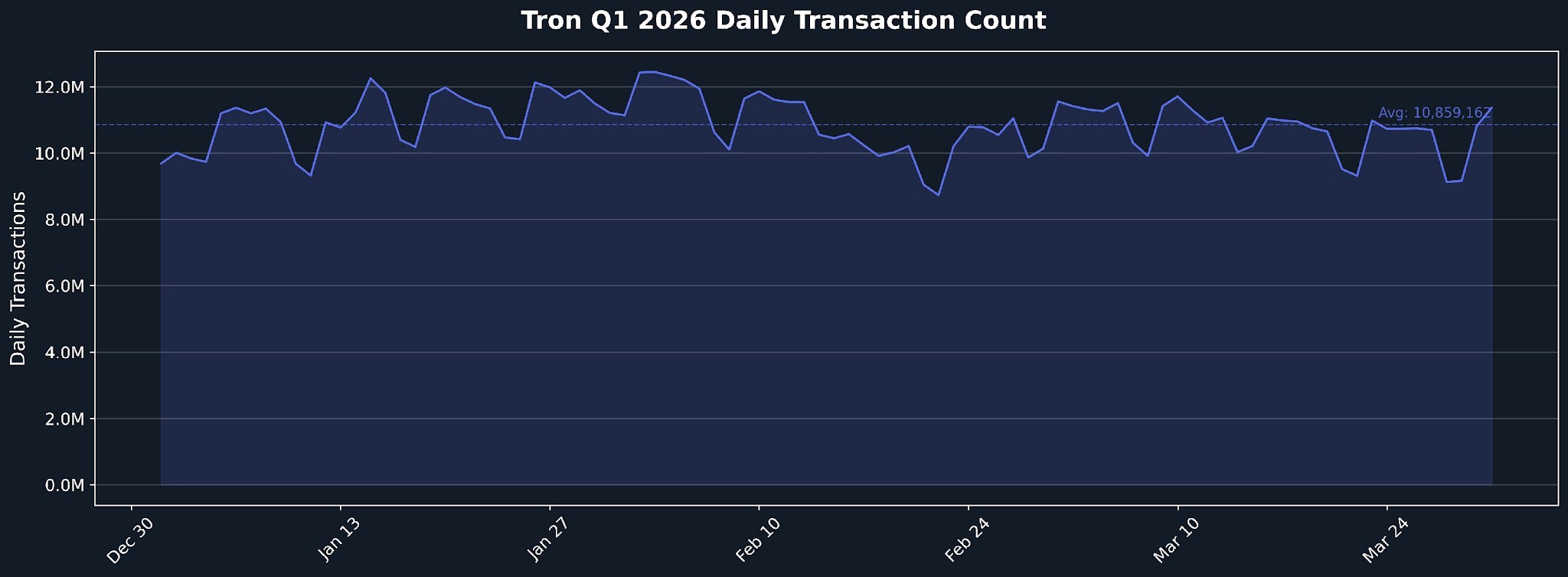
TRON processed approximately 977 million transactions across Q1 2026, averaging 10.86 million transactions per day, placing it among the highest-throughput blockchain networks globally. Activity remained remarkably consistent throughout the quarter, reflecting the steady drumbeat of stablecoin settlement rather than speculative spikes: January averaged 11.01M daily transactions, February 10.87M, and March 10.70M. The peak daily count of 12.45M occurred on February 3, while the lowest was 8.73M on February 22, a relatively narrow range that underscores TRON’s reliability as settlement infrastructure.
The consistency of transaction volume is notable because it coincided with significant market volatility and multiple major partnership announcements. Rather than producing short-term spikes, the Mastercard and institutional partnership announcements in March appeared to maintain rather than disrupt TRON’s steady throughput pattern. The stablecoin supply on TRON hit a new milestone of $86 billion as the March cycle closed, with USDT comprising 98.37% of total stablecoin value on the network.
Daily Active Addresses
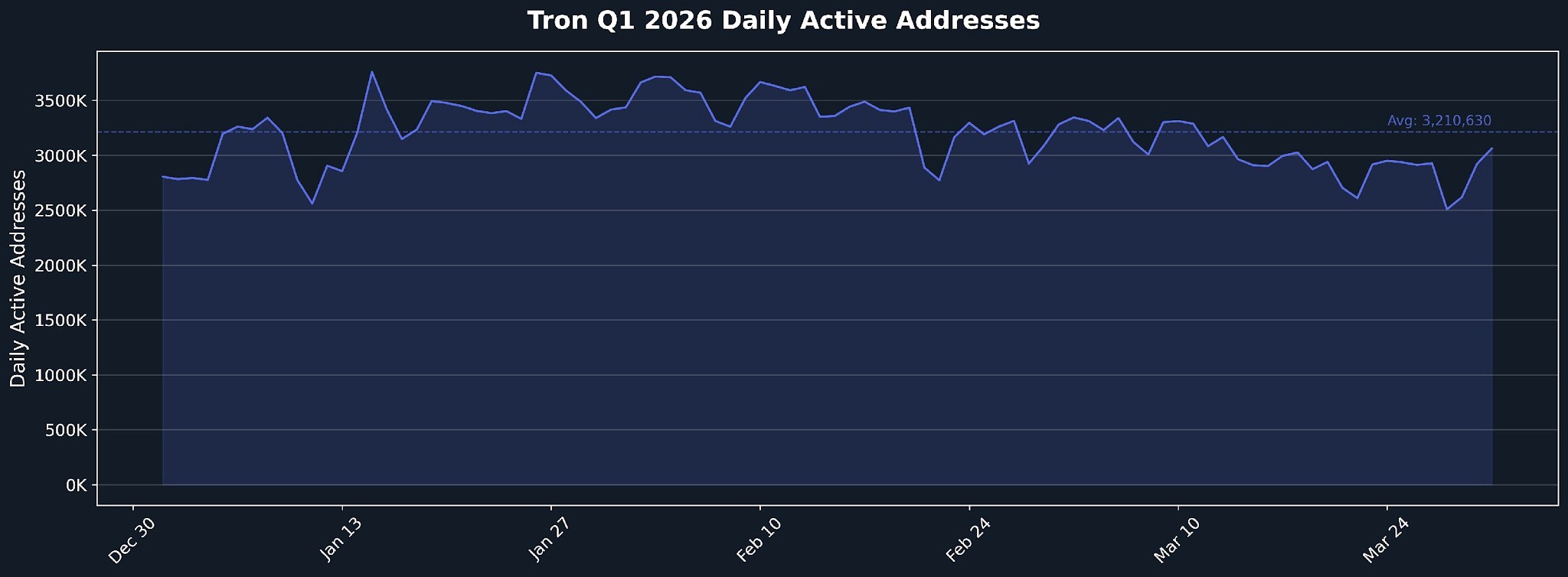
TRON averaged approximately 3.21 million daily active addresses during Q1 2026, with consistent engagement across all three months. January averaged 3.24M, February peaked at 3.39M, and March settled at 3.02M. The highest single-day count reached 3.76M on January 15. The sustained multi-million daily active address count underscores TRON’s role as a mass-adoption blockchain, with user activity driven primarily by stablecoin payments and remittances, centralized exchange interactions, and DeFi protocol usage.
The slight decline from January to March (3.24M to 3.02M monthly average) coincides with broader crypto market cooling in late March rather than any TRON-specific trend. The network grew from 362 million total user accounts at the start of Q1 to over 373 million by end of March, adding roughly 11 million new accounts during the quarter — a growth rate of approximately 3% that reflects continued adoption particularly in emerging markets where TRON serves as de facto payment infrastructure for cross-border remittances and USDT transfers.
Top Entities by Users and Transactions
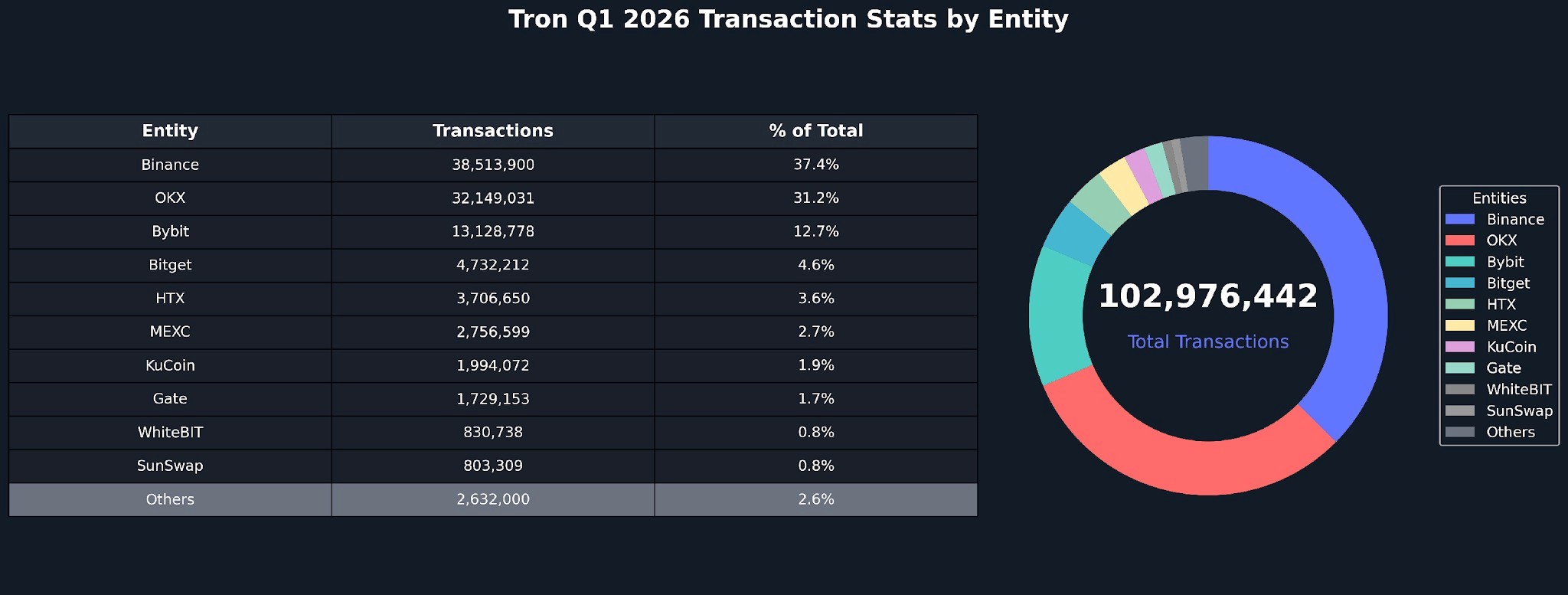
TRON’s entity landscape in Q1 2026 was dominated by centralized exchanges, reflecting the network’s primary role as a settlement layer for exchange-to-exchange transfers and retail stablecoin transactions. Binance led with 38.5 million transactions and 5.07 million unique users, followed closely by OKX with 32.1 million transactions and 5.0 million users. Bybit contributed 13.1 million transactions with 2.64 million users, while Bitget (4.73M txs, 2.04M users) and HTX (3.71M txs, 1.13M users) rounded out the top five.
The concentration of activity among exchanges is structurally characteristic of TRON’s role in the crypto ecosystem. TRON has become the default settlement rail for stablecoin transfers due to its combination of fast block finality, negligible fees, and deep USDT liquidity. The Mastercard, Wirex/Visa, and Zerohash partnerships announced in Q1 aim to extend this settlement infrastructure from crypto-native exchange flows into mainstream consumer payments.
Closing Thoughts
Q1 2026 reinforced TRON’s identity as a specialized stablecoin settlement and payments infrastructure layer and significantly expanded the network’s reach into mainstream finance. The Mastercard Crypto Partner Program entry, Wirex/Visa onchain payment layer, and Zerohash enterprise partnership collectively extend TRON’s settlement infrastructure to over 170 million merchant endpoints across Visa and Mastercard networks in 130+ countries. These are not proof-of-concept integrations; they represent production-grade infrastructure partnerships with two of the largest payment networks in the world.
As TRON continues to convert institutional partnerships into production deployments and expand its AI infrastructure thesis, the network enters Q2 2026 positioned to capture a growing share of both stablecoin settlement and mainstream payment flows.