Stellar Q2 2026 Report

Written by

Read Time

10 min read

Posted on

Overview

Stellar is a decentralized Layer 1 blockchain network purpose-built for payments, asset tokenization, and institutional-grade financial infrastructure. Founded in 2014 and governed by the Stellar Development Foundation (SDF), the network uses a unique Stellar Consensus Protocol (SCP) — sometimes called “Proof-of-Agreement” — in which known, trusted validators reach consensus without the energy costs or anonymous-participation risks of Proof-of-Work or Proof-of-Stake systems. Stellar has become the infrastructure of choice for major institutions including Franklin Templeton, U.S. Bank, MoneyGram, DTCC, and Societe Generale for real-world asset tokenization and cross-border payments.

Key Developments: Q2 2026

  • Protocol 26 “Yardstick” went live on mainnet (May 6), introducing Quorum Freeze (CAP-77), checked 256-bit arithmetic, precise TTL control, cheaper ZK cryptography, and Stellar Asset Contract improvements.

  • Protocol 27 “Zipper” entered testnet (June 18), adding authentication delegation for smart contract accounts (CAP-71) and address-bound Soroban credentials to prevent replay attacks. Mainnet vote scheduled for July 8.

  • Circle CCTP launched on Stellar (May 19), enabling native USDC cross-chain transfers across 24 blockchains through a burn-and-mint mechanism that settles in seconds — no wrapped tokens or bridges required.

  • Confidential Tokens developer preview released (June 29), allowing any SEP-41 token to gain private balances and transfer amounts via zero-knowledge proofs while preserving address visibility for compliance.

  • Quantum Preparedness Plan published (June 9), outlining a three-stage roadmap starting in 2026 with post-quantum verification in Soroban contracts and progressing to full protocol-level integration by 2027.

  • Six-region Market Development team announced (May 8), with dedicated senior leaders for Latin America, Brazil, Europe, Africa, Middle East, and APAC to drive localized institutional adoption.

Ecosystem

Protocol Upgrades and Network Governance

Stellar shipped two major protocol upgrades in Q2, reflecting an accelerating cadence of infrastructure improvements. Protocol 26 “Yardstick,” which went live on mainnet on May 6 following a testnet launch on April 16, introduced six core enhancements focused on precision and reliability rather than raw feature expansion. The headline capability is CAP-77 (Quorum Freeze), the first protocol-native, onchain account freeze mechanism on a major L1 blockchain, which allows validators to freeze compromised ledger keys through federated consensus within minutes rather than hours. This was born out of real incidents — a DeFi protocol exploit in February 2026 — where the lack of formalized emergency response tools forced ad-hoc coordination. Additional Protocol 26 enhancements include checked 256-bit arithmetic (CAP-82) to prevent catastrophic overflow failures in financial calculations, precise TTL control (CAP-78) for equitable rent policies, cheaper BN254 cryptographic operations (CAP-80) to support zero-knowledge proof applications, Stellar Asset Contract improvements (CAP-73) enabling unlimited trustlines for classic accounts, and muxed address conversion support (CAP-79). Protocol 27 “Zipper” followed closely, entering testnet on June 18 with a mainnet vote scheduled later on. Its primary innovation is authentication delegation (CAP-71), which introduces a first-class mechanism for custom smart contract accounts to delegate authentication logic to other addresses, significantly reducing transaction size and complexity while enabling more sophisticated account abstraction patterns.

Governance Philosophy and Decentralization

SDF published a coordinated series of essays in May articulating a maturing governance philosophy for Stellar. CTO Nicolas Barry argued that true decentralization requires not just many validators but resilience against real-world pressures including political interference, security threats, and infrastructure failures, identifying geo-political resilience, security, and mission alignment as three critical dimensions. A companion piece made the case for moving from passive to active governance, where validators engage deliberately in network decisions rather than merely running software and accepting upgrades. The Quorum Freeze mechanism was presented as a concrete example of formalizing emergency response so that governance debates happen during calm periods rather than crises. Separately, a detailed comparison of Proof-of-Stake versus Stellar’s Proof-of-Agreement consensus mechanism highlighted structural vulnerabilities in PoS systems — including MEV extraction, anonymous validator participation, and susceptibility to state-actor threats — while positioning Stellar’s reputation-based validator model as inherently more resistant to these attack vectors. Taken together, these publications signal SDF’s intent to lead an industry-wide conversation about what practical, accountable decentralization looks like for networks that serve regulated financial institutions.

Privacy Infrastructure

Stellar made significant progress on institutional-grade privacy during Q2. The developer preview of Confidential Tokens, enables any SEP-41 token on the network to gain private balances and private transfer amounts through a wrapper contract architecture. Unlike fully anonymous solutions, Confidential Tokens deliberately keep sender and recipient addresses visible while hiding amounts, a design choice aimed squarely at institutional use cases such as payroll, treasury management, and large-value transfers where counterparties must be identifiable but transaction values should not be publicly visible. The system uses Pedersen commitments for balance encoding and Noir-based zero-knowledge proofs verified through Nethermind’s UltraHonk verifier, building on the cryptographic primitives introduced in Protocol 25 (“X-Ray”) and the cheaper ZK operations enabled by Protocol 26. Compliance features including auditor access keys, selective disclosure, account freezing, and configurable policy engines for identity verification are built in from the start. The preview is live on testnet and not yet approved for mainnet, positioning it as an area to watch in Q3 and beyond. This gives the ecosystem a spectrum of privacy tools tailored to different regulatory and institutional requirements.

Quantum Readiness

The Stellar Development Foundation published a comprehensive Quantum Preparedness Plan, establishing itself as one of the first major L1 blockchains to formalize a defense strategy against quantum computing threats. The plan addresses two distinct attack surfaces: compromising network consensus through validator signature forgery, and enabling account takeovers by deriving private keys from publicly exposed Ed25519 public keys. Stellar possesses a structural advantage because its account identity is separated from signing keys, meaning accounts can add quantum-safe signers without migrating to new addresses — a property not shared by most blockchain architectures where the address is derived from the public key. The three-stage roadmap begins in 2026 with adding post-quantum verification capabilities to Soroban smart contracts, progresses to protocol-level integration of post-quantum cryptographic standards by 2027, and concludes with a deprecation phase whose timing will be determined by threat evolution and community consensus. The plan explicitly defers decisions on dormant accounts and zero-knowledge protocol compatibility to future community discussion, reflecting a pragmatic approach that addresses the most critical risks first while acknowledging areas of genuine uncertainty.

Stablecoins and Cross-Chain Infrastructure

The launch of Circle’s Cross-Chain Transfer Protocol (CCTP) on Stellar in May represents a major infrastructure milestone, connecting Stellar’s USDC liquidity to 23 other blockchains including Ethereum, Solana, Base, and Arbitrum through a native burn-and-mint mechanism. Unlike bridge-based approaches that rely on wrapped tokens and custodial intermediaries, CCTP burns USDC on the source chain and mints an equivalent amount on the destination chain, settling in seconds with no counterparty risk. For Stellar specifically, CCTP unlocks bidirectional flows between the network’s payments-focused ecosystem and the broader DeFi landscape, allowing capital to flow to where it is most productive. The integration includes developer-facing features such as Hooks for embedding metadata in cross-chain transfers, enabling programmatic routing of funds for use cases like automated treasury management or cross-border payment orchestration. Combined with Stellar’s access to 475,000+ MoneyGram locations worldwide, CCTP effectively bridges onchain liquidity with physical cash distribution networks — a combination few other chains can offer.

Tokenized Real-World Assets and Securities

SDF CEO Denelle Dixon published a detailed analysis of the distinction between “wrapped” and “native” tokenized securities, arguing that the difference is fundamental rather than cosmetic. Wrapped tokens merely point to offchain assets held by custodians, requiring dual-ledger reconciliation and introducing custodial risk, while native tokens use the blockchain as the authoritative ledger of ownership. The practical implications are significant: native tokenization enables self-custody, real-time yield distribution (as demonstrated by Franklin Templeton’s money market fund crediting daily interest directly to wallets), instant settlement, 24/7 trading paired with stablecoins, and onchain governance through encoded voting rights. These advantages, combined with cost reductions from eliminating reconciliation overhead, allow issuers to lower investment minimums and expand access to previously institutional-only products. The Q2 2026 metrics reinforce the thesis: tokenized RWAs on Stellar crossed the $3 billion threshold, with notable growth from products like Spiko’s EU T-Bill product and new tokenized money market funds in Malaysia.

Distribution and Go-to-Market Strategy

Two related developments in Q2 signal a strategic pivot from technology building to distribution. In May, SDF announced a new Market Development team structured across six regions: Latin America (Federico Gomez Schumacher), Brazil (Claudia Antunes), Europe (Juan Lopez Carretero), Africa (Kwame Oppong), Middle East (Faraj Abutalibov), and APAC (Betty Sun-Lucas). The thesis is that blockchain adoption decisions are inherently local, driven by regional regulators, existing payment rails, and competitive dynamics, and that winning institutional adoption requires senior leaders with deep regional networks rather than centralized global campaigns. In June, Dixon articulated the broader strategic argument that distribution, not technology, is now the binding constraint on tokenized asset adoption. Rather than building more crypto-native applications, the industry must embed tokenized assets into the banks, brokerages, and advisor platforms where users already are, making blockchain infrastructure invisible. The MoneyGram integration serves as the proof point: millions of users access MGUSD stablecoin through their existing app without any awareness of the underlying blockchain. Regulatory tailwinds including the CFTC’s approval of tokenized money market funds as collateral and revised special-purpose broker-dealer rules are now enabling the third-party distribution channels that this strategy depends on.

Developer Ecosystem and Smart Contract Innovation

Stellar’s developer ecosystem continues to grow, reflecting growing interest in the Soroban smart contract platform. Stellar’s composable authorization model highlighted innovations in the Soroban auth framework that differentiate it from competing smart contract platforms. The “detachable auth” design, where authorization entries are signed separately from transaction envelopes, enables fee-payers to differ from authorizers, supports multi-party atomic operations, and makes authorization entries portable across transactions. These capabilities have practical implications for real-world financial applications: sponsored transactions allow users without cryptocurrency to interact with onchain services, atomic swaps can involve multiple independent parties, and session-key mechanisms enable delegated access without exposing master keys. Protocol 27’s authentication delegation (CAP-71) extends this further by allowing custom contract accounts to delegate their authentication logic, reducing complexity for developers building account abstraction and wallet infrastructure.

Onchain Data

Daily Transactions

Daily Transactions

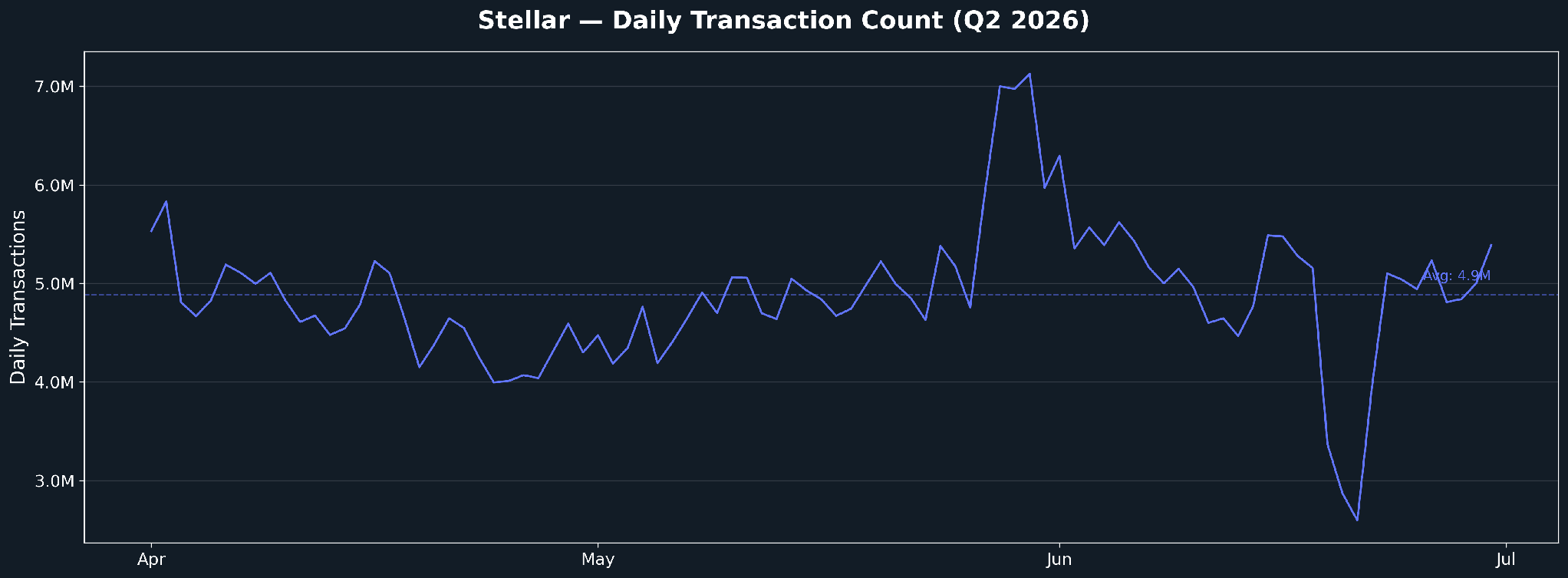
Stellar averaged approximately 4.9 million daily transactions in Q2 2026, with a range spanning from 2.6 million to 7.1 million. This level of throughput is consistent with Stellar’s positioning as a high-volume, low-cost payments rail. The variance in daily transaction counts likely reflects periodic batch processing by institutional users, stablecoin settlement cycles, and the natural rhythm of cross-border payment flows across different time zones. The sustained volume validates the network’s capacity to handle enterprise-grade workloads without degradation.

Daily Active Addresses

Daily Active Addresses

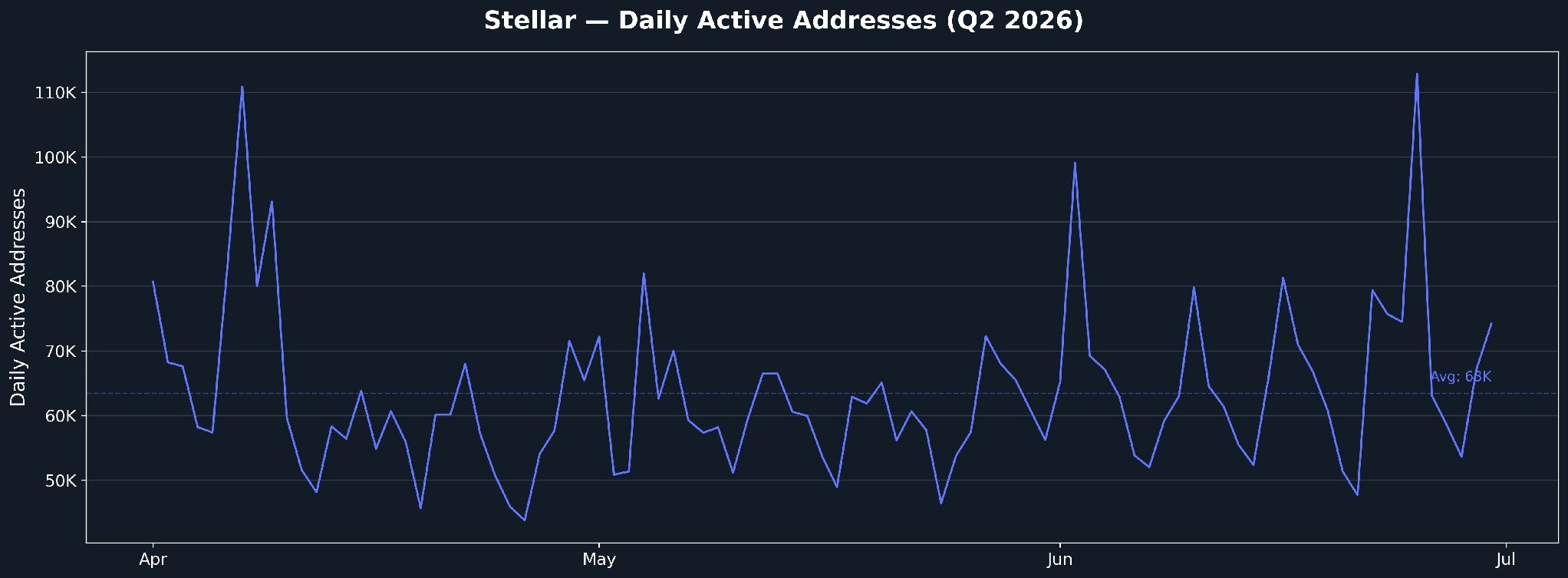
Stellar averaged approximately 63,000 daily active addresses in Q2, ranging between 44,000 and 113,000. The relatively modest address count relative to transaction volume is characteristic of Stellar’s institutional and infrastructure-heavy user base, where a smaller number of active entities (exchanges, payment processors, treasury operations) generate disproportionately high transaction volumes. Spikes in active addresses may correlate with retail-facing product launches such as MoneyGram’s MGUSD or new regional deployments by the Market Development team.

Closing Thoughts

Q2 2026 was arguably the most consequential quarter in Stellar’s recent history, not because of any single headline development but because of the coherence of the overall narrative. The technical, organizational, and strategic moves all point in the same direction: transforming Stellar from a capable but underutilized payments blockchain into the default infrastructure layer for regulated, institutional finance. Protocol 26’s Quorum Freeze gives regulated entities the emergency governance tools they need, Confidential Tokens address the privacy requirements that have historically blocked institutional adoption, CCTP eliminates the liquidity fragmentation that limited Stellar’s reach, and the regional Market Development team provides the on-the-ground relationships to close enterprise deals.

The acceleration from products like Spiko’s EU T-Bill fund and Franklin Templeton’s money market fund demonstrates that Stellar is winning not just pilot programs but production-scale deployments from serious financial institutions. The combination of real-time yield distribution, native tokenization with self-custody, and now cross-chain USDC liquidity creates a value proposition that is difficult for competing chains to replicate without the compliance-first infrastructure that Stellar spent seven years building.

Looking ahead to Q3 2026, the key catalysts to watch are Protocol 27’s mainnet activation (vote scheduled July 8), the progression of Confidential Tokens from testnet to mainnet readiness, early results from the regional Market Development teams, and any tangible growth in CCTP-driven cross-chain flows. The Quantum Preparedness Plan, while not immediately impactful, positions Stellar well for an industry conversation that will only intensify as quantum computing timelines compress. SDF’s thesis that distribution is the last constraint will face its real test in the coming quarters as the organizational and technical pieces assembled in Q2 begin generating measurable growth in institutional adoption and onchain activity.

Stellar Q2 2026 Report

Written by

Read Time

10 min read

Posted on

Overview

Stellar is a decentralized Layer 1 blockchain network purpose-built for payments, asset tokenization, and institutional-grade financial infrastructure. Founded in 2014 and governed by the Stellar Development Foundation (SDF), the network uses a unique Stellar Consensus Protocol (SCP) — sometimes called “Proof-of-Agreement” — in which known, trusted validators reach consensus without the energy costs or anonymous-participation risks of Proof-of-Work or Proof-of-Stake systems. Stellar has become the infrastructure of choice for major institutions including Franklin Templeton, U.S. Bank, MoneyGram, DTCC, and Societe Generale for real-world asset tokenization and cross-border payments.

Key Developments: Q2 2026

  • Protocol 26 “Yardstick” went live on mainnet (May 6), introducing Quorum Freeze (CAP-77), checked 256-bit arithmetic, precise TTL control, cheaper ZK cryptography, and Stellar Asset Contract improvements.

  • Protocol 27 “Zipper” entered testnet (June 18), adding authentication delegation for smart contract accounts (CAP-71) and address-bound Soroban credentials to prevent replay attacks. Mainnet vote scheduled for July 8.

  • Circle CCTP launched on Stellar (May 19), enabling native USDC cross-chain transfers across 24 blockchains through a burn-and-mint mechanism that settles in seconds — no wrapped tokens or bridges required.

  • Confidential Tokens developer preview released (June 29), allowing any SEP-41 token to gain private balances and transfer amounts via zero-knowledge proofs while preserving address visibility for compliance.

  • Quantum Preparedness Plan published (June 9), outlining a three-stage roadmap starting in 2026 with post-quantum verification in Soroban contracts and progressing to full protocol-level integration by 2027.

  • Six-region Market Development team announced (May 8), with dedicated senior leaders for Latin America, Brazil, Europe, Africa, Middle East, and APAC to drive localized institutional adoption.

Ecosystem

Protocol Upgrades and Network Governance

Stellar shipped two major protocol upgrades in Q2, reflecting an accelerating cadence of infrastructure improvements. Protocol 26 “Yardstick,” which went live on mainnet on May 6 following a testnet launch on April 16, introduced six core enhancements focused on precision and reliability rather than raw feature expansion. The headline capability is CAP-77 (Quorum Freeze), the first protocol-native, onchain account freeze mechanism on a major L1 blockchain, which allows validators to freeze compromised ledger keys through federated consensus within minutes rather than hours. This was born out of real incidents — a DeFi protocol exploit in February 2026 — where the lack of formalized emergency response tools forced ad-hoc coordination. Additional Protocol 26 enhancements include checked 256-bit arithmetic (CAP-82) to prevent catastrophic overflow failures in financial calculations, precise TTL control (CAP-78) for equitable rent policies, cheaper BN254 cryptographic operations (CAP-80) to support zero-knowledge proof applications, Stellar Asset Contract improvements (CAP-73) enabling unlimited trustlines for classic accounts, and muxed address conversion support (CAP-79). Protocol 27 “Zipper” followed closely, entering testnet on June 18 with a mainnet vote scheduled later on. Its primary innovation is authentication delegation (CAP-71), which introduces a first-class mechanism for custom smart contract accounts to delegate authentication logic to other addresses, significantly reducing transaction size and complexity while enabling more sophisticated account abstraction patterns.

Governance Philosophy and Decentralization

SDF published a coordinated series of essays in May articulating a maturing governance philosophy for Stellar. CTO Nicolas Barry argued that true decentralization requires not just many validators but resilience against real-world pressures including political interference, security threats, and infrastructure failures, identifying geo-political resilience, security, and mission alignment as three critical dimensions. A companion piece made the case for moving from passive to active governance, where validators engage deliberately in network decisions rather than merely running software and accepting upgrades. The Quorum Freeze mechanism was presented as a concrete example of formalizing emergency response so that governance debates happen during calm periods rather than crises. Separately, a detailed comparison of Proof-of-Stake versus Stellar’s Proof-of-Agreement consensus mechanism highlighted structural vulnerabilities in PoS systems — including MEV extraction, anonymous validator participation, and susceptibility to state-actor threats — while positioning Stellar’s reputation-based validator model as inherently more resistant to these attack vectors. Taken together, these publications signal SDF’s intent to lead an industry-wide conversation about what practical, accountable decentralization looks like for networks that serve regulated financial institutions.

Privacy Infrastructure

Stellar made significant progress on institutional-grade privacy during Q2. The developer preview of Confidential Tokens, enables any SEP-41 token on the network to gain private balances and private transfer amounts through a wrapper contract architecture. Unlike fully anonymous solutions, Confidential Tokens deliberately keep sender and recipient addresses visible while hiding amounts, a design choice aimed squarely at institutional use cases such as payroll, treasury management, and large-value transfers where counterparties must be identifiable but transaction values should not be publicly visible. The system uses Pedersen commitments for balance encoding and Noir-based zero-knowledge proofs verified through Nethermind’s UltraHonk verifier, building on the cryptographic primitives introduced in Protocol 25 (“X-Ray”) and the cheaper ZK operations enabled by Protocol 26. Compliance features including auditor access keys, selective disclosure, account freezing, and configurable policy engines for identity verification are built in from the start. The preview is live on testnet and not yet approved for mainnet, positioning it as an area to watch in Q3 and beyond. This gives the ecosystem a spectrum of privacy tools tailored to different regulatory and institutional requirements.

Quantum Readiness

The Stellar Development Foundation published a comprehensive Quantum Preparedness Plan, establishing itself as one of the first major L1 blockchains to formalize a defense strategy against quantum computing threats. The plan addresses two distinct attack surfaces: compromising network consensus through validator signature forgery, and enabling account takeovers by deriving private keys from publicly exposed Ed25519 public keys. Stellar possesses a structural advantage because its account identity is separated from signing keys, meaning accounts can add quantum-safe signers without migrating to new addresses — a property not shared by most blockchain architectures where the address is derived from the public key. The three-stage roadmap begins in 2026 with adding post-quantum verification capabilities to Soroban smart contracts, progresses to protocol-level integration of post-quantum cryptographic standards by 2027, and concludes with a deprecation phase whose timing will be determined by threat evolution and community consensus. The plan explicitly defers decisions on dormant accounts and zero-knowledge protocol compatibility to future community discussion, reflecting a pragmatic approach that addresses the most critical risks first while acknowledging areas of genuine uncertainty.

Stablecoins and Cross-Chain Infrastructure

The launch of Circle’s Cross-Chain Transfer Protocol (CCTP) on Stellar in May represents a major infrastructure milestone, connecting Stellar’s USDC liquidity to 23 other blockchains including Ethereum, Solana, Base, and Arbitrum through a native burn-and-mint mechanism. Unlike bridge-based approaches that rely on wrapped tokens and custodial intermediaries, CCTP burns USDC on the source chain and mints an equivalent amount on the destination chain, settling in seconds with no counterparty risk. For Stellar specifically, CCTP unlocks bidirectional flows between the network’s payments-focused ecosystem and the broader DeFi landscape, allowing capital to flow to where it is most productive. The integration includes developer-facing features such as Hooks for embedding metadata in cross-chain transfers, enabling programmatic routing of funds for use cases like automated treasury management or cross-border payment orchestration. Combined with Stellar’s access to 475,000+ MoneyGram locations worldwide, CCTP effectively bridges onchain liquidity with physical cash distribution networks — a combination few other chains can offer.

Tokenized Real-World Assets and Securities

SDF CEO Denelle Dixon published a detailed analysis of the distinction between “wrapped” and “native” tokenized securities, arguing that the difference is fundamental rather than cosmetic. Wrapped tokens merely point to offchain assets held by custodians, requiring dual-ledger reconciliation and introducing custodial risk, while native tokens use the blockchain as the authoritative ledger of ownership. The practical implications are significant: native tokenization enables self-custody, real-time yield distribution (as demonstrated by Franklin Templeton’s money market fund crediting daily interest directly to wallets), instant settlement, 24/7 trading paired with stablecoins, and onchain governance through encoded voting rights. These advantages, combined with cost reductions from eliminating reconciliation overhead, allow issuers to lower investment minimums and expand access to previously institutional-only products. The Q2 2026 metrics reinforce the thesis: tokenized RWAs on Stellar crossed the $3 billion threshold, with notable growth from products like Spiko’s EU T-Bill product and new tokenized money market funds in Malaysia.

Distribution and Go-to-Market Strategy

Two related developments in Q2 signal a strategic pivot from technology building to distribution. In May, SDF announced a new Market Development team structured across six regions: Latin America (Federico Gomez Schumacher), Brazil (Claudia Antunes), Europe (Juan Lopez Carretero), Africa (Kwame Oppong), Middle East (Faraj Abutalibov), and APAC (Betty Sun-Lucas). The thesis is that blockchain adoption decisions are inherently local, driven by regional regulators, existing payment rails, and competitive dynamics, and that winning institutional adoption requires senior leaders with deep regional networks rather than centralized global campaigns. In June, Dixon articulated the broader strategic argument that distribution, not technology, is now the binding constraint on tokenized asset adoption. Rather than building more crypto-native applications, the industry must embed tokenized assets into the banks, brokerages, and advisor platforms where users already are, making blockchain infrastructure invisible. The MoneyGram integration serves as the proof point: millions of users access MGUSD stablecoin through their existing app without any awareness of the underlying blockchain. Regulatory tailwinds including the CFTC’s approval of tokenized money market funds as collateral and revised special-purpose broker-dealer rules are now enabling the third-party distribution channels that this strategy depends on.

Developer Ecosystem and Smart Contract Innovation

Stellar’s developer ecosystem continues to grow, reflecting growing interest in the Soroban smart contract platform. Stellar’s composable authorization model highlighted innovations in the Soroban auth framework that differentiate it from competing smart contract platforms. The “detachable auth” design, where authorization entries are signed separately from transaction envelopes, enables fee-payers to differ from authorizers, supports multi-party atomic operations, and makes authorization entries portable across transactions. These capabilities have practical implications for real-world financial applications: sponsored transactions allow users without cryptocurrency to interact with onchain services, atomic swaps can involve multiple independent parties, and session-key mechanisms enable delegated access without exposing master keys. Protocol 27’s authentication delegation (CAP-71) extends this further by allowing custom contract accounts to delegate their authentication logic, reducing complexity for developers building account abstraction and wallet infrastructure.

Onchain Data

Daily Transactions


Daily Transactions

Stellar averaged approximately 4.9 million daily transactions in Q2 2026, with a range spanning from 2.6 million to 7.1 million. This level of throughput is consistent with Stellar’s positioning as a high-volume, low-cost payments rail. The variance in daily transaction counts likely reflects periodic batch processing by institutional users, stablecoin settlement cycles, and the natural rhythm of cross-border payment flows across different time zones. The sustained volume validates the network’s capacity to handle enterprise-grade workloads without degradation.

Daily Active Addresses


Daily Active Addresses

Stellar averaged approximately 63,000 daily active addresses in Q2, ranging between 44,000 and 113,000. The relatively modest address count relative to transaction volume is characteristic of Stellar’s institutional and infrastructure-heavy user base, where a smaller number of active entities (exchanges, payment processors, treasury operations) generate disproportionately high transaction volumes. Spikes in active addresses may correlate with retail-facing product launches such as MoneyGram’s MGUSD or new regional deployments by the Market Development team.

Closing Thoughts

Q2 2026 was arguably the most consequential quarter in Stellar’s recent history, not because of any single headline development but because of the coherence of the overall narrative. The technical, organizational, and strategic moves all point in the same direction: transforming Stellar from a capable but underutilized payments blockchain into the default infrastructure layer for regulated, institutional finance. Protocol 26’s Quorum Freeze gives regulated entities the emergency governance tools they need, Confidential Tokens address the privacy requirements that have historically blocked institutional adoption, CCTP eliminates the liquidity fragmentation that limited Stellar’s reach, and the regional Market Development team provides the on-the-ground relationships to close enterprise deals.

The acceleration from products like Spiko’s EU T-Bill fund and Franklin Templeton’s money market fund demonstrates that Stellar is winning not just pilot programs but production-scale deployments from serious financial institutions. The combination of real-time yield distribution, native tokenization with self-custody, and now cross-chain USDC liquidity creates a value proposition that is difficult for competing chains to replicate without the compliance-first infrastructure that Stellar spent seven years building.

Looking ahead to Q3 2026, the key catalysts to watch are Protocol 27’s mainnet activation (vote scheduled July 8), the progression of Confidential Tokens from testnet to mainnet readiness, early results from the regional Market Development teams, and any tangible growth in CCTP-driven cross-chain flows. The Quantum Preparedness Plan, while not immediately impactful, positions Stellar well for an industry conversation that will only intensify as quantum computing timelines compress. SDF’s thesis that distribution is the last constraint will face its real test in the coming quarters as the organizational and technical pieces assembled in Q2 begin generating measurable growth in institutional adoption and onchain activity.

About the Author

Visit our socials

You may also like these

Related Posts

Stellar Q2 2026 Report

Written by

Read Time

10 min read

Posted on

Overview

Stellar is a decentralized Layer 1 blockchain network purpose-built for payments, asset tokenization, and institutional-grade financial infrastructure. Founded in 2014 and governed by the Stellar Development Foundation (SDF), the network uses a unique Stellar Consensus Protocol (SCP) — sometimes called “Proof-of-Agreement” — in which known, trusted validators reach consensus without the energy costs or anonymous-participation risks of Proof-of-Work or Proof-of-Stake systems. Stellar has become the infrastructure of choice for major institutions including Franklin Templeton, U.S. Bank, MoneyGram, DTCC, and Societe Generale for real-world asset tokenization and cross-border payments.

Key Developments: Q2 2026

  • Protocol 26 “Yardstick” went live on mainnet (May 6), introducing Quorum Freeze (CAP-77), checked 256-bit arithmetic, precise TTL control, cheaper ZK cryptography, and Stellar Asset Contract improvements.

  • Protocol 27 “Zipper” entered testnet (June 18), adding authentication delegation for smart contract accounts (CAP-71) and address-bound Soroban credentials to prevent replay attacks. Mainnet vote scheduled for July 8.

  • Circle CCTP launched on Stellar (May 19), enabling native USDC cross-chain transfers across 24 blockchains through a burn-and-mint mechanism that settles in seconds — no wrapped tokens or bridges required.

  • Confidential Tokens developer preview released (June 29), allowing any SEP-41 token to gain private balances and transfer amounts via zero-knowledge proofs while preserving address visibility for compliance.

  • Quantum Preparedness Plan published (June 9), outlining a three-stage roadmap starting in 2026 with post-quantum verification in Soroban contracts and progressing to full protocol-level integration by 2027.

  • Six-region Market Development team announced (May 8), with dedicated senior leaders for Latin America, Brazil, Europe, Africa, Middle East, and APAC to drive localized institutional adoption.

Ecosystem

Protocol Upgrades and Network Governance

Stellar shipped two major protocol upgrades in Q2, reflecting an accelerating cadence of infrastructure improvements. Protocol 26 “Yardstick,” which went live on mainnet on May 6 following a testnet launch on April 16, introduced six core enhancements focused on precision and reliability rather than raw feature expansion. The headline capability is CAP-77 (Quorum Freeze), the first protocol-native, onchain account freeze mechanism on a major L1 blockchain, which allows validators to freeze compromised ledger keys through federated consensus within minutes rather than hours. This was born out of real incidents — a DeFi protocol exploit in February 2026 — where the lack of formalized emergency response tools forced ad-hoc coordination. Additional Protocol 26 enhancements include checked 256-bit arithmetic (CAP-82) to prevent catastrophic overflow failures in financial calculations, precise TTL control (CAP-78) for equitable rent policies, cheaper BN254 cryptographic operations (CAP-80) to support zero-knowledge proof applications, Stellar Asset Contract improvements (CAP-73) enabling unlimited trustlines for classic accounts, and muxed address conversion support (CAP-79). Protocol 27 “Zipper” followed closely, entering testnet on June 18 with a mainnet vote scheduled later on. Its primary innovation is authentication delegation (CAP-71), which introduces a first-class mechanism for custom smart contract accounts to delegate authentication logic to other addresses, significantly reducing transaction size and complexity while enabling more sophisticated account abstraction patterns.

Governance Philosophy and Decentralization

SDF published a coordinated series of essays in May articulating a maturing governance philosophy for Stellar. CTO Nicolas Barry argued that true decentralization requires not just many validators but resilience against real-world pressures including political interference, security threats, and infrastructure failures, identifying geo-political resilience, security, and mission alignment as three critical dimensions. A companion piece made the case for moving from passive to active governance, where validators engage deliberately in network decisions rather than merely running software and accepting upgrades. The Quorum Freeze mechanism was presented as a concrete example of formalizing emergency response so that governance debates happen during calm periods rather than crises. Separately, a detailed comparison of Proof-of-Stake versus Stellar’s Proof-of-Agreement consensus mechanism highlighted structural vulnerabilities in PoS systems — including MEV extraction, anonymous validator participation, and susceptibility to state-actor threats — while positioning Stellar’s reputation-based validator model as inherently more resistant to these attack vectors. Taken together, these publications signal SDF’s intent to lead an industry-wide conversation about what practical, accountable decentralization looks like for networks that serve regulated financial institutions.

Privacy Infrastructure

Stellar made significant progress on institutional-grade privacy during Q2. The developer preview of Confidential Tokens, enables any SEP-41 token on the network to gain private balances and private transfer amounts through a wrapper contract architecture. Unlike fully anonymous solutions, Confidential Tokens deliberately keep sender and recipient addresses visible while hiding amounts, a design choice aimed squarely at institutional use cases such as payroll, treasury management, and large-value transfers where counterparties must be identifiable but transaction values should not be publicly visible. The system uses Pedersen commitments for balance encoding and Noir-based zero-knowledge proofs verified through Nethermind’s UltraHonk verifier, building on the cryptographic primitives introduced in Protocol 25 (“X-Ray”) and the cheaper ZK operations enabled by Protocol 26. Compliance features including auditor access keys, selective disclosure, account freezing, and configurable policy engines for identity verification are built in from the start. The preview is live on testnet and not yet approved for mainnet, positioning it as an area to watch in Q3 and beyond. This gives the ecosystem a spectrum of privacy tools tailored to different regulatory and institutional requirements.

Quantum Readiness

The Stellar Development Foundation published a comprehensive Quantum Preparedness Plan, establishing itself as one of the first major L1 blockchains to formalize a defense strategy against quantum computing threats. The plan addresses two distinct attack surfaces: compromising network consensus through validator signature forgery, and enabling account takeovers by deriving private keys from publicly exposed Ed25519 public keys. Stellar possesses a structural advantage because its account identity is separated from signing keys, meaning accounts can add quantum-safe signers without migrating to new addresses — a property not shared by most blockchain architectures where the address is derived from the public key. The three-stage roadmap begins in 2026 with adding post-quantum verification capabilities to Soroban smart contracts, progresses to protocol-level integration of post-quantum cryptographic standards by 2027, and concludes with a deprecation phase whose timing will be determined by threat evolution and community consensus. The plan explicitly defers decisions on dormant accounts and zero-knowledge protocol compatibility to future community discussion, reflecting a pragmatic approach that addresses the most critical risks first while acknowledging areas of genuine uncertainty.

Stablecoins and Cross-Chain Infrastructure

The launch of Circle’s Cross-Chain Transfer Protocol (CCTP) on Stellar in May represents a major infrastructure milestone, connecting Stellar’s USDC liquidity to 23 other blockchains including Ethereum, Solana, Base, and Arbitrum through a native burn-and-mint mechanism. Unlike bridge-based approaches that rely on wrapped tokens and custodial intermediaries, CCTP burns USDC on the source chain and mints an equivalent amount on the destination chain, settling in seconds with no counterparty risk. For Stellar specifically, CCTP unlocks bidirectional flows between the network’s payments-focused ecosystem and the broader DeFi landscape, allowing capital to flow to where it is most productive. The integration includes developer-facing features such as Hooks for embedding metadata in cross-chain transfers, enabling programmatic routing of funds for use cases like automated treasury management or cross-border payment orchestration. Combined with Stellar’s access to 475,000+ MoneyGram locations worldwide, CCTP effectively bridges onchain liquidity with physical cash distribution networks — a combination few other chains can offer.

Tokenized Real-World Assets and Securities

SDF CEO Denelle Dixon published a detailed analysis of the distinction between “wrapped” and “native” tokenized securities, arguing that the difference is fundamental rather than cosmetic. Wrapped tokens merely point to offchain assets held by custodians, requiring dual-ledger reconciliation and introducing custodial risk, while native tokens use the blockchain as the authoritative ledger of ownership. The practical implications are significant: native tokenization enables self-custody, real-time yield distribution (as demonstrated by Franklin Templeton’s money market fund crediting daily interest directly to wallets), instant settlement, 24/7 trading paired with stablecoins, and onchain governance through encoded voting rights. These advantages, combined with cost reductions from eliminating reconciliation overhead, allow issuers to lower investment minimums and expand access to previously institutional-only products. The Q2 2026 metrics reinforce the thesis: tokenized RWAs on Stellar crossed the $3 billion threshold, with notable growth from products like Spiko’s EU T-Bill product and new tokenized money market funds in Malaysia.

Distribution and Go-to-Market Strategy

Two related developments in Q2 signal a strategic pivot from technology building to distribution. In May, SDF announced a new Market Development team structured across six regions: Latin America (Federico Gomez Schumacher), Brazil (Claudia Antunes), Europe (Juan Lopez Carretero), Africa (Kwame Oppong), Middle East (Faraj Abutalibov), and APAC (Betty Sun-Lucas). The thesis is that blockchain adoption decisions are inherently local, driven by regional regulators, existing payment rails, and competitive dynamics, and that winning institutional adoption requires senior leaders with deep regional networks rather than centralized global campaigns. In June, Dixon articulated the broader strategic argument that distribution, not technology, is now the binding constraint on tokenized asset adoption. Rather than building more crypto-native applications, the industry must embed tokenized assets into the banks, brokerages, and advisor platforms where users already are, making blockchain infrastructure invisible. The MoneyGram integration serves as the proof point: millions of users access MGUSD stablecoin through their existing app without any awareness of the underlying blockchain. Regulatory tailwinds including the CFTC’s approval of tokenized money market funds as collateral and revised special-purpose broker-dealer rules are now enabling the third-party distribution channels that this strategy depends on.

Developer Ecosystem and Smart Contract Innovation

Stellar’s developer ecosystem continues to grow, reflecting growing interest in the Soroban smart contract platform. Stellar’s composable authorization model highlighted innovations in the Soroban auth framework that differentiate it from competing smart contract platforms. The “detachable auth” design, where authorization entries are signed separately from transaction envelopes, enables fee-payers to differ from authorizers, supports multi-party atomic operations, and makes authorization entries portable across transactions. These capabilities have practical implications for real-world financial applications: sponsored transactions allow users without cryptocurrency to interact with onchain services, atomic swaps can involve multiple independent parties, and session-key mechanisms enable delegated access without exposing master keys. Protocol 27’s authentication delegation (CAP-71) extends this further by allowing custom contract accounts to delegate their authentication logic, reducing complexity for developers building account abstraction and wallet infrastructure.

Onchain Data

Daily Transactions


Daily Transactions

Stellar averaged approximately 4.9 million daily transactions in Q2 2026, with a range spanning from 2.6 million to 7.1 million. This level of throughput is consistent with Stellar’s positioning as a high-volume, low-cost payments rail. The variance in daily transaction counts likely reflects periodic batch processing by institutional users, stablecoin settlement cycles, and the natural rhythm of cross-border payment flows across different time zones. The sustained volume validates the network’s capacity to handle enterprise-grade workloads without degradation.

Daily Active Addresses


Daily Active Addresses

Stellar averaged approximately 63,000 daily active addresses in Q2, ranging between 44,000 and 113,000. The relatively modest address count relative to transaction volume is characteristic of Stellar’s institutional and infrastructure-heavy user base, where a smaller number of active entities (exchanges, payment processors, treasury operations) generate disproportionately high transaction volumes. Spikes in active addresses may correlate with retail-facing product launches such as MoneyGram’s MGUSD or new regional deployments by the Market Development team.

Closing Thoughts

Q2 2026 was arguably the most consequential quarter in Stellar’s recent history, not because of any single headline development but because of the coherence of the overall narrative. The technical, organizational, and strategic moves all point in the same direction: transforming Stellar from a capable but underutilized payments blockchain into the default infrastructure layer for regulated, institutional finance. Protocol 26’s Quorum Freeze gives regulated entities the emergency governance tools they need, Confidential Tokens address the privacy requirements that have historically blocked institutional adoption, CCTP eliminates the liquidity fragmentation that limited Stellar’s reach, and the regional Market Development team provides the on-the-ground relationships to close enterprise deals.

The acceleration from products like Spiko’s EU T-Bill fund and Franklin Templeton’s money market fund demonstrates that Stellar is winning not just pilot programs but production-scale deployments from serious financial institutions. The combination of real-time yield distribution, native tokenization with self-custody, and now cross-chain USDC liquidity creates a value proposition that is difficult for competing chains to replicate without the compliance-first infrastructure that Stellar spent seven years building.

Looking ahead to Q3 2026, the key catalysts to watch are Protocol 27’s mainnet activation (vote scheduled July 8), the progression of Confidential Tokens from testnet to mainnet readiness, early results from the regional Market Development teams, and any tangible growth in CCTP-driven cross-chain flows. The Quantum Preparedness Plan, while not immediately impactful, positions Stellar well for an industry conversation that will only intensify as quantum computing timelines compress. SDF’s thesis that distribution is the last constraint will face its real test in the coming quarters as the organizational and technical pieces assembled in Q2 begin generating measurable growth in institutional adoption and onchain activity.

About the Author

You may also like these

Related Posts