
Overview
Starknet is a permissionless validity rollup (ZK-rollup) operating as an Ethereum Layer 2. It uses STARK proofs computed off-chain and verified on-chain to achieve Ethereum-grade security with dramatically higher throughput and lower transaction costs. Smart contracts are written in Cairo, a language purpose-built for provable computation, and executed by Starknet’s own VM. The network supports native account abstraction, enabling flexible wallet logic and gas sponsorship out of the box.
The first half of 2026 was defined by a singular strategic pivot: Starknet evolved from a high-performance rollup into a privacy-preserving execution layer. The launch of STRK20 — a protocol-level privacy framework — and strkBTC — a shielded Bitcoin asset — represent the most consequential upgrades in Starknet’s history. Beyond privacy, H1 2026 saw continued maturation of developer tooling through Starkzap (v1 and v2), the emergence of Starkscan as an agent-ready data API, significant positioning around perpetuals trading, and the publication of a 2026 infrastructure roadmap addressing execution performance, decentralization, and economic sustainability.
Key Developments: H1 2026
Privacy and Confidential Finance
Starknet v0.14.2 — The Privacy Engine: The most foundational upgrade of H1 2026, v0.14.2 introduced SNIP-36, which enables in-protocol proof verification allowing transactions to reference off-chain execution proofs directly. This is the technical prerequisite that makes STRK20 and strkBTC possible — confidential state transitions can now be validated by the network without exposing underlying balances or counterparties. The upgrade also rebalanced Starknet’s economic model through SNIP-37, increasing storage costs while reducing base L2 gas prices to better align incentives around state growth. StarkGate token contracts were upgraded to v3.0.0, standardizing ERC-20 events to ease indexing for the wave of privacy-enabled applications that would follow.
STRK20 Privacy Framework Launch: STRK20 went live as Starknet’s native privacy layer, enabling users to shield any ERC-20 asset into encrypted private balances and conduct confidential transfers, swaps, and DeFi interactions. The system uses note-based cryptography with zero-knowledge proofs generated via S-two and Cairo. Rather than building a separate privacy chain or mixer, STRK20 operates at the protocol level — encrypted notes are stored directly on Starknet without separate commitment trees, enabling efficient multi-asset support. Each shielded transaction costs a fixed 4 STRK. The compliance architecture is notable: an encrypted viewing key framework allows authorized third-party auditors to reconstruct specific user transaction histories for regulatory purposes without compromising uninvolved users’ privacy. At launch, ecosystem teams including AVNU, Ekubo, Vesu, and Endur announced STRK20 integrations across trading, lending, staking, and yield protocols.
Compliance Aware Privacy: STRK20 screens users when they deposit into the privacy pool and requires every participant to create a valid encrypted viewing key. This allows transaction histories to be decrypted in response to verified lawful requests, addressing the limitations of systems where compliance depends on users voluntarily opting into disclosure.
Scoped Disclosure as a Differentiator: STRK20 viewing keys are designed to disclose only the information required for a specific lawful request, while unrelated activity remains private. For example, disclosure can be limited to a particular counterparty transfer within a defined period rather than exposing the user’s entire transaction history. This provides institutions with a path to transact privately within a permissionless DeFi ecosystem while retaining a mechanism for targeted regulatory disclosure.
Private USDC on Starknet: USDC became the first major stablecoin with protocol-level privacy on Starknet. Users can shield USDC balances, conduct confidential transfers, and maintain composability with DeFi applications — all through existing wallets (Ready, Xverse) without migrating to specialized privacy tools. The fixed-fee model (4 STRK per transaction rather than percentage-based) makes privacy economically viable for both small payments and large treasury movements. This positions Starknet as a credible venue for institutional stablecoin activity where transaction visibility is a genuine operational concern.
Private DeFi Integration: Starknet articulated a comprehensive vision for privacy-enabled DeFi that goes beyond simple shielded transfers. The framework encompasses private swaps through AVNU and Ekubo (routed through anonymizing contracts that break the on-chain link between wallet and trade), lending against shielded collateral through Vesu, and yield generation on private positions through Endur’s liquid staking tokens (xSTRK, xstrkBTC). The phased rollout prioritizes basic operations before advancing to complex vault strategies, reflecting a pragmatic approach to shipping privacy incrementally rather than waiting for a comprehensive launch.
STRK20 Application Design Space: A developer-focused overview outlined 11 concrete applications enabled by STRK20, spanning from immediately buildable use cases (private payroll, institutional treasury management, trade obfuscation, private lending) to emerging design patterns (sealed-bid auctions, games with hidden state, private governance voting, and private AI agent payments). The breadth of the design space signals that Starknet’s privacy infrastructure is intended as a platform primitive, not a narrow product feature.
Bitcoin on Starknet (BTCFi)
strkBTC Launch: strkBTC launched as a Bitcoin-backed asset on Starknet, representing the network’s most significant BTCFi initiative. The asset operates in dual modes: public (standard ERC-20) and shielded (private via STRK20). A federated bridge model currently backs every strkBTC with locked Bitcoin, with a stated path toward full decentralization. Three bridge routes were available at launch — strkbtc.io (powered by Atomiq), Atomiq directly, and Garden Finance — each requiring approximately 20 minutes for Bitcoin confirmations. Ready X and Xverse wallets provided native shielding support from day one. BTCFi incentives were structured around Vesu lending markets and Ekubo liquidity pairs, with liquid staking available through Endur. The launch was supported by comprehensive user documentation, reflecting a focus on onboarding Bitcoin holders who may be unfamiliar with L2 ecosystems.
Protocol Infrastructure and Roadmap
2026 Technical Infrastructure Roadmap: Starknet published a comprehensive roadmap organized around three pillars. For execution performance, the plan includes deploying S-two to reduce L1 finality below one hour, implementing a Rust Committer for 2-3x throughput improvement, and enabling sub-second preconfirmations for 95% of transactions. Decentralization goals include rolling out decentralized block validation with multiple independent validators and formalizing protocol upgrades through social governance. On the economic side, the network plans to stabilize fee structures and adjust contract fees to better price state growth. The roadmap explicitly acknowledges that privacy, Starknomics, and Layer 3 development represent future priorities beyond the 2026 scope.
Derivatives and Trading
Perpetuals Trading Ecosystem: Starknet positioned itself as a leading venue for perpetual futures trading, citing three major platforms operating on its technology stack: Extended (on mainnet since August 2025 with approximately $180 billion in cumulative volume), edgeX (StarkEx-based with over $800 billion cumulative volume), and Paradex (an appchain optimized for derivatives). The network’s architecture — Cairo-native execution exceeding 100 TPS for perp trades, account abstraction for streamlined UX, and validity-proven settlement — addresses the latency sensitivity and security demands that distinguish derivatives from spot trading. The combined volume figures across these platforms ($980 billion+) represent one of the strongest quantitative arguments for Starknet’s production readiness.
Developer Tooling and Ecosystem
Starkzap SDK Launch: Starkzap launched as a TypeScript SDK designed to compress crypto integration timelines from months to minutes. The toolkit provides four core modules: Wallets (social login via Privy and Cartridge Controller), Paymaster (gasless transactions), DeFi products (native BTC and STRK staking, token operations), and cross-platform compatibility for web and mobile. The launch was paired with substantial ecosystem funding — developers building on Starkzap qualify for up to $2 million in combined support through Seed Grants (up to $25K), Growth Grants (up to $1M), and the Propulsion Program (up to $1M in gas reimbursements).
Starkzap v2: Just one month after the initial release, Starkzap v2 expanded from basic wallet and staking modules to a comprehensive DeFi toolkit with five production-ready modules: swaps (via AVNU or Ekubo), dollar-cost averaging, lending and borrowing (through Vesu), cross-chain bridging, and confidential transfers (via Tongo). The rapid v1-to-v2 progression reflects both the urgency of the developer tooling gap and the growing complexity of DeFi primitives available on Starknet.
Starkscan Block Explorer and Data API: Starkscan launched in public beta as a dual-purpose platform combining traditional block explorer functionality with a self-serve data API. The API is specifically designed for agent workflows, providing repeatable queries and consistent JSON schemas that enable multi-step investigations across contracts and wallet activity. It decodes Starknet-specific features including Cairo contracts, account abstraction, and STRK20 privacy pool interactions, positioning itself as the data infrastructure layer for both human analysts and autonomous agents building on Starknet.
AI Coding Stack for Starknet Development: A developer-oriented article evaluated AI-assisted development stacks for building on Starknet, recommending open-weight models (GLM 5.2, DeepSeek V4 Pro) paired with OpenCode and Venice.ai as the preferred configuration. The emphasis on open-source, model-neutral, and crypto-aligned tooling reflects the ecosystem’s broader philosophical alignment with decentralization and developer sovereignty — even in the choice of AI coding assistants.
Agent Security Best Practices: As autonomous coding agents become standard development tools, Starknet published guidance on protecting developer secrets in agent environments. The article evaluates containers, Docker Sandboxes, and micro-VM isolation, ultimately recommending sandboxed environments with restricted filesystem and network access. Notably, it identifies an unsolved challenge: there is currently no secure mechanism for agents to sign cryptocurrency transactions without exposing private keys, highlighting an open problem at the intersection of agent autonomy and wallet security.
Onchain Data
Daily Transactions
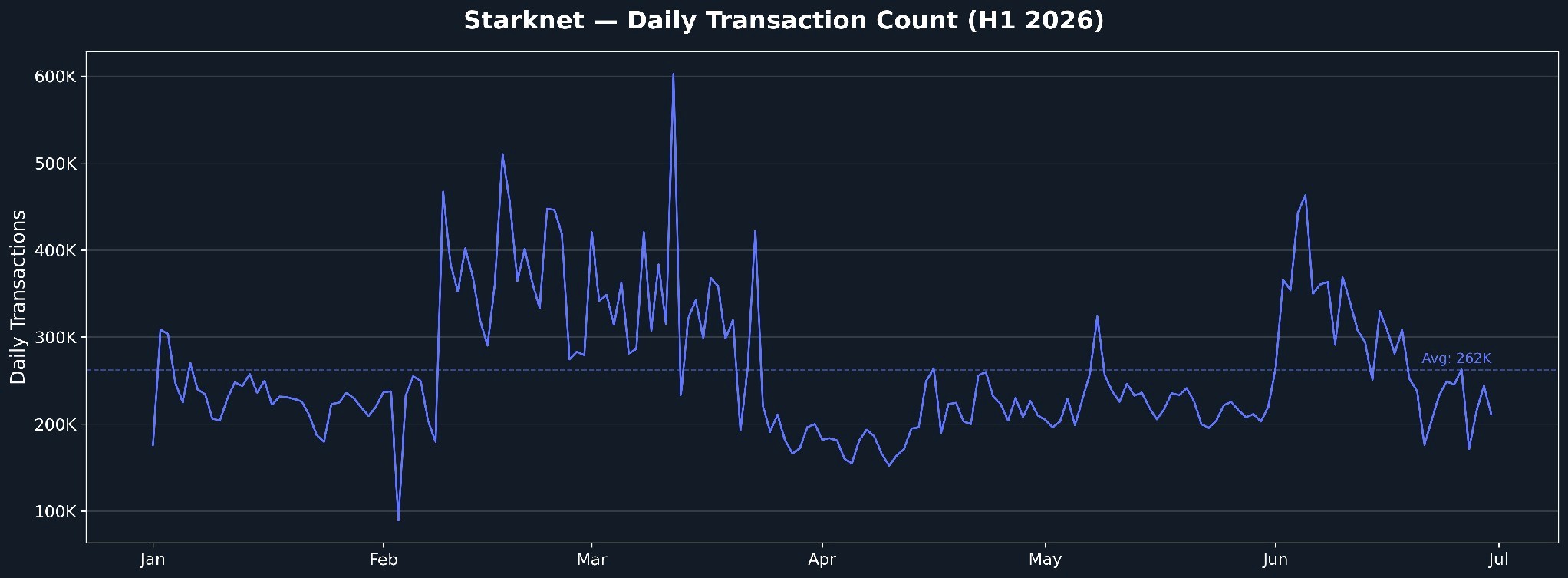
Starknet averaged approximately 239,000 daily transactions during the Q2 2026 portion of the reporting period, with a range spanning from 152,000 to 463,000. The wide variance reflects the episodic nature of on-chain activity driven by protocol launches and incentive campaigns — the strkBTC launch in mid-May and the STRK20 privacy rollout in June likely contributed to the upper end of the range. The overall trajectory through H1 shows a network still in its growth phase, with activity increasingly tied to product launches rather than organic baseline demand.
Daily Active Addresses
Starknet averaged roughly 50,000 daily active addresses in Q2 2026, ranging from 23,000 to 65,000. The ratio of daily transactions to daily active addresses (~4.8x) suggests moderate per-user engagement, with the typical active address submitting roughly five transactions per day. The relatively tight address range compared to the wider transaction range indicates that spikes in activity are driven more by increased per-user transaction volume than by waves of new users — a pattern consistent with power users and DeFi protocols rather than broad retail onboarding.
Top Entities by Transactions
Top Entities by Users
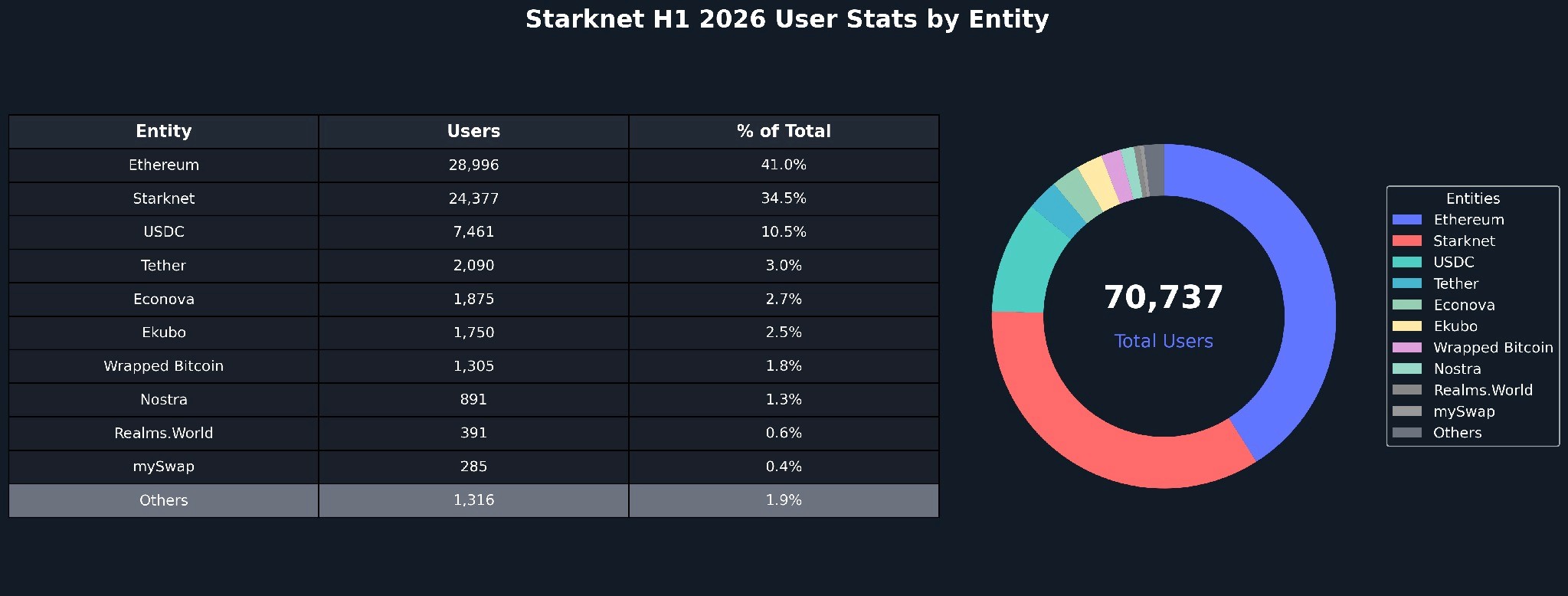
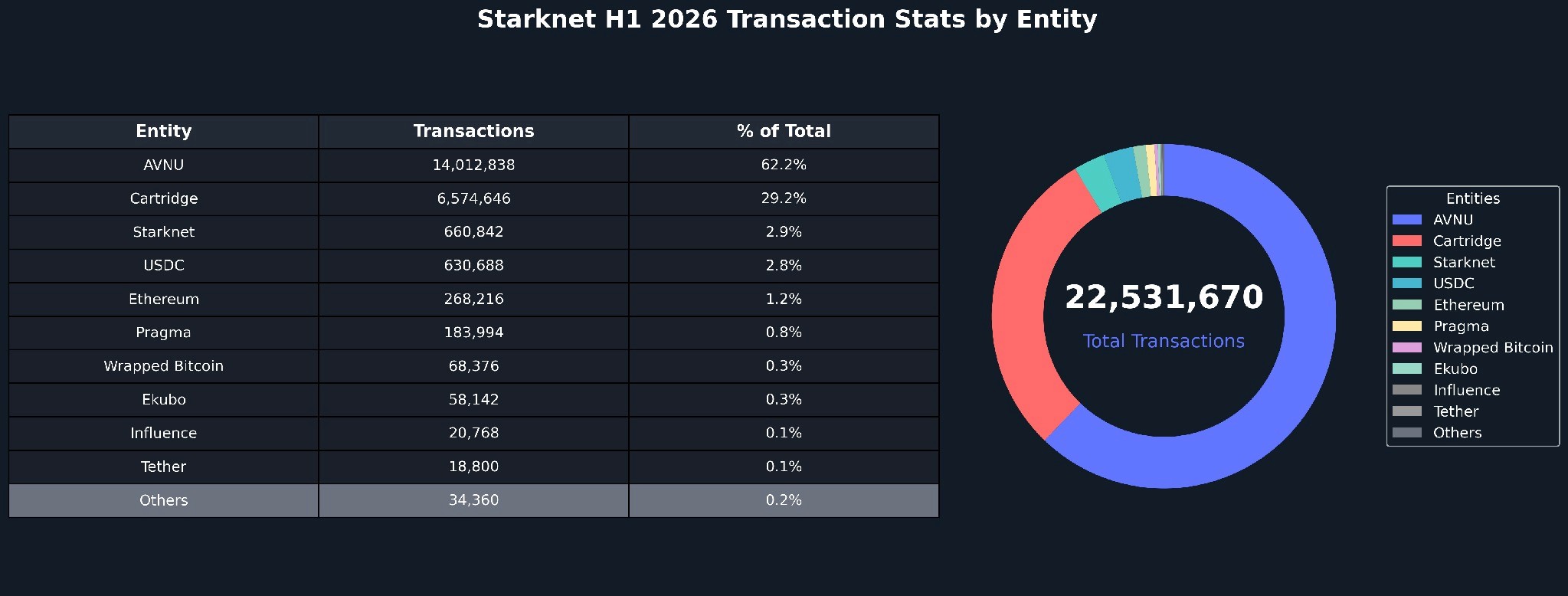
Onchain activity in Q2 2026 totaled 22.5 million transactions across 71,000 unique users, revealing a highly concentrated ecosystem. AVNU, the DEX aggregator, dominated with 14 million transactions (62.2% of total), underscoring its role as the primary routing layer for all swap activity on Starknet — a position that will become even more critical as STRK20 private swaps route through AVNU and Ekubo. Cartridge accounted for 6.57 million transactions, reflecting the gaming sector’s outsized contribution to raw transaction counts. Together, AVNU and Cartridge represent 91% of all transactions, a concentration level that highlights both the ecosystem’s reliance on a few anchor applications and the significant opportunity for diversification. Starknet native transactions (661K), USDC activity (631K), and Ethereum bridge usage (268K) round out the top five, with the USDC figure likely to grow substantially as private USDC features drive new stablecoin use cases in H2.
Closing Thoughts
H1 2026 will be remembered as the half-year Starknet became a privacy chain — not in the narrow sense of Zcash or Tornado Cash, but as a general-purpose execution layer where confidentiality is a first-class protocol primitive. The progression from v0.14.2’s technical foundations in April, through strkBTC’s launch in May, to STRK20’s full rollout across DeFi in June represents one of the most coherent product arcs in the L2 landscape. The compliance-aware design (viewing keys, auditor access) is a pragmatic acknowledgment that protocol-level privacy must coexist with regulatory reality, and positions Starknet for institutional use cases that purely anonymous systems cannot address.
The developer ecosystem also showed promising momentum through Starkzap’s rapid iteration (v1 to v2 in one month), Starkscan’s agent-ready data API, and the $2 million in available grants. The emphasis on TypeScript SDKs, social login, and gasless transactions reflects a clear awareness that developer adoption requires meeting builders where they are, not where Cairo’s technical elegance might suggest they should be. Overall, things are in place for a promising H2 ahead in 2026.


