NEAR Protocol Q2 2026 Report

Written by

Read Time

10 min read

Posted on

Overview

NEAR Protocol is a layer-1 blockchain built on a sharded proof-of-stake architecture originally described in the 2019 Nightshade whitepaper. The protocol is designed for high throughput, low latency, and developer accessibility, with a particular emphasis on chain abstraction and cross-chain interoperability through its Intents system. NEAR's account model uses human-readable account names rather than raw cryptographic addresses, supporting features such as key rotation and multi-key access that distinguish it from address-locked chains. In late 2025, the protocol reached 1 million transactions per second in a publicly verifiable benchmark, shipped stateless validation, and expanded from 6 to 9 mainnet shards. NEAR Intents, launched in late 2024, has grown to facilitate over $22 billion in cumulative cross-chain swap volume across 35+ blockchains.

Q2 2026 was defined less by new infrastructure than by that infrastructure starting to generate measurable revenue: NEAR's protocol fee capture rate rose from an 11.5% lifetime average to 30.5% over the trailing 30 days, and confidential Intents TVL crossed $30 million, with 42% of near.com's swap volume now running privately by default.

Key Developments: Q2 2026

  • Dynamic resharding launched as part of network upgrade v2.13, enabling NEAR to automatically split hot shards and merge underused ones based on real-time demand, completing the protocol’s long-standing vision of fully elastic horizontal scaling

  • SPICE (Separation of Consensus and Execution) previewed as the next major protocol upgrade, targeting 200ms block times (3x faster than current 600ms) and sub-half-second finality on the roadmap to Nightshade 3.0

  • Post-quantum signing (FIPS-204 / ML-DSA) added to the protocol, making NEAR one of the first major L1s to ship a NIST-approved quantum-resistant signing scheme, with testnet availability by end of Q2

  • Confidential Intents architecture detailed publicly, showing how a private shard with TEE-based bridge enables MEV-resistant, frontrunning-proof cross-chain DeFi with selective disclosure for compliance

  • NEAR@3.33 milestone incentive program launched, distributing 333,333 milestone tokens to Confidential Swap users conditional on Confidential Intents TVL reaching $70 million and NEAR VWAP sustaining above $3.33

  • SimpleSwap integrated NEAR Intents, bringing intent-based cross-chain execution to a platform with over 10 million users, 2,800+ supported assets, and availability on web, iOS, and Android

  • Ledger Wallet’s upgraded UI showcased NEAR Intents integration via SwapKit, enabling hardware-secured cross-chain swaps across 30+ chains with on-device confirmation

  • Near launched a new revenue dashboard tracking protocol revenue and other key metrics like, front-end fees, quote improvement, private agreements, and partner channels. It gives the fee switch a verifiable data layer, letting capture rate and revenue figures be seen. 

Ecosystem

Protocol Upgrades and Scalability

  • Dynamic Resharding: NEAR shipped one of the most significant protocol upgrades in its history with dynamic resharding, arriving as part of network upgrade v2.13. The upgrade enables the protocol to monitor each shard’s state size in real time and automatically split shards that cross a capacity threshold or merge underutilized ones, all without human coordination or governance voting. This capability is especially relevant for AI-driven workloads on NEAR, where inference payments and agent-to-agent bidding can produce unpredictable demand spikes that require elastic capacity. Dynamic resharding represents the culmination of years of iterative sharding upgrades since the original Nightshade design in 2019, progressing through Simple Nightshade, Phase 1 resharding, and stateless validation. The NEP was approved by subject-matter experts and the protocol working group. The announcement catalyzed a 27-30% surge in the NEAR token price within 24 hours, reflecting market recognition of the technical milestone.

  • SPICE: Separation of Consensus and Execution: The Near One team previewed SPICE, the next major upgrade on the path to Nightshade 3.0, which will decouple the consensus layer from transaction execution entirely. Under the current architecture, validators must execute transactions before reaching consensus on a block; SPICE removes this dependency, allowing consensus to proceed in parallel with execution. The practical impact is a reduction in block times from 600ms to approximately 200ms, with Defuse Labs CEO Alex Shevchenko estimating final confirmation times of approximately 0.4 seconds, exceeding Visa’s standard of roughly 3 seconds. SPICE is described as the biggest fundamental architectural change since the 2024 Stateless Validation update. The upgrade is designed to support the emerging AI agent economy on NEAR, where sub-second settlement enables autonomous agent-to-agent transactions and complex multi-step operations.

  • Post-Quantum Cryptography: NEAR became one of the first major layer-1 blockchains to add a NIST-approved post-quantum signing scheme, FIPS-204 (ML-DSA, also known as Dilithium), a lattice-based algorithm. NEAR’s account model is uniquely suited for this transition because accounts use human-readable IDs decoupled from cryptography, with rotatable access keys rather than being bound to a single keypair. This means any NEAR user can upgrade to quantum-safe keys via a simple key rotation transaction without creating a new account. The Near One team is collaborating with Ledger and other hardware wallet builders to support the larger key and signature sizes required by post-quantum schemes. Separately, the Defuse team is developing quantum-safe Chain Signatures to protect NEAR Intents users operating across 35+ chains, and NEAR is researching a seed-phrase-based zero-knowledge proof mechanism that could allow rightful owners to prove asset ownership even after quantum computers break current cryptographic assumptions.

Privacy and Confidential Infrastructure

  • Confidential Intents Technical Architecture: NEAR published a detailed technical breakdown of Confidential Intents, its privacy layer for cross-chain DeFi. The system operates through a dedicated private shard run by decentralized, independent permissioned validators connected to NEAR mainnet via a Trusted Execution Environment (TEE) bridge. When users toggle into confidential mode on near.com, their transactions execute within this private shard, keeping token pairs, order sizes, direction, and timing hidden from the public chain. This design prevents MEV extraction, frontrunning, and strategy copying that occur when transaction data is publicly visible. Unlike zero-knowledge-based privacy systems that require complex client-side proof generation, NEAR’s approach leverages TEE hardware for confidential execution while maintaining cryptographic integrity and verifiable settlement. A live demonstration showed Alex Shevchenko sending 0.1 ETH from a NEAR confidential account to the Ethereum Foundation on Ethereum, with the ETH arriving as a standard transfer bearing no visible onchain link to the NEAR sender. The system supports selective disclosure and auditable execution for institutional compliance.

  • NEAR@3.33 Milestone Incentive Program: NEAR launched a growth incentive program directly tied to Confidential Intents adoption metrics. Drop 1 will distribute 333,333 milestone tokens to eligible Confidential Swap users once aggregate Confidential Intents TVL reaches $70 million, up from approximately $26.65 million at announcement (requiring roughly 2.6x growth). Milestone tokens are locked and non-transferable on arrival; they convert 1:1 into NEAR only if the token’s volume-weighted average price sustains at or above $3.33 for three consecutive days. A per-account cap ensures broad distribution across participants. The dual-condition structure (TVL milestone plus price threshold) is designed to align user incentives with genuine ecosystem growth rather than wash trading or short-term speculation, creating a flywheel where increased usage drives TVL targets while market confidence determines token conversion eligibility.

Partnerships and Integrations

  • SimpleSwap Integration: SimpleSwap, a self-custodial swap aggregator operational since 2018 with over 10 million users, integrated NEAR Intents into its liquidity provider network. The integration brings intent-based cross-chain execution to SimpleSwap’s platform, supporting over 2,800 assets and 3.2 million trading pairs across web, iOS, and Android. NEAR Intents operates as one of many liquidity providers within SimpleSwap’s aggregation engine, but introduces a structural difference: users declare a desired swap outcome (send asset X on chain A, receive asset Y on chain B), and a solver network competitively handles route selection, cross-chain settlement, and execution. Notably, NEAR Intents does not require a persistent wallet connection for cross-chain swaps, reducing friction relative to traditional bridge-based providers. For larger positions, solver competition provides pricing from a different source of depth than standard CEX or DEX liquidity.

  • Ledger Wallet UI Upgrade: Ledger Wallet shipped a redesigned UI that makes cross-chain swaps powered by NEAR Intents (via SwapKit) more accessible to hardware wallet users. Since the initial integration in fall 2025, the partnership has processed millions of dollars in cross-chain swap volume. The integration is carefully designed around Ledger’s hardware security model: route discovery and transaction construction happen off-device in the Ledger software, while signing occurs on the Ledger hardware device with destination address and amount displayed on the secure screen for user verification. Users can swap across 30+ supported chains without manual bridging, compare quotes from multiple providers inside Ledger Wallet, and confirm every transaction on-device. Most swaps complete in seconds to a few minutes depending on destination chain congestion. Ledger Wallet uses NEAR Intents to power cross-chain swaps and is working with NEAR to align hardware wallet security for the quantum era.

Onchain Data

Daily Transactions

Daily Transactions

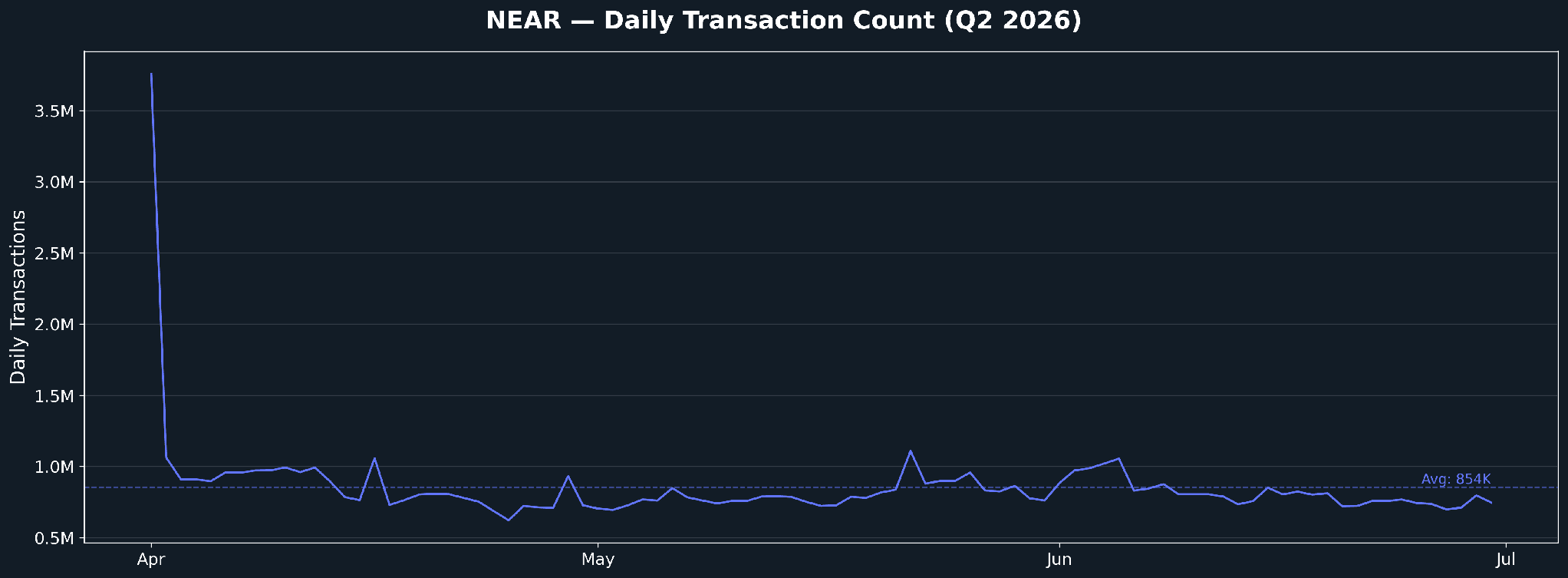
NEAR averaged approximately 854,000 daily transactions in Q2 2026, with a range spanning from roughly 622,000 to a peak of 3.76 million. The network showed a steady baseline of activity with periodic spikes, likely corresponding to protocol upgrade deployments (dynamic resharding went live in June), incentive program launches (NEAR@3.33), and broader market activity events. The peak transaction day may correlate with the dynamic resharding announcement in mid-May, which catalyzed a 27-30% price surge and likely drove heightened onchain activity.

Daily Active Addresses

Daily Active Addresses

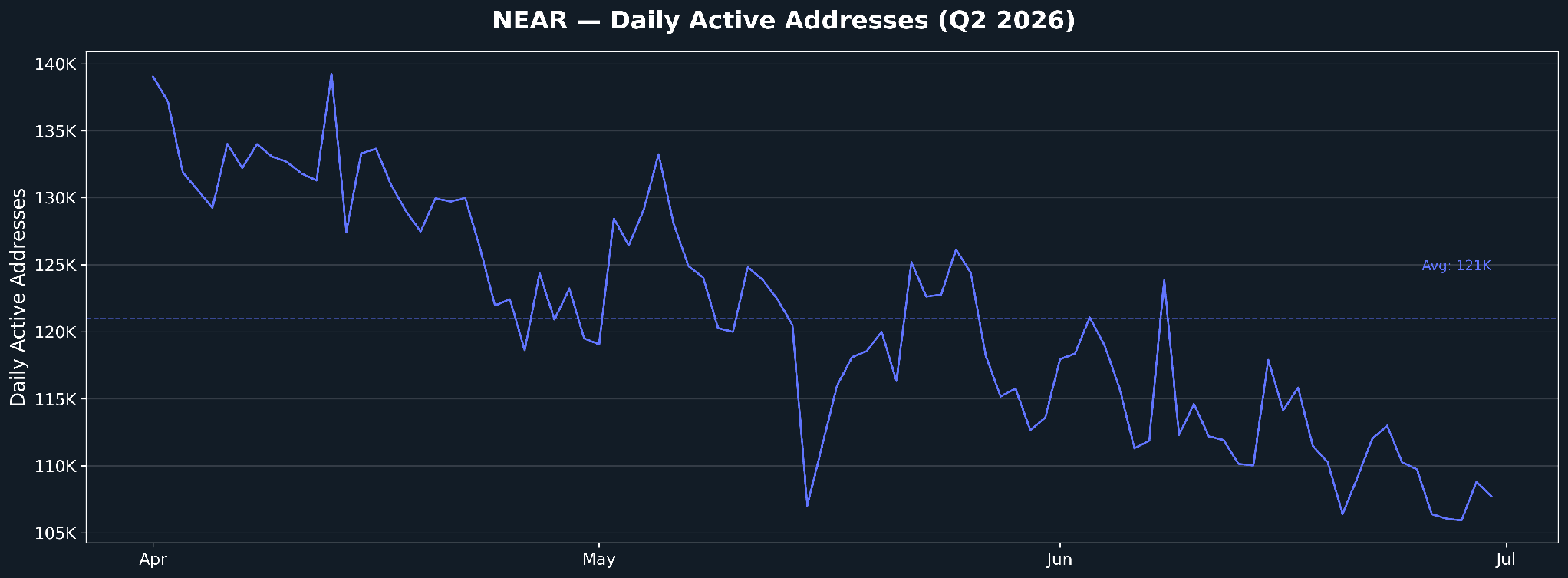
NEAR averaged approximately 121,000 daily active addresses in Q2 2026, ranging from 106,000 to 139,000. This relatively stable band suggests a consistent core user base rather than speculative spikes, with organic growth driven by integrations such as SimpleSwap and Ledger rather than one-time airdrop-driven activity. The narrow range of daily active addresses compared to the wider transaction count range indicates that usage intensity per user varies more than the user count itself.

Top Entities by Transactions

Transactions by Entity

Top Entities by Users


Users by Entity

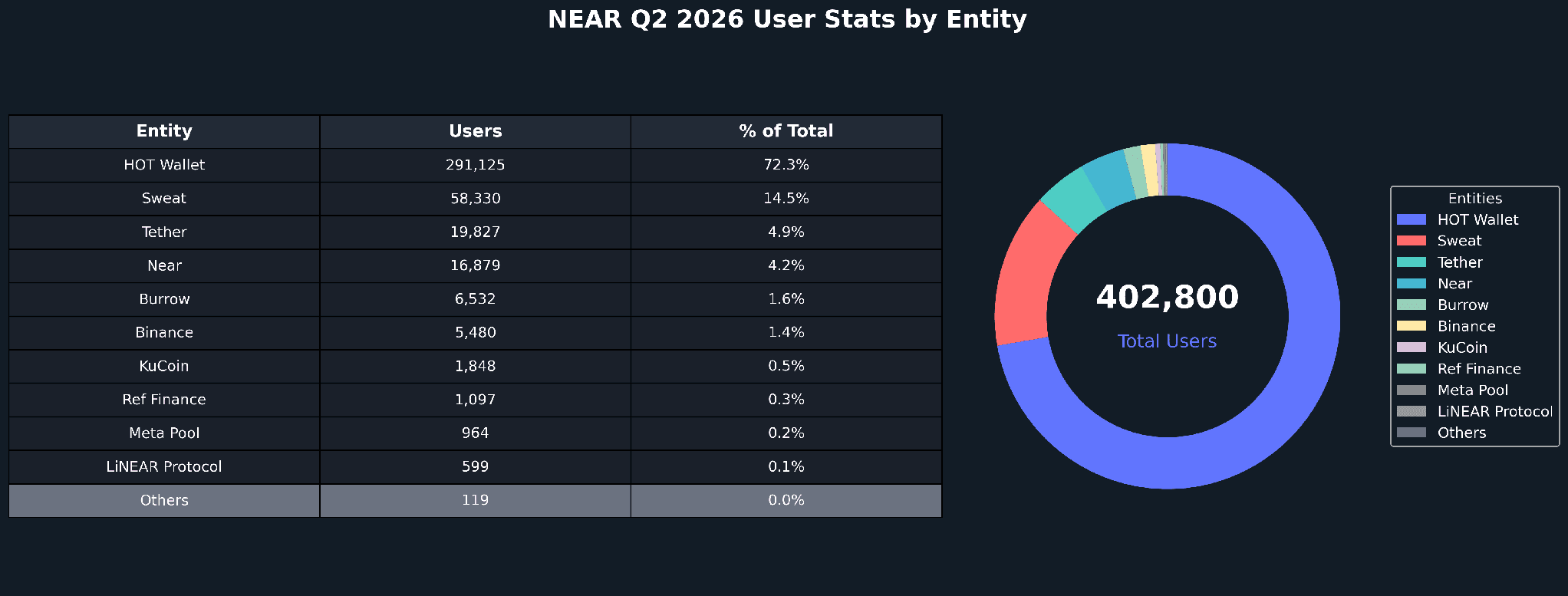
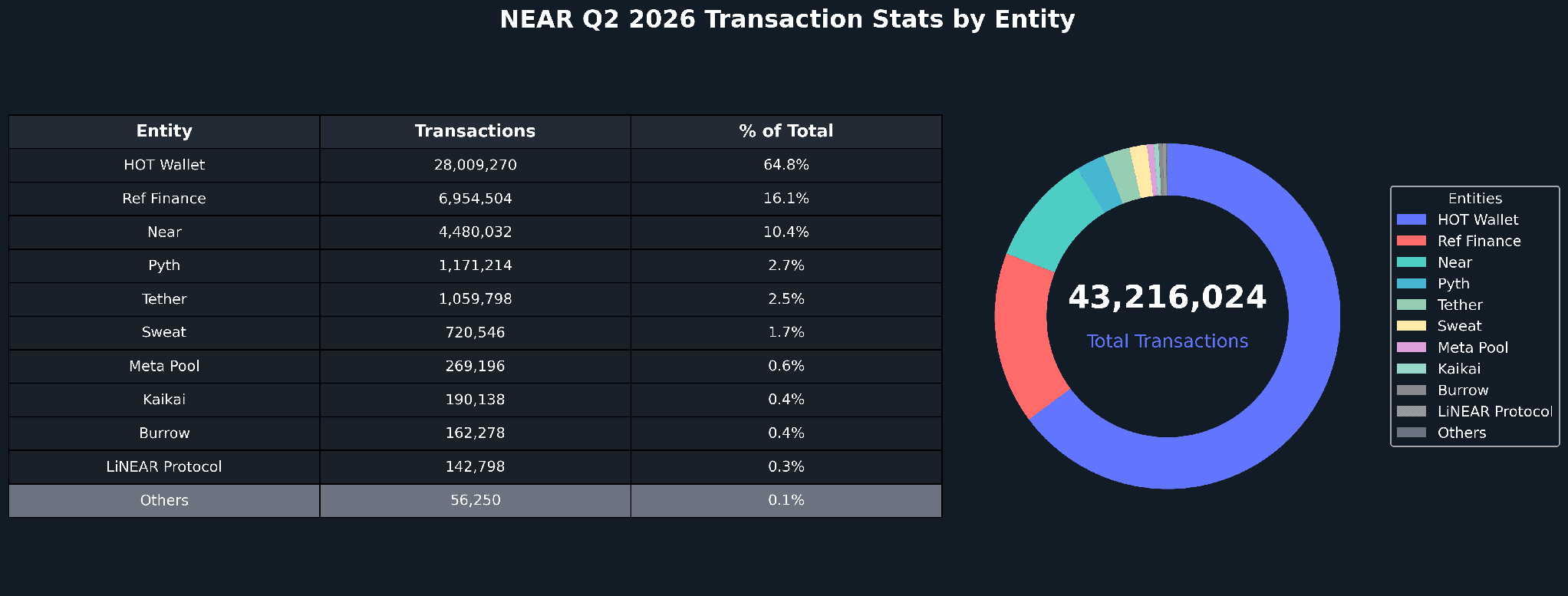
Total Q2 2026 transactions reached 43.2 million across approximately 403,000 unique users. HOT Wallet dominated the transaction count with 28 million transactions (roughly 65% of total), though this represents a 26.9% decline quarter-over-quarter, suggesting some normalization of HOT-related activity. Despite its outsized transaction share, HOT Wallet’s user count of 291,000 indicates high per-user transaction frequency, characteristic of a gaming or social application with high-frequency micro-transactions. Ref Finance, NEAR’s leading DEX (now part of the merged RHEA Finance), generated 6.95 million transactions, reflecting sustained DeFi activity. Native NEAR operations accounted for 4.48 million transactions, while Pyth oracle contributed 1.17 million transactions as price feed infrastructure. Tether’s presence with 1.06 million transactions and 19,800 users highlights growing stablecoin activity on the network, consistent with NEAR’s strategic emphasis on stablecoin infrastructure through Intents.

Closing Thoughts

Q2 2026 represented a quarter of significant technical execution for NEAR Protocol. The launch of dynamic resharding delivered on one of the core promises of the original Nightshade sharding design, giving NEAR elastic horizontal scaling capabilities that few other layer-1 protocols have achieved in production. Combined with the SPICE preview targeting 200ms block times and the addition of post-quantum signing, NEAR is positioning its base layer to support the throughput, latency, and security requirements of an AI-driven onchain economy. These are not theoretical research directions but protocol changes shipping to mainnet or approaching testnet readiness within the quarter.

On the product side, the maturation of Confidential Intents from launch (Q1 2026) to detailed technical disclosure and a structured incentive program in Q2 represents a deliberate effort to differentiate NEAR’s cross-chain DeFi offering. Privacy in DeFi has historically been associated with either fully opaque privacy chains or complex ZK-based solutions with poor user experience. NEAR’s approach of using a private shard with TEE infrastructure offers a pragmatic middle ground that supports institutional compliance through selective disclosure while still preventing the MEV and frontrunning problems that push large traders toward centralized exchanges.

The partnership strategy of embedding NEAR Intents into established platforms like SimpleSwap (10 million users) and Ledger Wallet continues a pattern of distribution-first growth rather than building new user interfaces from scratch. This approach leverages existing user bases and trust relationships, potentially accelerating adoption of intent-based cross-chain execution as a default experience rather than a niche feature. Looking ahead, the activation of SPICE, continued growth of Confidential Intents TVL toward the $70 million milestone target, and the broader rollout of post-quantum cryptography will be key metrics to track in Q3 2026.

NEAR Protocol Q2 2026 Report

Written by

Read Time

10 min read

Posted on

Overview

NEAR Protocol is a layer-1 blockchain built on a sharded proof-of-stake architecture originally described in the 2019 Nightshade whitepaper. The protocol is designed for high throughput, low latency, and developer accessibility, with a particular emphasis on chain abstraction and cross-chain interoperability through its Intents system. NEAR's account model uses human-readable account names rather than raw cryptographic addresses, supporting features such as key rotation and multi-key access that distinguish it from address-locked chains. In late 2025, the protocol reached 1 million transactions per second in a publicly verifiable benchmark, shipped stateless validation, and expanded from 6 to 9 mainnet shards. NEAR Intents, launched in late 2024, has grown to facilitate over $22 billion in cumulative cross-chain swap volume across 35+ blockchains.

Q2 2026 was defined less by new infrastructure than by that infrastructure starting to generate measurable revenue: NEAR's protocol fee capture rate rose from an 11.5% lifetime average to 30.5% over the trailing 30 days, and confidential Intents TVL crossed $30 million, with 42% of near.com's swap volume now running privately by default.

Key Developments: Q2 2026

  • Dynamic resharding launched as part of network upgrade v2.13, enabling NEAR to automatically split hot shards and merge underused ones based on real-time demand, completing the protocol’s long-standing vision of fully elastic horizontal scaling

  • SPICE (Separation of Consensus and Execution) previewed as the next major protocol upgrade, targeting 200ms block times (3x faster than current 600ms) and sub-half-second finality on the roadmap to Nightshade 3.0

  • Post-quantum signing (FIPS-204 / ML-DSA) added to the protocol, making NEAR one of the first major L1s to ship a NIST-approved quantum-resistant signing scheme, with testnet availability by end of Q2

  • Confidential Intents architecture detailed publicly, showing how a private shard with TEE-based bridge enables MEV-resistant, frontrunning-proof cross-chain DeFi with selective disclosure for compliance

  • NEAR@3.33 milestone incentive program launched, distributing 333,333 milestone tokens to Confidential Swap users conditional on Confidential Intents TVL reaching $70 million and NEAR VWAP sustaining above $3.33

  • SimpleSwap integrated NEAR Intents, bringing intent-based cross-chain execution to a platform with over 10 million users, 2,800+ supported assets, and availability on web, iOS, and Android

  • Ledger Wallet’s upgraded UI showcased NEAR Intents integration via SwapKit, enabling hardware-secured cross-chain swaps across 30+ chains with on-device confirmation

  • Near launched a new revenue dashboard tracking protocol revenue and other key metrics like, front-end fees, quote improvement, private agreements, and partner channels. It gives the fee switch a verifiable data layer, letting capture rate and revenue figures be seen. 

Ecosystem

Protocol Upgrades and Scalability

  • Dynamic Resharding: NEAR shipped one of the most significant protocol upgrades in its history with dynamic resharding, arriving as part of network upgrade v2.13. The upgrade enables the protocol to monitor each shard’s state size in real time and automatically split shards that cross a capacity threshold or merge underutilized ones, all without human coordination or governance voting. This capability is especially relevant for AI-driven workloads on NEAR, where inference payments and agent-to-agent bidding can produce unpredictable demand spikes that require elastic capacity. Dynamic resharding represents the culmination of years of iterative sharding upgrades since the original Nightshade design in 2019, progressing through Simple Nightshade, Phase 1 resharding, and stateless validation. The NEP was approved by subject-matter experts and the protocol working group. The announcement catalyzed a 27-30% surge in the NEAR token price within 24 hours, reflecting market recognition of the technical milestone.

  • SPICE: Separation of Consensus and Execution: The Near One team previewed SPICE, the next major upgrade on the path to Nightshade 3.0, which will decouple the consensus layer from transaction execution entirely. Under the current architecture, validators must execute transactions before reaching consensus on a block; SPICE removes this dependency, allowing consensus to proceed in parallel with execution. The practical impact is a reduction in block times from 600ms to approximately 200ms, with Defuse Labs CEO Alex Shevchenko estimating final confirmation times of approximately 0.4 seconds, exceeding Visa’s standard of roughly 3 seconds. SPICE is described as the biggest fundamental architectural change since the 2024 Stateless Validation update. The upgrade is designed to support the emerging AI agent economy on NEAR, where sub-second settlement enables autonomous agent-to-agent transactions and complex multi-step operations.

  • Post-Quantum Cryptography: NEAR became one of the first major layer-1 blockchains to add a NIST-approved post-quantum signing scheme, FIPS-204 (ML-DSA, also known as Dilithium), a lattice-based algorithm. NEAR’s account model is uniquely suited for this transition because accounts use human-readable IDs decoupled from cryptography, with rotatable access keys rather than being bound to a single keypair. This means any NEAR user can upgrade to quantum-safe keys via a simple key rotation transaction without creating a new account. The Near One team is collaborating with Ledger and other hardware wallet builders to support the larger key and signature sizes required by post-quantum schemes. Separately, the Defuse team is developing quantum-safe Chain Signatures to protect NEAR Intents users operating across 35+ chains, and NEAR is researching a seed-phrase-based zero-knowledge proof mechanism that could allow rightful owners to prove asset ownership even after quantum computers break current cryptographic assumptions.

Privacy and Confidential Infrastructure

  • Confidential Intents Technical Architecture: NEAR published a detailed technical breakdown of Confidential Intents, its privacy layer for cross-chain DeFi. The system operates through a dedicated private shard run by decentralized, independent permissioned validators connected to NEAR mainnet via a Trusted Execution Environment (TEE) bridge. When users toggle into confidential mode on near.com, their transactions execute within this private shard, keeping token pairs, order sizes, direction, and timing hidden from the public chain. This design prevents MEV extraction, frontrunning, and strategy copying that occur when transaction data is publicly visible. Unlike zero-knowledge-based privacy systems that require complex client-side proof generation, NEAR’s approach leverages TEE hardware for confidential execution while maintaining cryptographic integrity and verifiable settlement. A live demonstration showed Alex Shevchenko sending 0.1 ETH from a NEAR confidential account to the Ethereum Foundation on Ethereum, with the ETH arriving as a standard transfer bearing no visible onchain link to the NEAR sender. The system supports selective disclosure and auditable execution for institutional compliance.

  • NEAR@3.33 Milestone Incentive Program: NEAR launched a growth incentive program directly tied to Confidential Intents adoption metrics. Drop 1 will distribute 333,333 milestone tokens to eligible Confidential Swap users once aggregate Confidential Intents TVL reaches $70 million, up from approximately $26.65 million at announcement (requiring roughly 2.6x growth). Milestone tokens are locked and non-transferable on arrival; they convert 1:1 into NEAR only if the token’s volume-weighted average price sustains at or above $3.33 for three consecutive days. A per-account cap ensures broad distribution across participants. The dual-condition structure (TVL milestone plus price threshold) is designed to align user incentives with genuine ecosystem growth rather than wash trading or short-term speculation, creating a flywheel where increased usage drives TVL targets while market confidence determines token conversion eligibility.

Partnerships and Integrations

  • SimpleSwap Integration: SimpleSwap, a self-custodial swap aggregator operational since 2018 with over 10 million users, integrated NEAR Intents into its liquidity provider network. The integration brings intent-based cross-chain execution to SimpleSwap’s platform, supporting over 2,800 assets and 3.2 million trading pairs across web, iOS, and Android. NEAR Intents operates as one of many liquidity providers within SimpleSwap’s aggregation engine, but introduces a structural difference: users declare a desired swap outcome (send asset X on chain A, receive asset Y on chain B), and a solver network competitively handles route selection, cross-chain settlement, and execution. Notably, NEAR Intents does not require a persistent wallet connection for cross-chain swaps, reducing friction relative to traditional bridge-based providers. For larger positions, solver competition provides pricing from a different source of depth than standard CEX or DEX liquidity.

  • Ledger Wallet UI Upgrade: Ledger Wallet shipped a redesigned UI that makes cross-chain swaps powered by NEAR Intents (via SwapKit) more accessible to hardware wallet users. Since the initial integration in fall 2025, the partnership has processed millions of dollars in cross-chain swap volume. The integration is carefully designed around Ledger’s hardware security model: route discovery and transaction construction happen off-device in the Ledger software, while signing occurs on the Ledger hardware device with destination address and amount displayed on the secure screen for user verification. Users can swap across 30+ supported chains without manual bridging, compare quotes from multiple providers inside Ledger Wallet, and confirm every transaction on-device. Most swaps complete in seconds to a few minutes depending on destination chain congestion. Ledger Wallet uses NEAR Intents to power cross-chain swaps and is working with NEAR to align hardware wallet security for the quantum era.

Onchain Data

Daily Transactions


Daily Transactions

NEAR averaged approximately 854,000 daily transactions in Q2 2026, with a range spanning from roughly 622,000 to a peak of 3.76 million. The network showed a steady baseline of activity with periodic spikes, likely corresponding to protocol upgrade deployments (dynamic resharding went live in June), incentive program launches (NEAR@3.33), and broader market activity events. The peak transaction day may correlate with the dynamic resharding announcement in mid-May, which catalyzed a 27-30% price surge and likely drove heightened onchain activity.

Daily Active Addresses


Daily Active Addresses

NEAR averaged approximately 121,000 daily active addresses in Q2 2026, ranging from 106,000 to 139,000. This relatively stable band suggests a consistent core user base rather than speculative spikes, with organic growth driven by integrations such as SimpleSwap and Ledger rather than one-time airdrop-driven activity. The narrow range of daily active addresses compared to the wider transaction count range indicates that usage intensity per user varies more than the user count itself.

Top Entities by Transactions


Transactions by Entity

Top Entities by Users


Users by Entity

Total Q2 2026 transactions reached 43.2 million across approximately 403,000 unique users. HOT Wallet dominated the transaction count with 28 million transactions (roughly 65% of total), though this represents a 26.9% decline quarter-over-quarter, suggesting some normalization of HOT-related activity. Despite its outsized transaction share, HOT Wallet’s user count of 291,000 indicates high per-user transaction frequency, characteristic of a gaming or social application with high-frequency micro-transactions. Ref Finance, NEAR’s leading DEX (now part of the merged RHEA Finance), generated 6.95 million transactions, reflecting sustained DeFi activity. Native NEAR operations accounted for 4.48 million transactions, while Pyth oracle contributed 1.17 million transactions as price feed infrastructure. Tether’s presence with 1.06 million transactions and 19,800 users highlights growing stablecoin activity on the network, consistent with NEAR’s strategic emphasis on stablecoin infrastructure through Intents.

Closing Thoughts

Q2 2026 represented a quarter of significant technical execution for NEAR Protocol. The launch of dynamic resharding delivered on one of the core promises of the original Nightshade sharding design, giving NEAR elastic horizontal scaling capabilities that few other layer-1 protocols have achieved in production. Combined with the SPICE preview targeting 200ms block times and the addition of post-quantum signing, NEAR is positioning its base layer to support the throughput, latency, and security requirements of an AI-driven onchain economy. These are not theoretical research directions but protocol changes shipping to mainnet or approaching testnet readiness within the quarter.

On the product side, the maturation of Confidential Intents from launch (Q1 2026) to detailed technical disclosure and a structured incentive program in Q2 represents a deliberate effort to differentiate NEAR’s cross-chain DeFi offering. Privacy in DeFi has historically been associated with either fully opaque privacy chains or complex ZK-based solutions with poor user experience. NEAR’s approach of using a private shard with TEE infrastructure offers a pragmatic middle ground that supports institutional compliance through selective disclosure while still preventing the MEV and frontrunning problems that push large traders toward centralized exchanges.

The partnership strategy of embedding NEAR Intents into established platforms like SimpleSwap (10 million users) and Ledger Wallet continues a pattern of distribution-first growth rather than building new user interfaces from scratch. This approach leverages existing user bases and trust relationships, potentially accelerating adoption of intent-based cross-chain execution as a default experience rather than a niche feature. Looking ahead, the activation of SPICE, continued growth of Confidential Intents TVL toward the $70 million milestone target, and the broader rollout of post-quantum cryptography will be key metrics to track in Q3 2026.

About the Author

Visit our socials

You may also like these

Related Posts

NEAR Protocol Q2 2026 Report

Written by

Read Time

10 min read

Posted on

Overview

NEAR Protocol is a layer-1 blockchain built on a sharded proof-of-stake architecture originally described in the 2019 Nightshade whitepaper. The protocol is designed for high throughput, low latency, and developer accessibility, with a particular emphasis on chain abstraction and cross-chain interoperability through its Intents system. NEAR's account model uses human-readable account names rather than raw cryptographic addresses, supporting features such as key rotation and multi-key access that distinguish it from address-locked chains. In late 2025, the protocol reached 1 million transactions per second in a publicly verifiable benchmark, shipped stateless validation, and expanded from 6 to 9 mainnet shards. NEAR Intents, launched in late 2024, has grown to facilitate over $22 billion in cumulative cross-chain swap volume across 35+ blockchains.

Q2 2026 was defined less by new infrastructure than by that infrastructure starting to generate measurable revenue: NEAR's protocol fee capture rate rose from an 11.5% lifetime average to 30.5% over the trailing 30 days, and confidential Intents TVL crossed $30 million, with 42% of near.com's swap volume now running privately by default.

Key Developments: Q2 2026

  • Dynamic resharding launched as part of network upgrade v2.13, enabling NEAR to automatically split hot shards and merge underused ones based on real-time demand, completing the protocol’s long-standing vision of fully elastic horizontal scaling

  • SPICE (Separation of Consensus and Execution) previewed as the next major protocol upgrade, targeting 200ms block times (3x faster than current 600ms) and sub-half-second finality on the roadmap to Nightshade 3.0

  • Post-quantum signing (FIPS-204 / ML-DSA) added to the protocol, making NEAR one of the first major L1s to ship a NIST-approved quantum-resistant signing scheme, with testnet availability by end of Q2

  • Confidential Intents architecture detailed publicly, showing how a private shard with TEE-based bridge enables MEV-resistant, frontrunning-proof cross-chain DeFi with selective disclosure for compliance

  • NEAR@3.33 milestone incentive program launched, distributing 333,333 milestone tokens to Confidential Swap users conditional on Confidential Intents TVL reaching $70 million and NEAR VWAP sustaining above $3.33

  • SimpleSwap integrated NEAR Intents, bringing intent-based cross-chain execution to a platform with over 10 million users, 2,800+ supported assets, and availability on web, iOS, and Android

  • Ledger Wallet’s upgraded UI showcased NEAR Intents integration via SwapKit, enabling hardware-secured cross-chain swaps across 30+ chains with on-device confirmation

  • Near launched a new revenue dashboard tracking protocol revenue and other key metrics like, front-end fees, quote improvement, private agreements, and partner channels. It gives the fee switch a verifiable data layer, letting capture rate and revenue figures be seen. 

Ecosystem

Protocol Upgrades and Scalability

  • Dynamic Resharding: NEAR shipped one of the most significant protocol upgrades in its history with dynamic resharding, arriving as part of network upgrade v2.13. The upgrade enables the protocol to monitor each shard’s state size in real time and automatically split shards that cross a capacity threshold or merge underutilized ones, all without human coordination or governance voting. This capability is especially relevant for AI-driven workloads on NEAR, where inference payments and agent-to-agent bidding can produce unpredictable demand spikes that require elastic capacity. Dynamic resharding represents the culmination of years of iterative sharding upgrades since the original Nightshade design in 2019, progressing through Simple Nightshade, Phase 1 resharding, and stateless validation. The NEP was approved by subject-matter experts and the protocol working group. The announcement catalyzed a 27-30% surge in the NEAR token price within 24 hours, reflecting market recognition of the technical milestone.

  • SPICE: Separation of Consensus and Execution: The Near One team previewed SPICE, the next major upgrade on the path to Nightshade 3.0, which will decouple the consensus layer from transaction execution entirely. Under the current architecture, validators must execute transactions before reaching consensus on a block; SPICE removes this dependency, allowing consensus to proceed in parallel with execution. The practical impact is a reduction in block times from 600ms to approximately 200ms, with Defuse Labs CEO Alex Shevchenko estimating final confirmation times of approximately 0.4 seconds, exceeding Visa’s standard of roughly 3 seconds. SPICE is described as the biggest fundamental architectural change since the 2024 Stateless Validation update. The upgrade is designed to support the emerging AI agent economy on NEAR, where sub-second settlement enables autonomous agent-to-agent transactions and complex multi-step operations.

  • Post-Quantum Cryptography: NEAR became one of the first major layer-1 blockchains to add a NIST-approved post-quantum signing scheme, FIPS-204 (ML-DSA, also known as Dilithium), a lattice-based algorithm. NEAR’s account model is uniquely suited for this transition because accounts use human-readable IDs decoupled from cryptography, with rotatable access keys rather than being bound to a single keypair. This means any NEAR user can upgrade to quantum-safe keys via a simple key rotation transaction without creating a new account. The Near One team is collaborating with Ledger and other hardware wallet builders to support the larger key and signature sizes required by post-quantum schemes. Separately, the Defuse team is developing quantum-safe Chain Signatures to protect NEAR Intents users operating across 35+ chains, and NEAR is researching a seed-phrase-based zero-knowledge proof mechanism that could allow rightful owners to prove asset ownership even after quantum computers break current cryptographic assumptions.

Privacy and Confidential Infrastructure

  • Confidential Intents Technical Architecture: NEAR published a detailed technical breakdown of Confidential Intents, its privacy layer for cross-chain DeFi. The system operates through a dedicated private shard run by decentralized, independent permissioned validators connected to NEAR mainnet via a Trusted Execution Environment (TEE) bridge. When users toggle into confidential mode on near.com, their transactions execute within this private shard, keeping token pairs, order sizes, direction, and timing hidden from the public chain. This design prevents MEV extraction, frontrunning, and strategy copying that occur when transaction data is publicly visible. Unlike zero-knowledge-based privacy systems that require complex client-side proof generation, NEAR’s approach leverages TEE hardware for confidential execution while maintaining cryptographic integrity and verifiable settlement. A live demonstration showed Alex Shevchenko sending 0.1 ETH from a NEAR confidential account to the Ethereum Foundation on Ethereum, with the ETH arriving as a standard transfer bearing no visible onchain link to the NEAR sender. The system supports selective disclosure and auditable execution for institutional compliance.

  • NEAR@3.33 Milestone Incentive Program: NEAR launched a growth incentive program directly tied to Confidential Intents adoption metrics. Drop 1 will distribute 333,333 milestone tokens to eligible Confidential Swap users once aggregate Confidential Intents TVL reaches $70 million, up from approximately $26.65 million at announcement (requiring roughly 2.6x growth). Milestone tokens are locked and non-transferable on arrival; they convert 1:1 into NEAR only if the token’s volume-weighted average price sustains at or above $3.33 for three consecutive days. A per-account cap ensures broad distribution across participants. The dual-condition structure (TVL milestone plus price threshold) is designed to align user incentives with genuine ecosystem growth rather than wash trading or short-term speculation, creating a flywheel where increased usage drives TVL targets while market confidence determines token conversion eligibility.

Partnerships and Integrations

  • SimpleSwap Integration: SimpleSwap, a self-custodial swap aggregator operational since 2018 with over 10 million users, integrated NEAR Intents into its liquidity provider network. The integration brings intent-based cross-chain execution to SimpleSwap’s platform, supporting over 2,800 assets and 3.2 million trading pairs across web, iOS, and Android. NEAR Intents operates as one of many liquidity providers within SimpleSwap’s aggregation engine, but introduces a structural difference: users declare a desired swap outcome (send asset X on chain A, receive asset Y on chain B), and a solver network competitively handles route selection, cross-chain settlement, and execution. Notably, NEAR Intents does not require a persistent wallet connection for cross-chain swaps, reducing friction relative to traditional bridge-based providers. For larger positions, solver competition provides pricing from a different source of depth than standard CEX or DEX liquidity.

  • Ledger Wallet UI Upgrade: Ledger Wallet shipped a redesigned UI that makes cross-chain swaps powered by NEAR Intents (via SwapKit) more accessible to hardware wallet users. Since the initial integration in fall 2025, the partnership has processed millions of dollars in cross-chain swap volume. The integration is carefully designed around Ledger’s hardware security model: route discovery and transaction construction happen off-device in the Ledger software, while signing occurs on the Ledger hardware device with destination address and amount displayed on the secure screen for user verification. Users can swap across 30+ supported chains without manual bridging, compare quotes from multiple providers inside Ledger Wallet, and confirm every transaction on-device. Most swaps complete in seconds to a few minutes depending on destination chain congestion. Ledger Wallet uses NEAR Intents to power cross-chain swaps and is working with NEAR to align hardware wallet security for the quantum era.

Onchain Data

Daily Transactions


Daily Transactions

NEAR averaged approximately 854,000 daily transactions in Q2 2026, with a range spanning from roughly 622,000 to a peak of 3.76 million. The network showed a steady baseline of activity with periodic spikes, likely corresponding to protocol upgrade deployments (dynamic resharding went live in June), incentive program launches (NEAR@3.33), and broader market activity events. The peak transaction day may correlate with the dynamic resharding announcement in mid-May, which catalyzed a 27-30% price surge and likely drove heightened onchain activity.

Daily Active Addresses


Daily Active Addresses

NEAR averaged approximately 121,000 daily active addresses in Q2 2026, ranging from 106,000 to 139,000. This relatively stable band suggests a consistent core user base rather than speculative spikes, with organic growth driven by integrations such as SimpleSwap and Ledger rather than one-time airdrop-driven activity. The narrow range of daily active addresses compared to the wider transaction count range indicates that usage intensity per user varies more than the user count itself.

Top Entities by Transactions


Transactions by Entity

Top Entities by Users


Users by Entity

Total Q2 2026 transactions reached 43.2 million across approximately 403,000 unique users. HOT Wallet dominated the transaction count with 28 million transactions (roughly 65% of total), though this represents a 26.9% decline quarter-over-quarter, suggesting some normalization of HOT-related activity. Despite its outsized transaction share, HOT Wallet’s user count of 291,000 indicates high per-user transaction frequency, characteristic of a gaming or social application with high-frequency micro-transactions. Ref Finance, NEAR’s leading DEX (now part of the merged RHEA Finance), generated 6.95 million transactions, reflecting sustained DeFi activity. Native NEAR operations accounted for 4.48 million transactions, while Pyth oracle contributed 1.17 million transactions as price feed infrastructure. Tether’s presence with 1.06 million transactions and 19,800 users highlights growing stablecoin activity on the network, consistent with NEAR’s strategic emphasis on stablecoin infrastructure through Intents.

Closing Thoughts

Q2 2026 represented a quarter of significant technical execution for NEAR Protocol. The launch of dynamic resharding delivered on one of the core promises of the original Nightshade sharding design, giving NEAR elastic horizontal scaling capabilities that few other layer-1 protocols have achieved in production. Combined with the SPICE preview targeting 200ms block times and the addition of post-quantum signing, NEAR is positioning its base layer to support the throughput, latency, and security requirements of an AI-driven onchain economy. These are not theoretical research directions but protocol changes shipping to mainnet or approaching testnet readiness within the quarter.

On the product side, the maturation of Confidential Intents from launch (Q1 2026) to detailed technical disclosure and a structured incentive program in Q2 represents a deliberate effort to differentiate NEAR’s cross-chain DeFi offering. Privacy in DeFi has historically been associated with either fully opaque privacy chains or complex ZK-based solutions with poor user experience. NEAR’s approach of using a private shard with TEE infrastructure offers a pragmatic middle ground that supports institutional compliance through selective disclosure while still preventing the MEV and frontrunning problems that push large traders toward centralized exchanges.

The partnership strategy of embedding NEAR Intents into established platforms like SimpleSwap (10 million users) and Ledger Wallet continues a pattern of distribution-first growth rather than building new user interfaces from scratch. This approach leverages existing user bases and trust relationships, potentially accelerating adoption of intent-based cross-chain execution as a default experience rather than a niche feature. Looking ahead, the activation of SPICE, continued growth of Confidential Intents TVL toward the $70 million milestone target, and the broader rollout of post-quantum cryptography will be key metrics to track in Q3 2026.
About the Author

You may also like these

Related Posts