Mantle Q1 2026 Report

Written by

Read Time

10 min read

Posted on

Overview

Mantle is an Ethereum Layer-2 network that became the first OP Stack L2 to launch as a ZK Validity Rollup, powered by Succinct’s SP1 zkVM. The network positions itself as a premier distribution layer for institutions and TradFi to connect with onchain liquidity and real-world assets. With over $4B in community-owned assets and anchored by $MNT within Bybit, Mantle’s ecosystem includes core products like mETH, fBTC, and MI4 alongside partners such as Ethena USDe and Ondo USDY.

Q1 2026 was headlined by the landmark Aave integration reaching $1 billion in total market size in just 19 days — one of the fastest lending market ramps in DeFi history. Broader DeFi TVL hit an all-time high of over $755 million with a 66% weekly increase. Technical upgrades included the transition to Ethereum blobs as the primary data availability layer, enabled by Ethereum's Fusaka upgrade, marking Mantle's evolution from a Validium-based configuration to a full Ethereum ZK rollup architecture secured directly by Ethereum.

Key Developments: Q1 2026

  • Mantle had some major infrastructure updates for AI/AI agents including ERC 8183 update via Virtual protocol, skills and scaffolds, and a mainnet sepolia upgrade. These new upgrades allow for more trustless agentic commerce, create a new fee model, unify multiple OP Stack forks into one clean activation. The skills and scaffolds enable faster Mantle integration, execute Mantle-related tasks with precision, and operate reliably across any connected workflow.

  • Mantle’s Aave integration crossed $1 billion in total market size within just 19 days of launch, making it one of the fastest-growing Aave markets in the protocol’s history. The milestone was fueled by over $200 million in organic capital inflows during a single weekend, signaling strong institutional and retail demand for lending infrastructure on the network. The speed of capital deployment suggests that pent-up demand for institutional-grade lending on Mantle was substantial — capital allocators were waiting for a trusted lending protocol to deploy on the network before committing significant assets. The Aave integration specifically supports Mantle’s core ecosystem assets including fBTC (wrapped Bitcoin), MNT, USDT0, sUSDe, USDC, and more, enabling leveraged yield strategies that were previously not possible on the network. 

  • Mantle’s DeFi Total Value Locked surged to a new all-time high of over $755 million, marking a 66% weekly increase driven primarily by the Aave launch. The network now ranks within the top 3 Layer-2 solutions by TVL at over $1.2 billion locked across its ecosystem in Q1. This positions Mantle as Ethereum’s largest L2 with ZK proofs, having transitioned from an optimistic rollup to a ZK Validity Rollup powered by Succinct’s SP1 zkVM — the first OP Stack L2 to make this transition. The ZK architecture enables faster settlement, safer execution, and more efficient capital flow compared to the 7-day challenge period of optimistic rollups. 

  • Mantle remains committed to its EigenLayer partnership, continuing to utilise EigenCloud for specialised use cases including perpetuals, prediction markets, AI agent infrastructure, and ecosystem shared security through the mETH protocol — where verifiable compute and crypto-economic security provide a competitive edge beyond what standard blob-based DA requires. Together, the Ethereum blob transition and continued EigenLayer collaboration position Mantle as one of the most architecturally advanced Layer 2 networks on Ethereum, combining the security of a ZK rollup with the flexibility of modular infrastructure.

  • Mantle became one of the first Ethereum Layer 2 networks to bring tokenized equities to onchain liquidity through the live integration of xStocks in collaboration with Bybit and Flowdesk. Tradable via Fluxion, Mantle's native DEX, the integration enables users to access TSLAx, NVDAx, AAPLx, METAx, GOOGLx, MSTRx, HOODx, SPYx, QQQx, and CRCLx onchain, 24/7, globally. As one of the few chains with direct deposit and withdrawal support for xStocks exclusively through Bybit, the integration reinforces Mantle's position as the premier distribution layer for real-world assets.

  • Mantle Vault on Bybit Onchain Earn, powered by Aave and CIAN, surpassed $200M TVL during Q1 — a new all-time high. The product requires no onchain experience from users, with deposits flowing through Bybit's familiar interface while Mantle's infrastructure handles execution onchain. The milestone validates Mantle's CeDeFi thesis: institutional-grade yield, accessible at consumer scale.

Ecosystem

DeFi

  • The Aave lending market on Mantle drove the majority of Q1 DeFi growth, anchoring a DeFi ecosystem that now includes over 200+ decentralized applications across DeFi, gaming, and NFTs. The Aave integration specifically supports Mantle’s core ecosystem assets fBTC (wrapped Bitcoin providing BTC exposure within the Mantle ecosystem) — enabling leveraged yield strategies that were previously not possible on the network. The ecosystem is structurally anchored by $MNT within Bybit, providing deep centralized exchange liquidity as a foundation for onchain DeFi activity. The speed of capital deployment into Aave ($1B in 19 days, with $200M flowing in over a single weekend) suggests that pent-up demand for institutional-grade lending on Mantle was substantial — capital allocators were waiting for a trusted lending protocol to deploy on the network before committing significant assets. 

Institutional Distribution

  • Mantle’s ZK Validity Rollup architecture (first OP Stack L2 to achieve this transition via Succinct’s SP1 zkVM) underpins the institutional proposition with faster settlement, safer execution, and more efficient capital flow compared to the 7-day challenge period of optimistic rollups. 

AI on Mantle

  • Alongside with infra update for AI/Agents on Mantle, protocols are deploying their AI related products on Mantle. Mantle is rapidly pushing toward a fully “agent-native” DeFi and trading ecosystem, where complex onchain workflows are abstracted into simple, chat-based interactions. Through integrations like Pieverse’s Purr-Fect Claw, Mantle AI Agent Skills are now embedded directly into everyday messaging platforms (WhatsApp, Line, Kakao), allowing users to access ecosystem workflows conversationally. At the same time, Infinit Labs has introduced “prompt-to-DeFi,” enabling users to execute core DeFi actions—such as swaps via LI.FI and lending/borrowing via Aave—through a single prompt, significantly reducing friction in navigating the DeFi stack.

  • On the trading side, Mantle is integrating intelligence directly into execution environments. The partnership between Elfa AI and Fluxion brings real-time social sentiment, asset data, and trade insights into the trading interface itself, eliminating the need to context-switch across tools. This reflects a broader shift toward vertically integrated, AI-assisted trading terminals where discovery, analysis, and execution converge.

  • Underpinning these product releases is a broader ecosystem push: Mantle is actively cultivating an “agentic economy.” Initiatives like “When AI Meets Mantle” focus on empowering creators to build with AI, while the Turing Test Hackathon (starting with ClawHack) signals continued investment in expanding agent infrastructure and use cases. Collectively, these updates position Mantle as building toward a seamless, AI-driven user experience where on-chain actions, insights, and interfaces are unified through agents.

Community Layer

  • Mantle Squad functioned as the core “distribution layer” behind Mantle’s ecosystem growth in Q1, mobilizing a global network of builders, creators, and community operators to amplify key milestones during a challenging market environment. Across three major initiatives, the program engaged 2,800+ contributors spanning 20+ countries, generating over 5.8M impressions while supporting major ecosystem achievements like $755M DeFi TVL, rapid Aave deposit growth, and early AI agent identity standards. Structurally, Mantle Squad operates through creator bounties (driving high-quality, context-specific content tied to product launches), regional teams (Korea, Japan, China) executing localized growth strategies, and on-the-ground representation at major conferences—effectively blending online distribution with real-world presence. This model validated that decentralized, incentive-aligned community participation can scale narrative control and ecosystem awareness more effectively than centralized marketing, and Mantle is now doubling down by expanding the program globally (including the Americas) and evolving toward more continuous, event-driven content cycles. 

Onchain Data

Daily Transactions
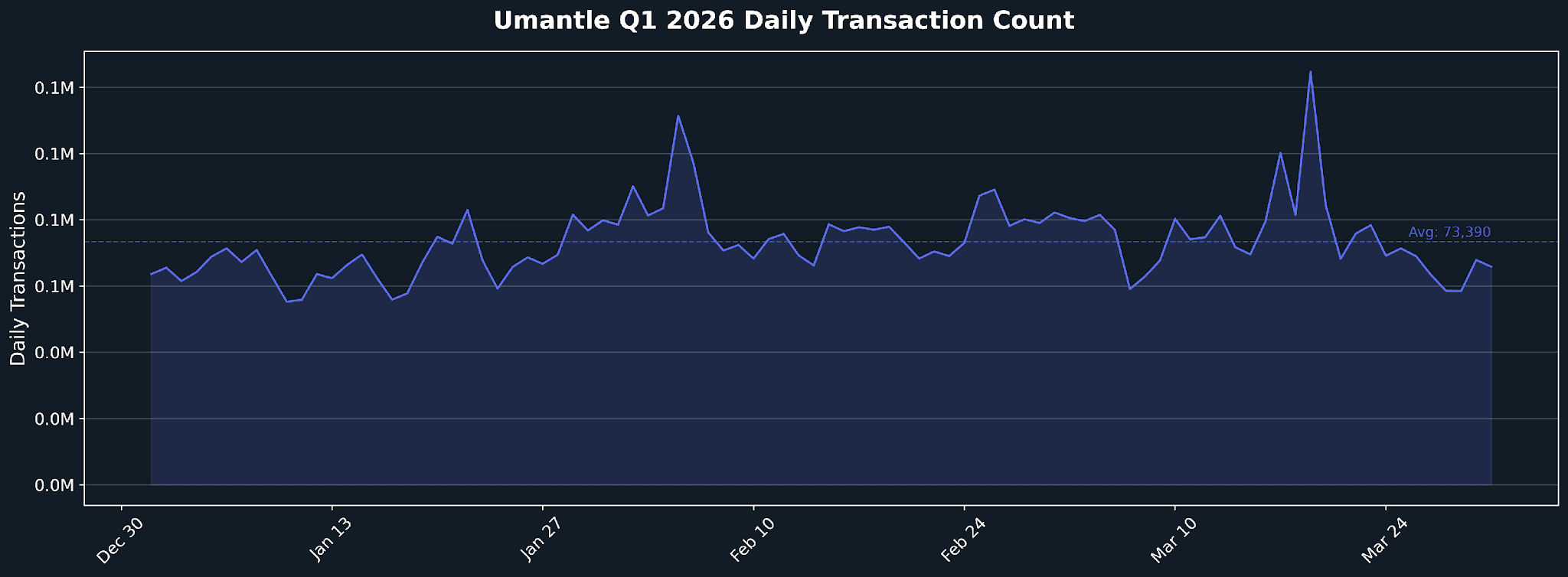

mantle_q1_2026_transactions_timeseries.png

Mantle processed approximately 6.6 million transactions across Q1 2026, averaging 73,390 daily transactions. This reflects Mantle’s positioning as a value-dense L2 where individual transactions tend to carry higher economic weight (lending operations, RWA interactions, institutional flows) rather than high-frequency micro-transactions.

Daily Active Addresses

mantle_q1_2026_users_timeseries.png

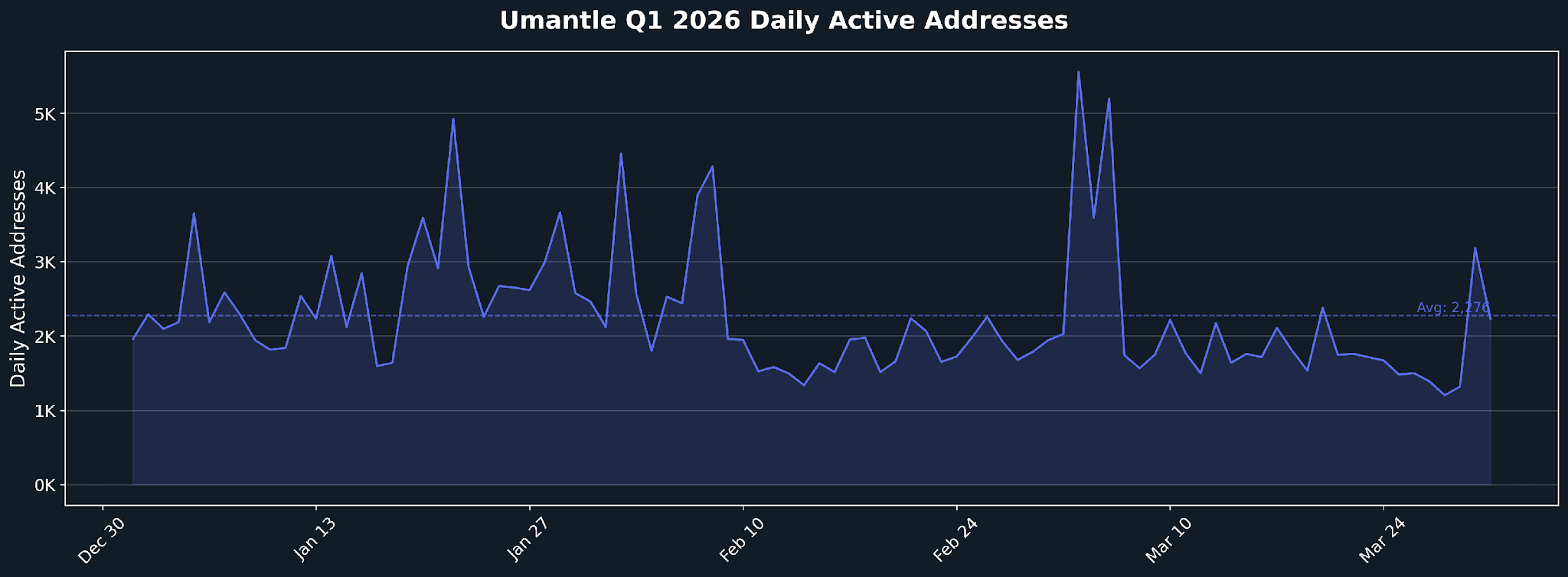
Mantle averaged approximately 2,276 daily active addresses during Q1 2026, with a peak of 5,557. The active address count, combined with the $1B+ Aave market and $755M+ TVL, suggests a network with relatively concentrated but high-value institutional usage, consistent with Mantle’s positioning as an institutional-grade L2.

Top Entities by Users and Transactions

mantle_q1_2026_transactions_by_entity.png


mantle_q1_2026_users_by_entity.png

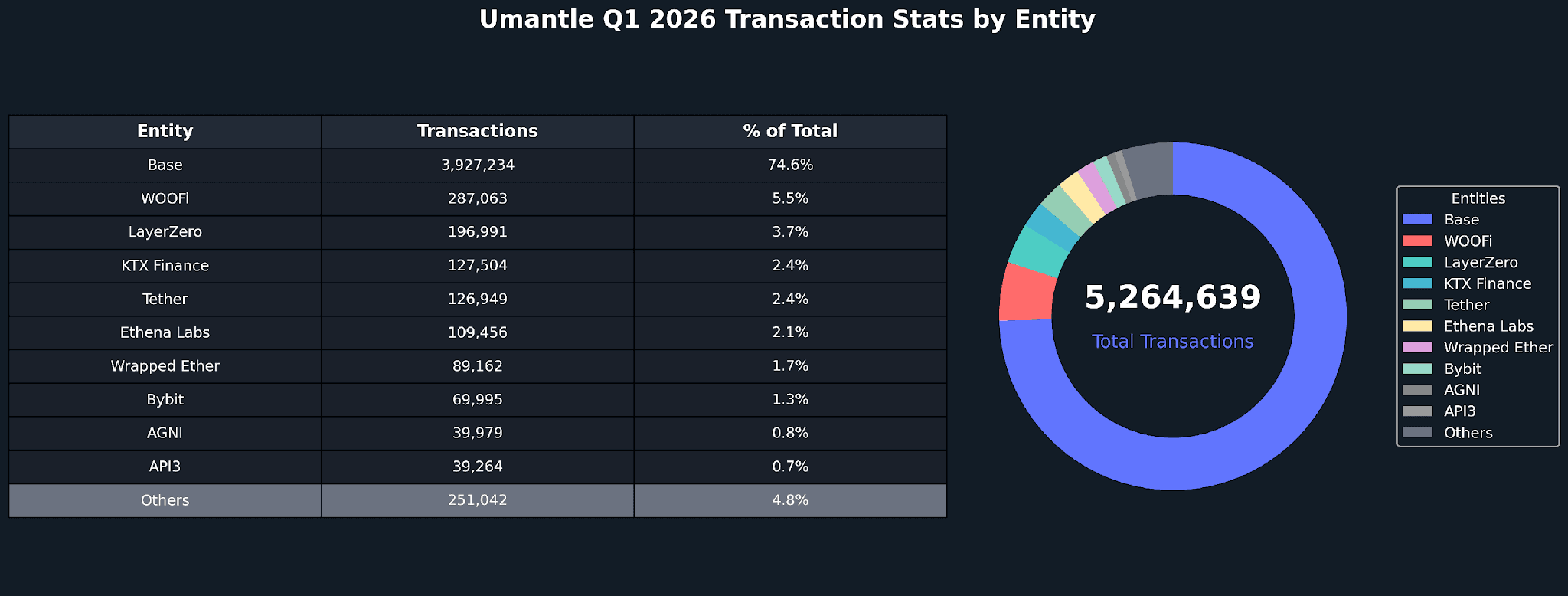
Mantle’s entity landscape in Q1 2026 was led by Base with 3.93M transactions, reflecting cross-chain bridge and infrastructure activity. WOOFi (287K txs) and LayerZero (197K txs) followed as the next largest transaction generators, both indicating cross-chain liquidity infrastructure activity. KTX Finance contributed 127.5K transactions as a notable DeFi presence. By unique users, Tether led with 23.9K unique addresses, followed by Bybit with 12.5K users and 70K transactions — reflecting the network’s structural anchor within the Bybit ecosystem. Native Mantle operations accounted for 21.7K transactions and 10.9K users. Wrapped Ether (89.2K txs, 9.4K users), USDC (17.9K txs, 6.3K users), and Ethena Labs (109.5K txs, 1.4K users) highlighted stablecoin and yield-bearing asset activity consistent with Mantle’s institutional DeFi positioning. Lending protocols Lendle (15.3K txs, 3.2K users) and INIT Capital (4.8K txs, 822 users) complemented the Aave deployment, while DEXs AGNI (40K txs), Uniswap (19.7K txs), Trader Joe (14.5K txs), and Merchant Moe (13.5K txs, 2.4K users) provided decentralized trading infrastructure across the ecosystem.

Mantle ranked second globally for net bridge inflows in the week of April 27, recording $367M in net inflows over seven days according to DefiLlama — behind only Solana at $553M and ahead of BSC at $244M. The figure reflects growing conviction from capital allocators in Mantle's infrastructure, with meaningful liquidity migrating onto the distribution layer from competing chains. For a network positioning itself as the institutional gateway between TradFi and onchain liquidity, second-ranked bridge inflows globally is a signal worth noting.

AI and the Turing Test Hackathon

Q1 2026 also marked Mantle's first major move into agentic AI infrastructure with the announcement and launch of the Turing Test Hackathon — a two-phase, $120,000 AI competition designed to establish the first onchain benchmark for autonomous AI agents. Co-hosted with Bybit, Byreal, and Blockchain for Good Alliance, and co-supported by DoraHacks and HackQuest, the hackathon reflects Mantle's conviction that the next wave of onchain activity will be driven not just by human participants but by autonomous agents executing financial strategies at speed. Phase 1, ClawHack, launched on April 15 with a $20,000 prize pool, deploying 200+ AI agents across Mantle's DeFi ecosystem, including Merchant Moe, Agni Finance, and Fluxion, via RealClaw, the AI agent trading platform built by Byreal on Mantle. Every agent decision and outcome is recorded permanently onchain via the ERC-8004 agent identity standard, establishing a verifiable, decentralised record of AI performance. Phase 2, AI Awakening, follows with a $100,000 prize pool across six tracks, a Human vs. AI format, and a live judging finale featuring representatives from Allora Network, Animoca Brands, Nansen, Caladan, Hashed, and the University of Hong Kong. The Turing Test Hackathon positions Mantle not only as the distribution layer for real-world assets but as the infrastructure home for the agentic economy — where AI agents hold wallets, execute strategies, and generate verifiable onchain value.

Closing Thoughts

Q1 2026 validated Mantle's institutional DeFi thesis across multiple fronts and opened up a massive push to be the native home to AI/AI agents. The Aave $1B milestone in 19 days demonstrated that institutional capital moves rapidly when it finds the right infrastructure. The xStocks integration proved that tokenized equities have a natural home on the distribution layer. The Turing Test Hackathon launch signalled that the next phase of onchain activity will be driven by autonomous agents, not just human participants. Further, Mantle is converging toward a fully agent-driven crypto ecosystem, where execution, intelligence, and distribution are unified through AI interfaces and community-powered growth. By combining prompt-based DeFi, embedded trading intelligence, and a globally scaled creator network, Mantle is building both the infrastructure and the narrative layer for an emerging agentic economy. With Mantle Vault at $200M TVL and stablecoins at a new ATH, Mantle enters Q2 2026 with its strongest institutional stack to date and a clear roadmap for what comes next.

Mantle Q1 2026 Report

Written by

Read Time

10 min read

Posted on

Overview

Mantle is an Ethereum Layer-2 network that became the first OP Stack L2 to launch as a ZK Validity Rollup, powered by Succinct’s SP1 zkVM. The network positions itself as a premier distribution layer for institutions and TradFi to connect with onchain liquidity and real-world assets. With over $4B in community-owned assets and anchored by $MNT within Bybit, Mantle’s ecosystem includes core products like mETH, fBTC, and MI4 alongside partners such as Ethena USDe and Ondo USDY.

Q1 2026 was headlined by the landmark Aave integration reaching $1 billion in total market size in just 19 days — one of the fastest lending market ramps in DeFi history. Broader DeFi TVL hit an all-time high of over $755 million with a 66% weekly increase. Technical upgrades included the transition to Ethereum blobs as the primary data availability layer, enabled by Ethereum's Fusaka upgrade, marking Mantle's evolution from a Validium-based configuration to a full Ethereum ZK rollup architecture secured directly by Ethereum.

Key Developments: Q1 2026

  • Mantle had some major infrastructure updates for AI/AI agents including ERC 8183 update via Virtual protocol, skills and scaffolds, and a mainnet sepolia upgrade. These new upgrades allow for more trustless agentic commerce, create a new fee model, unify multiple OP Stack forks into one clean activation. The skills and scaffolds enable faster Mantle integration, execute Mantle-related tasks with precision, and operate reliably across any connected workflow.

  • Mantle’s Aave integration crossed $1 billion in total market size within just 19 days of launch, making it one of the fastest-growing Aave markets in the protocol’s history. The milestone was fueled by over $200 million in organic capital inflows during a single weekend, signaling strong institutional and retail demand for lending infrastructure on the network. The speed of capital deployment suggests that pent-up demand for institutional-grade lending on Mantle was substantial — capital allocators were waiting for a trusted lending protocol to deploy on the network before committing significant assets. The Aave integration specifically supports Mantle’s core ecosystem assets including fBTC (wrapped Bitcoin), MNT, USDT0, sUSDe, USDC, and more, enabling leveraged yield strategies that were previously not possible on the network. 

  • Mantle’s DeFi Total Value Locked surged to a new all-time high of over $755 million, marking a 66% weekly increase driven primarily by the Aave launch. The network now ranks within the top 3 Layer-2 solutions by TVL at over $1.2 billion locked across its ecosystem in Q1. This positions Mantle as Ethereum’s largest L2 with ZK proofs, having transitioned from an optimistic rollup to a ZK Validity Rollup powered by Succinct’s SP1 zkVM — the first OP Stack L2 to make this transition. The ZK architecture enables faster settlement, safer execution, and more efficient capital flow compared to the 7-day challenge period of optimistic rollups. 

  • Mantle remains committed to its EigenLayer partnership, continuing to utilise EigenCloud for specialised use cases including perpetuals, prediction markets, AI agent infrastructure, and ecosystem shared security through the mETH protocol — where verifiable compute and crypto-economic security provide a competitive edge beyond what standard blob-based DA requires. Together, the Ethereum blob transition and continued EigenLayer collaboration position Mantle as one of the most architecturally advanced Layer 2 networks on Ethereum, combining the security of a ZK rollup with the flexibility of modular infrastructure.

  • Mantle became one of the first Ethereum Layer 2 networks to bring tokenized equities to onchain liquidity through the live integration of xStocks in collaboration with Bybit and Flowdesk. Tradable via Fluxion, Mantle's native DEX, the integration enables users to access TSLAx, NVDAx, AAPLx, METAx, GOOGLx, MSTRx, HOODx, SPYx, QQQx, and CRCLx onchain, 24/7, globally. As one of the few chains with direct deposit and withdrawal support for xStocks exclusively through Bybit, the integration reinforces Mantle's position as the premier distribution layer for real-world assets.

  • Mantle Vault on Bybit Onchain Earn, powered by Aave and CIAN, surpassed $200M TVL during Q1 — a new all-time high. The product requires no onchain experience from users, with deposits flowing through Bybit's familiar interface while Mantle's infrastructure handles execution onchain. The milestone validates Mantle's CeDeFi thesis: institutional-grade yield, accessible at consumer scale.

Ecosystem

DeFi

  • The Aave lending market on Mantle drove the majority of Q1 DeFi growth, anchoring a DeFi ecosystem that now includes over 200+ decentralized applications across DeFi, gaming, and NFTs. The Aave integration specifically supports Mantle’s core ecosystem assets fBTC (wrapped Bitcoin providing BTC exposure within the Mantle ecosystem) — enabling leveraged yield strategies that were previously not possible on the network. The ecosystem is structurally anchored by $MNT within Bybit, providing deep centralized exchange liquidity as a foundation for onchain DeFi activity. The speed of capital deployment into Aave ($1B in 19 days, with $200M flowing in over a single weekend) suggests that pent-up demand for institutional-grade lending on Mantle was substantial — capital allocators were waiting for a trusted lending protocol to deploy on the network before committing significant assets. 

Institutional Distribution

  • Mantle’s ZK Validity Rollup architecture (first OP Stack L2 to achieve this transition via Succinct’s SP1 zkVM) underpins the institutional proposition with faster settlement, safer execution, and more efficient capital flow compared to the 7-day challenge period of optimistic rollups. 

AI on Mantle

  • Alongside with infra update for AI/Agents on Mantle, protocols are deploying their AI related products on Mantle. Mantle is rapidly pushing toward a fully “agent-native” DeFi and trading ecosystem, where complex onchain workflows are abstracted into simple, chat-based interactions. Through integrations like Pieverse’s Purr-Fect Claw, Mantle AI Agent Skills are now embedded directly into everyday messaging platforms (WhatsApp, Line, Kakao), allowing users to access ecosystem workflows conversationally. At the same time, Infinit Labs has introduced “prompt-to-DeFi,” enabling users to execute core DeFi actions—such as swaps via LI.FI and lending/borrowing via Aave—through a single prompt, significantly reducing friction in navigating the DeFi stack.

  • On the trading side, Mantle is integrating intelligence directly into execution environments. The partnership between Elfa AI and Fluxion brings real-time social sentiment, asset data, and trade insights into the trading interface itself, eliminating the need to context-switch across tools. This reflects a broader shift toward vertically integrated, AI-assisted trading terminals where discovery, analysis, and execution converge.

  • Underpinning these product releases is a broader ecosystem push: Mantle is actively cultivating an “agentic economy.” Initiatives like “When AI Meets Mantle” focus on empowering creators to build with AI, while the Turing Test Hackathon (starting with ClawHack) signals continued investment in expanding agent infrastructure and use cases. Collectively, these updates position Mantle as building toward a seamless, AI-driven user experience where on-chain actions, insights, and interfaces are unified through agents.

Community Layer

  • Mantle Squad functioned as the core “distribution layer” behind Mantle’s ecosystem growth in Q1, mobilizing a global network of builders, creators, and community operators to amplify key milestones during a challenging market environment. Across three major initiatives, the program engaged 2,800+ contributors spanning 20+ countries, generating over 5.8M impressions while supporting major ecosystem achievements like $755M DeFi TVL, rapid Aave deposit growth, and early AI agent identity standards. Structurally, Mantle Squad operates through creator bounties (driving high-quality, context-specific content tied to product launches), regional teams (Korea, Japan, China) executing localized growth strategies, and on-the-ground representation at major conferences—effectively blending online distribution with real-world presence. This model validated that decentralized, incentive-aligned community participation can scale narrative control and ecosystem awareness more effectively than centralized marketing, and Mantle is now doubling down by expanding the program globally (including the Americas) and evolving toward more continuous, event-driven content cycles. 

Onchain Data

Daily Transactions


mantle_q1_2026_transactions_timeseries.png

Mantle processed approximately 6.6 million transactions across Q1 2026, averaging 73,390 daily transactions. This reflects Mantle’s positioning as a value-dense L2 where individual transactions tend to carry higher economic weight (lending operations, RWA interactions, institutional flows) rather than high-frequency micro-transactions.

Daily Active Addresses


mantle_q1_2026_users_timeseries.png

Mantle averaged approximately 2,276 daily active addresses during Q1 2026, with a peak of 5,557. The active address count, combined with the $1B+ Aave market and $755M+ TVL, suggests a network with relatively concentrated but high-value institutional usage, consistent with Mantle’s positioning as an institutional-grade L2.

Top Entities by Users and Transactions

mantle_q1_2026_transactions_by_entity.png


mantle_q1_2026_users_by_entity.png

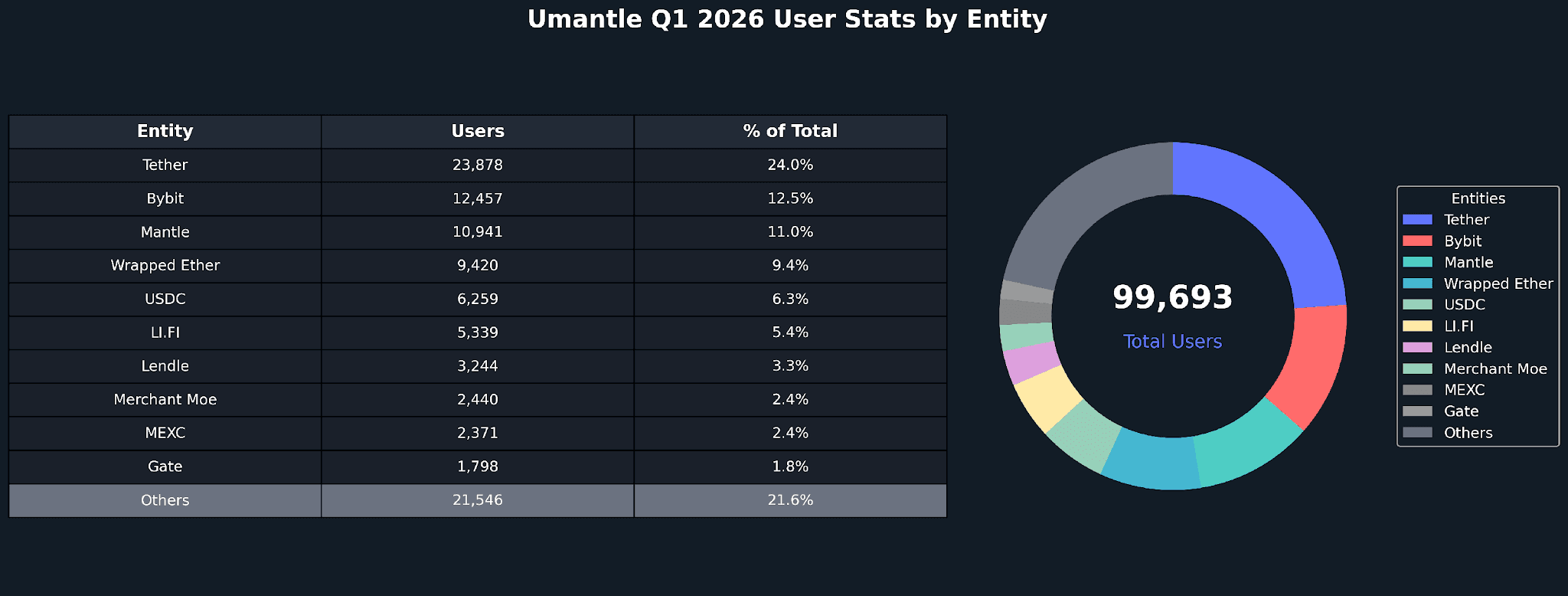
Mantle’s entity landscape in Q1 2026 was led by Base with 3.93M transactions, reflecting cross-chain bridge and infrastructure activity. WOOFi (287K txs) and LayerZero (197K txs) followed as the next largest transaction generators, both indicating cross-chain liquidity infrastructure activity. KTX Finance contributed 127.5K transactions as a notable DeFi presence. By unique users, Tether led with 23.9K unique addresses, followed by Bybit with 12.5K users and 70K transactions — reflecting the network’s structural anchor within the Bybit ecosystem. Native Mantle operations accounted for 21.7K transactions and 10.9K users. Wrapped Ether (89.2K txs, 9.4K users), USDC (17.9K txs, 6.3K users), and Ethena Labs (109.5K txs, 1.4K users) highlighted stablecoin and yield-bearing asset activity consistent with Mantle’s institutional DeFi positioning. Lending protocols Lendle (15.3K txs, 3.2K users) and INIT Capital (4.8K txs, 822 users) complemented the Aave deployment, while DEXs AGNI (40K txs), Uniswap (19.7K txs), Trader Joe (14.5K txs), and Merchant Moe (13.5K txs, 2.4K users) provided decentralized trading infrastructure across the ecosystem.

Mantle ranked second globally for net bridge inflows in the week of April 27, recording $367M in net inflows over seven days according to DefiLlama — behind only Solana at $553M and ahead of BSC at $244M. The figure reflects growing conviction from capital allocators in Mantle's infrastructure, with meaningful liquidity migrating onto the distribution layer from competing chains. For a network positioning itself as the institutional gateway between TradFi and onchain liquidity, second-ranked bridge inflows globally is a signal worth noting.

AI and the Turing Test Hackathon

Q1 2026 also marked Mantle's first major move into agentic AI infrastructure with the announcement and launch of the Turing Test Hackathon — a two-phase, $120,000 AI competition designed to establish the first onchain benchmark for autonomous AI agents. Co-hosted with Bybit, Byreal, and Blockchain for Good Alliance, and co-supported by DoraHacks and HackQuest, the hackathon reflects Mantle's conviction that the next wave of onchain activity will be driven not just by human participants but by autonomous agents executing financial strategies at speed. Phase 1, ClawHack, launched on April 15 with a $20,000 prize pool, deploying 200+ AI agents across Mantle's DeFi ecosystem, including Merchant Moe, Agni Finance, and Fluxion, via RealClaw, the AI agent trading platform built by Byreal on Mantle. Every agent decision and outcome is recorded permanently onchain via the ERC-8004 agent identity standard, establishing a verifiable, decentralised record of AI performance. Phase 2, AI Awakening, follows with a $100,000 prize pool across six tracks, a Human vs. AI format, and a live judging finale featuring representatives from Allora Network, Animoca Brands, Nansen, Caladan, Hashed, and the University of Hong Kong. The Turing Test Hackathon positions Mantle not only as the distribution layer for real-world assets but as the infrastructure home for the agentic economy — where AI agents hold wallets, execute strategies, and generate verifiable onchain value.

Closing Thoughts

Q1 2026 validated Mantle's institutional DeFi thesis across multiple fronts and opened up a massive push to be the native home to AI/AI agents. The Aave $1B milestone in 19 days demonstrated that institutional capital moves rapidly when it finds the right infrastructure. The xStocks integration proved that tokenized equities have a natural home on the distribution layer. The Turing Test Hackathon launch signalled that the next phase of onchain activity will be driven by autonomous agents, not just human participants. Further, Mantle is converging toward a fully agent-driven crypto ecosystem, where execution, intelligence, and distribution are unified through AI interfaces and community-powered growth. By combining prompt-based DeFi, embedded trading intelligence, and a globally scaled creator network, Mantle is building both the infrastructure and the narrative layer for an emerging agentic economy. With Mantle Vault at $200M TVL and stablecoins at a new ATH, Mantle enters Q2 2026 with its strongest institutional stack to date and a clear roadmap for what comes next.

About the Author

Visit our socials

You may also like these

Related Posts

Mantle Q1 2026 Report

Written by

Read Time

10 min read

Posted on

Overview

Mantle is an Ethereum Layer-2 network that became the first OP Stack L2 to launch as a ZK Validity Rollup, powered by Succinct’s SP1 zkVM. The network positions itself as a premier distribution layer for institutions and TradFi to connect with onchain liquidity and real-world assets. With over $4B in community-owned assets and anchored by $MNT within Bybit, Mantle’s ecosystem includes core products like mETH, fBTC, and MI4 alongside partners such as Ethena USDe and Ondo USDY.

Q1 2026 was headlined by the landmark Aave integration reaching $1 billion in total market size in just 19 days — one of the fastest lending market ramps in DeFi history. Broader DeFi TVL hit an all-time high of over $755 million with a 66% weekly increase. Technical upgrades included the transition to Ethereum blobs as the primary data availability layer, enabled by Ethereum's Fusaka upgrade, marking Mantle's evolution from a Validium-based configuration to a full Ethereum ZK rollup architecture secured directly by Ethereum.

Key Developments: Q1 2026

  • Mantle had some major infrastructure updates for AI/AI agents including ERC 8183 update via Virtual protocol, skills and scaffolds, and a mainnet sepolia upgrade. These new upgrades allow for more trustless agentic commerce, create a new fee model, unify multiple OP Stack forks into one clean activation. The skills and scaffolds enable faster Mantle integration, execute Mantle-related tasks with precision, and operate reliably across any connected workflow.

  • Mantle’s Aave integration crossed $1 billion in total market size within just 19 days of launch, making it one of the fastest-growing Aave markets in the protocol’s history. The milestone was fueled by over $200 million in organic capital inflows during a single weekend, signaling strong institutional and retail demand for lending infrastructure on the network. The speed of capital deployment suggests that pent-up demand for institutional-grade lending on Mantle was substantial — capital allocators were waiting for a trusted lending protocol to deploy on the network before committing significant assets. The Aave integration specifically supports Mantle’s core ecosystem assets including fBTC (wrapped Bitcoin), MNT, USDT0, sUSDe, USDC, and more, enabling leveraged yield strategies that were previously not possible on the network. 

  • Mantle’s DeFi Total Value Locked surged to a new all-time high of over $755 million, marking a 66% weekly increase driven primarily by the Aave launch. The network now ranks within the top 3 Layer-2 solutions by TVL at over $1.2 billion locked across its ecosystem in Q1. This positions Mantle as Ethereum’s largest L2 with ZK proofs, having transitioned from an optimistic rollup to a ZK Validity Rollup powered by Succinct’s SP1 zkVM — the first OP Stack L2 to make this transition. The ZK architecture enables faster settlement, safer execution, and more efficient capital flow compared to the 7-day challenge period of optimistic rollups. 

  • Mantle remains committed to its EigenLayer partnership, continuing to utilise EigenCloud for specialised use cases including perpetuals, prediction markets, AI agent infrastructure, and ecosystem shared security through the mETH protocol — where verifiable compute and crypto-economic security provide a competitive edge beyond what standard blob-based DA requires. Together, the Ethereum blob transition and continued EigenLayer collaboration position Mantle as one of the most architecturally advanced Layer 2 networks on Ethereum, combining the security of a ZK rollup with the flexibility of modular infrastructure.

  • Mantle became one of the first Ethereum Layer 2 networks to bring tokenized equities to onchain liquidity through the live integration of xStocks in collaboration with Bybit and Flowdesk. Tradable via Fluxion, Mantle's native DEX, the integration enables users to access TSLAx, NVDAx, AAPLx, METAx, GOOGLx, MSTRx, HOODx, SPYx, QQQx, and CRCLx onchain, 24/7, globally. As one of the few chains with direct deposit and withdrawal support for xStocks exclusively through Bybit, the integration reinforces Mantle's position as the premier distribution layer for real-world assets.

  • Mantle Vault on Bybit Onchain Earn, powered by Aave and CIAN, surpassed $200M TVL during Q1 — a new all-time high. The product requires no onchain experience from users, with deposits flowing through Bybit's familiar interface while Mantle's infrastructure handles execution onchain. The milestone validates Mantle's CeDeFi thesis: institutional-grade yield, accessible at consumer scale.

Ecosystem

DeFi

  • The Aave lending market on Mantle drove the majority of Q1 DeFi growth, anchoring a DeFi ecosystem that now includes over 200+ decentralized applications across DeFi, gaming, and NFTs. The Aave integration specifically supports Mantle’s core ecosystem assets fBTC (wrapped Bitcoin providing BTC exposure within the Mantle ecosystem) — enabling leveraged yield strategies that were previously not possible on the network. The ecosystem is structurally anchored by $MNT within Bybit, providing deep centralized exchange liquidity as a foundation for onchain DeFi activity. The speed of capital deployment into Aave ($1B in 19 days, with $200M flowing in over a single weekend) suggests that pent-up demand for institutional-grade lending on Mantle was substantial — capital allocators were waiting for a trusted lending protocol to deploy on the network before committing significant assets. 

Institutional Distribution

  • Mantle’s ZK Validity Rollup architecture (first OP Stack L2 to achieve this transition via Succinct’s SP1 zkVM) underpins the institutional proposition with faster settlement, safer execution, and more efficient capital flow compared to the 7-day challenge period of optimistic rollups. 

AI on Mantle

  • Alongside with infra update for AI/Agents on Mantle, protocols are deploying their AI related products on Mantle. Mantle is rapidly pushing toward a fully “agent-native” DeFi and trading ecosystem, where complex onchain workflows are abstracted into simple, chat-based interactions. Through integrations like Pieverse’s Purr-Fect Claw, Mantle AI Agent Skills are now embedded directly into everyday messaging platforms (WhatsApp, Line, Kakao), allowing users to access ecosystem workflows conversationally. At the same time, Infinit Labs has introduced “prompt-to-DeFi,” enabling users to execute core DeFi actions—such as swaps via LI.FI and lending/borrowing via Aave—through a single prompt, significantly reducing friction in navigating the DeFi stack.

  • On the trading side, Mantle is integrating intelligence directly into execution environments. The partnership between Elfa AI and Fluxion brings real-time social sentiment, asset data, and trade insights into the trading interface itself, eliminating the need to context-switch across tools. This reflects a broader shift toward vertically integrated, AI-assisted trading terminals where discovery, analysis, and execution converge.

  • Underpinning these product releases is a broader ecosystem push: Mantle is actively cultivating an “agentic economy.” Initiatives like “When AI Meets Mantle” focus on empowering creators to build with AI, while the Turing Test Hackathon (starting with ClawHack) signals continued investment in expanding agent infrastructure and use cases. Collectively, these updates position Mantle as building toward a seamless, AI-driven user experience where on-chain actions, insights, and interfaces are unified through agents.

Community Layer

  • Mantle Squad functioned as the core “distribution layer” behind Mantle’s ecosystem growth in Q1, mobilizing a global network of builders, creators, and community operators to amplify key milestones during a challenging market environment. Across three major initiatives, the program engaged 2,800+ contributors spanning 20+ countries, generating over 5.8M impressions while supporting major ecosystem achievements like $755M DeFi TVL, rapid Aave deposit growth, and early AI agent identity standards. Structurally, Mantle Squad operates through creator bounties (driving high-quality, context-specific content tied to product launches), regional teams (Korea, Japan, China) executing localized growth strategies, and on-the-ground representation at major conferences—effectively blending online distribution with real-world presence. This model validated that decentralized, incentive-aligned community participation can scale narrative control and ecosystem awareness more effectively than centralized marketing, and Mantle is now doubling down by expanding the program globally (including the Americas) and evolving toward more continuous, event-driven content cycles. 

Onchain Data

Daily Transactions


mantle_q1_2026_transactions_timeseries.png

Mantle processed approximately 6.6 million transactions across Q1 2026, averaging 73,390 daily transactions. This reflects Mantle’s positioning as a value-dense L2 where individual transactions tend to carry higher economic weight (lending operations, RWA interactions, institutional flows) rather than high-frequency micro-transactions.

Daily Active Addresses


mantle_q1_2026_users_timeseries.png

Mantle averaged approximately 2,276 daily active addresses during Q1 2026, with a peak of 5,557. The active address count, combined with the $1B+ Aave market and $755M+ TVL, suggests a network with relatively concentrated but high-value institutional usage, consistent with Mantle’s positioning as an institutional-grade L2.

Top Entities by Users and Transactions


mantle_q1_2026_transactions_by_entity.png


mantle_q1_2026_users_by_entity.png

Mantle’s entity landscape in Q1 2026 was led by Base with 3.93M transactions, reflecting cross-chain bridge and infrastructure activity. WOOFi (287K txs) and LayerZero (197K txs) followed as the next largest transaction generators, both indicating cross-chain liquidity infrastructure activity. KTX Finance contributed 127.5K transactions as a notable DeFi presence. By unique users, Tether led with 23.9K unique addresses, followed by Bybit with 12.5K users and 70K transactions — reflecting the network’s structural anchor within the Bybit ecosystem. Native Mantle operations accounted for 21.7K transactions and 10.9K users. Wrapped Ether (89.2K txs, 9.4K users), USDC (17.9K txs, 6.3K users), and Ethena Labs (109.5K txs, 1.4K users) highlighted stablecoin and yield-bearing asset activity consistent with Mantle’s institutional DeFi positioning. Lending protocols Lendle (15.3K txs, 3.2K users) and INIT Capital (4.8K txs, 822 users) complemented the Aave deployment, while DEXs AGNI (40K txs), Uniswap (19.7K txs), Trader Joe (14.5K txs), and Merchant Moe (13.5K txs, 2.4K users) provided decentralized trading infrastructure across the ecosystem.

Mantle ranked second globally for net bridge inflows in the week of April 27, recording $367M in net inflows over seven days according to DefiLlama — behind only Solana at $553M and ahead of BSC at $244M. The figure reflects growing conviction from capital allocators in Mantle's infrastructure, with meaningful liquidity migrating onto the distribution layer from competing chains. For a network positioning itself as the institutional gateway between TradFi and onchain liquidity, second-ranked bridge inflows globally is a signal worth noting.

AI and the Turing Test Hackathon

Q1 2026 also marked Mantle's first major move into agentic AI infrastructure with the announcement and launch of the Turing Test Hackathon — a two-phase, $120,000 AI competition designed to establish the first onchain benchmark for autonomous AI agents. Co-hosted with Bybit, Byreal, and Blockchain for Good Alliance, and co-supported by DoraHacks and HackQuest, the hackathon reflects Mantle's conviction that the next wave of onchain activity will be driven not just by human participants but by autonomous agents executing financial strategies at speed. Phase 1, ClawHack, launched on April 15 with a $20,000 prize pool, deploying 200+ AI agents across Mantle's DeFi ecosystem, including Merchant Moe, Agni Finance, and Fluxion, via RealClaw, the AI agent trading platform built by Byreal on Mantle. Every agent decision and outcome is recorded permanently onchain via the ERC-8004 agent identity standard, establishing a verifiable, decentralised record of AI performance. Phase 2, AI Awakening, follows with a $100,000 prize pool across six tracks, a Human vs. AI format, and a live judging finale featuring representatives from Allora Network, Animoca Brands, Nansen, Caladan, Hashed, and the University of Hong Kong. The Turing Test Hackathon positions Mantle not only as the distribution layer for real-world assets but as the infrastructure home for the agentic economy — where AI agents hold wallets, execute strategies, and generate verifiable onchain value.

Closing Thoughts

Q1 2026 validated Mantle's institutional DeFi thesis across multiple fronts and opened up a massive push to be the native home to AI/AI agents. The Aave $1B milestone in 19 days demonstrated that institutional capital moves rapidly when it finds the right infrastructure. The xStocks integration proved that tokenized equities have a natural home on the distribution layer. The Turing Test Hackathon launch signalled that the next phase of onchain activity will be driven by autonomous agents, not just human participants. Further, Mantle is converging toward a fully agent-driven crypto ecosystem, where execution, intelligence, and distribution are unified through AI interfaces and community-powered growth. By combining prompt-based DeFi, embedded trading intelligence, and a globally scaled creator network, Mantle is building both the infrastructure and the narrative layer for an emerging agentic economy. With Mantle Vault at $200M TVL and stablecoins at a new ATH, Mantle enters Q2 2026 with its strongest institutional stack to date and a clear roadmap for what comes next.

About the Author

You may also like these

Related Posts