

Perpetual futures are the most traded product in crypto, and Hyperliquid is where an increasing share of that trading now happens onchain.
If you have never traded perps before, the jargon is the first wall: funding rates, mark price, cross-margin, liquidation. None of it is complicated once it is explained plainly. This guide covers the concepts you need before your first trade, how Hyperliquid perps work specifically, and the mistakes that end most beginners' accounts early.
One thing before we start: perps are leveraged instruments. They can multiply losses as easily as gains, and no guide removes that risk. Read this to understand the machine before you put money into it.
What Are Perpetual Futures?
A perpetual futures contract (a "perp") lets you speculate on an asset's price without holding the asset, using leverage, with no expiry date.
Traditional futures expire on a set date. Perps never do. Instead, a mechanism called the funding rate keeps the perp's price tethered to the real market price of the underlying asset indefinitely.
You can go long (profit if price rises) or short (profit if price falls). That flexibility, plus leverage, is why perps dominate crypto trading volume.
Key Concepts Before Your First Perps Trade
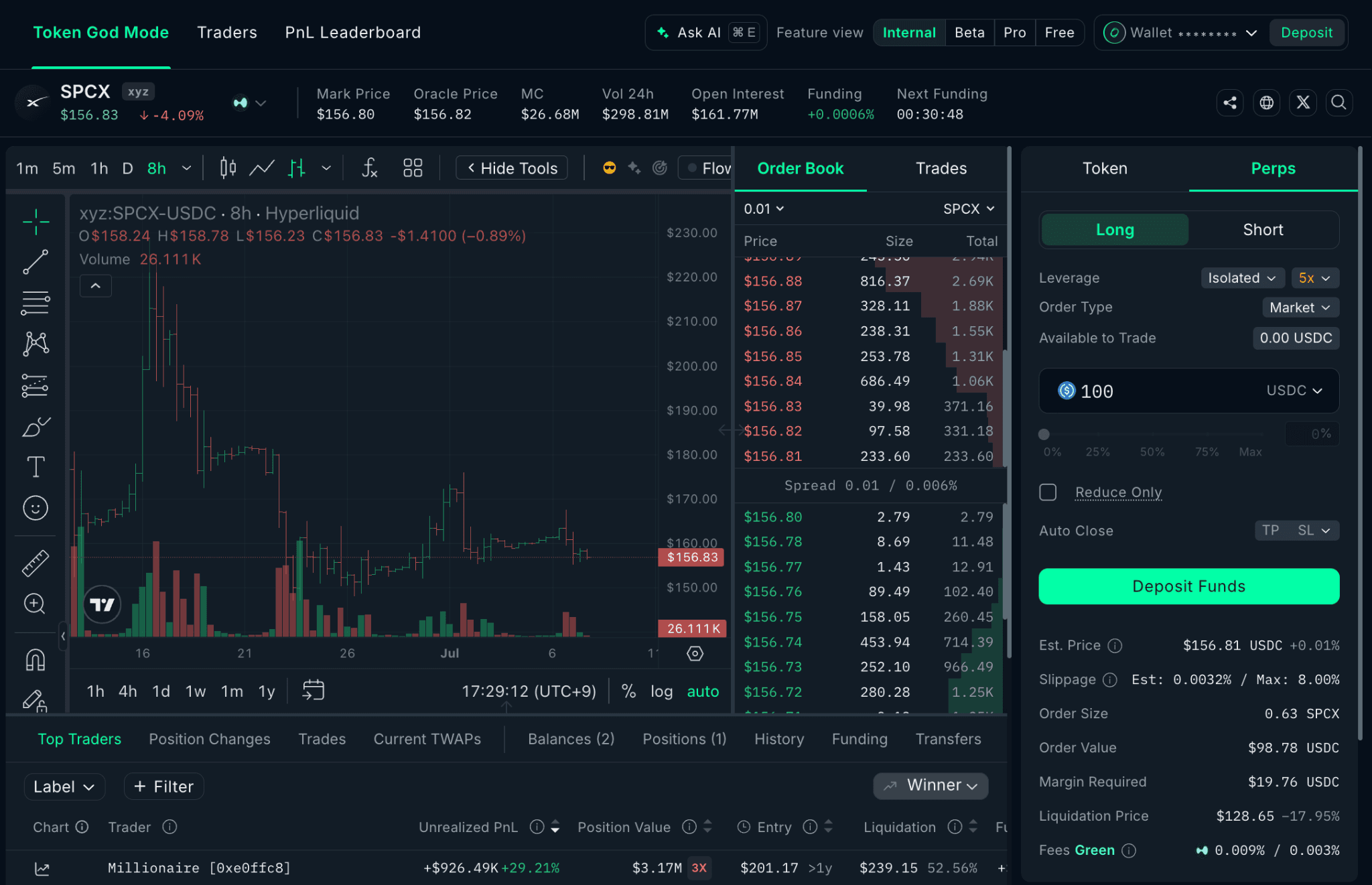
Leverage and margin
Margin is the collateral you post. Leverage multiplies your exposure relative to that collateral. With $100 of margin at 5x leverage, you control a $500 position: a 1% move in the asset becomes a 5% move in your equity, in either direction.
On Hyperliquid, positions are margined in USDC, and maximum leverage varies by market, up to 40x on the largest markets with lower caps on smaller ones. Beginners have no business anywhere near the maximum. Low single-digit leverage is where you learn.
Funding rates
Every hour, Hyperliquid exchanges a funding payment between longs and shorts. When the perp trades above the underlying's price, longs pay shorts, nudging the price back down. When it trades below, shorts pay longs.
Two practical implications: holding a position costs (or earns) money over time, and extreme funding is a crowding signal. When everyone is long and paying heavily for the privilege, squeezes become more likely.
Mark price and liquidation
Your position is valued against the mark price, an oracle-based fair price designed to resist manipulation, rather than the last traded price alone.
If losses eat too far into your margin, the position is liquidated: closed automatically to protect the system. Liquidation is the risk that defines perps. Before opening any position, know the exact price at which yours would be liquidated, and treat that number as non-negotiable information.
Cross-margin vs isolated margin
Isolated margin assigns specific collateral to one position; if it goes wrong, only that collateral is at risk. Cross-margin shares your whole account balance across positions, which is capital-efficient but means one bad trade can drain everything.
Hyperliquid supports both. Beginners should start isolated.
Open interest
Open interest (OI) is the total value of outstanding perp positions in a market. Rising OI means new money entering; falling OI means positions closing. Combined with price direction, it tells you whether a move is being built or unwound.
Why Beginners Learn on Hyperliquid
Hyperliquid has become the default venue for onchain perps for reasons covered fully in why traders are moving to Hyperliquid perpetuals. The short version for beginners:
No gas fees on orders, so you can place, adjust, and cancel without bleeding fees while you learn.
Deep liquidity on major markets, so small orders fill cleanly at fair prices.
Everything is public. Positions, liquidations, and funding are onchain. You can study how the market actually behaves, and with Nansen's Smart Money data, you can see how wallets with verified track records are positioned before you trade.
Self-custody. Your margin sits in a wallet you control, not an exchange's account.
How to Place Your First Hyperliquid Perps Trade
Fund a wallet with USDC. USDC is the margin asset for Hyperliquid perps. Only fund with an amount you can genuinely afford to lose entirely.
Pick a major market. Start with BTC or ETH perps. Deep books, tight spreads, and abundant analysis make them the sensible classroom. Ignore exotic markets for now.
Set isolated margin and low leverage. 2x to 3x maximum while learning. Your goal in the first months is education, not returns.
Check the context before entering. What is funding doing? Is open interest rising or falling? How are experienced wallets positioned? Our guide to trading Hyperliquid perps with Smart Money data walks through this exact checklist.
Place the order and set your exit rules. Know your invalidation point (where you admit the idea failed) and your liquidation price before you click. Use stop orders rather than promises to yourself.
Review every trade. Win or lose, write down why you entered, what happened, and what you would repeat. This habit compounds faster than any indicator.
Five Mistakes That End Beginner Accounts
Maximum leverage. High leverage means normal volatility liquidates you. Being right about direction does not matter if you are liquidated before the move.
No liquidation awareness. Opening a position without knowing its liquidation price is gambling, not trading.
Ignoring funding. Paying elevated hourly funding for weeks can turn a winning idea into a losing position.
Averaging down on losers. Adding margin to a failing leveraged trade converts a small controlled loss into an account-level one.
Trading illiquid markets first. Thin books mean bad fills, wild wicks, and liquidations that would not happen on majors.
FAQ: Perpetual Futures on Hyperliquid
What is a perpetual futures contract? A leveraged derivative with no expiry that tracks an underlying asset's price via funding payments. Traders use perps to go long or short with more exposure than their capital alone allows.
How much money do I need to start trading Hyperliquid perps? There is no meaningful minimum, and that is the point: start with a small amount you can afford to lose completely, because your first months are tuition.
What is a good leverage for beginners? As low as possible. 2x to 3x on isolated margin gives you the mechanics of perps without the hair-trigger liquidations. Leverage is a tool for sizing, not a shortcut to bigger wins.
How often is funding paid on Hyperliquid? Hourly. The rate updates continuously based on the gap between the perp price and the underlying index price.
Can I lose more than I deposit? With isolated margin, your loss is capped at the collateral assigned to that position. With cross-margin, a position can draw on your whole account balance, which is why beginners should start isolated.
How is Hyperliquid different from trading perps on a centralized exchange? Execution quality is comparable, but Hyperliquid is non-custodial (you hold your funds), has no per-trade gas fees, and makes all positioning data public onchain.
Conclusion
Perpetual futures reward preparation and punish improvisation.
Learn the mechanics, respect leverage, start small on major markets, and use the transparency Hyperliquid gives you: the positioning of the entire market, including its most consistently profitable wallets, is public.