

Overview
Avalanche is a high-performance blockchain platform designed for speed, scalability, and customization. Its unique multi-chain architecture separates the network into specialized chains — the C-Chain (contract execution), P-Chain (platform coordination and staking), and X-Chain (asset transfers) while enabling developers to launch sovereign Layer 1 blockchains (formerly called subnets) with their own validators, virtual machines, and rulesets. Powered by the Avalanche consensus protocol, the network achieves sub-second finality with high throughput and low fees, making it a leading infrastructure choice for DeFi, enterprise applications, real-world asset tokenization, and institutional settlement.
Q2 by the Numbers
C-Chain processed a record 235.6M transactions in Q2, including 76.4M in April, 82.6M in May, and 76.7M in June, marking its seventh consecutive quarter of growth. Stablecoin transfer volume reached $84.4B, while C-Chain DEX volume totaled $8.7B. The ecosystem also recorded $1.65B in RWAs and $21M in protocol fees. Median C-Chain transaction fees fell 99.6% YoY to $0.000014, while block times have remained below one second since April, twice as fast as before Granite.
In Q2 2026, Avalanche’s ecosystem narrative sharpened around three themes: payments infrastructure, institutional adoption in Asia, and sovereign L1 expansion.
Key Developments: Q2 2026
Avalanche launched the Avalanche Payments Collective, a formalized network of 28 organizations building payment infrastructure on the network. Members include Franklin Templeton, VanEck, WisdomTree, Agora, Paxos, Rain, Axiym, Ethena, Anchorage Digital, Tassat, Nonco, and others spanning settlement, stablecoins, treasury infrastructure, foreign exchange, asset management, compliance, and global payouts. The collective’s members collectively support payment flows reaching more than 150 countries, 96 currencies, and approximately 22 billion payout endpoints across bank accounts, cards, and mobile wallets.
The Avalanche Foundation launched a research grants program offering up to $50,000 per grant for original academic work examining cryptoasset pricing and valuation and validator economics. An independent six-member selection committee was assembled, including Emin Gün Sirer (Ava Labs CEO), Campbell Harvey (Duke University professor and former American Finance Association president), Agostino Capponi (Columbia University, Director of the Center for Digital Finance), and Fahad Saleh (University of Florida). Grants are disbursed over 12 months, and grantees are invited to present at the 3rd Crafting the Cryptoeconomy Conference at Columbia University in fall 2026.
Avalanche Foundation is redesigning how it allocates resources and capital to better meet the needs of builders. It introduces a three-tier user verification system (unregistered, connected, and verified) and power-weighted scoring to give smaller projects proportionally larger rewards. The program has distributed over $100,000 to builders in previous rounds. Round 4 offers a reward pool of up to 10,000 AVAX with 5x multipliers for new projects and Build Games projects.
Avalanche Team1, the global community program, opened applications for its next cohort. The program has grown to over 450 members across 40+ countries with six official chapters, hosting 600+ community events and establishing 130 university collaborations. Six new country chapters launched in 2026, with nine additional planned.
Ecosystem
Payments & Settlement
Tassat moved Lynq, its real-time settlement and collateral network, onto a dedicated Avalanche L1. Tassat-powered systems have settled more than $2.5 trillion historically. The Lynq network connects over 30 institutions including B2C2, Crypto.com, FalconX, Fireblocks, Galaxy, and Wintermute, enabling instant settlement that eliminates traditional clearing delays. The yield-in-transit fund (TFND) has accumulated roughly $90 million in assets.
Avalanche is becoming a core infrastructure layer for Asia’s largest financial institutions. In South Korea, NHN KCP (processing over $38 billion annually) is building Korea’s first payment-dedicated blockchain on Avalanche with sub-one-second processing. In Japan, TIS (handling ~50% of Japan’s credit card transactions) deployed a Multi-Token Platform, Progmat is migrating $2 billion in tokenized securities, and SMBC is exploring 24/7 stablecoin settlement. In Singapore, StraitsX operates a dedicated Avalanche L1 for regulated stablecoins (XSGD, XUSD) with Grab and AliPay+ partnerships enabling cross-border payments. In Thailand, KBank’s Q Wallet enables real-time QR code payments between Thai and Singaporean merchants via the Quarix blockchain.
AI & Agents
Kite launched its mainnet as a sovereign Avalanche L1, introducing an execution and settlement layer for AI agent-driven commerce. The platform provides AI agents with verifiable identity via Kite Passport, programmable permissions, and instant stablecoin-based settlement. Kite’s testnet processed 1.9 billion agent interactions, peaking at 30 million daily calls, with over 300 million transactions across 51 million addresses. Kite raised $33 million from PayPal Ventures, General Catalyst, Coinbase Ventures, and the Avalanche Foundation, with live integrations including a PayPal pilot and Shopify.
Enterprise & Real-World Applications
Avalanche’s RWA market reached $1.65B at quarter-end, up 27% QoQ from $1.33B in April. This included $1.25B on C-Chain excluding stablecoins and $395M on the Intain L1 through the FIS x Intain gateway.
BlackRock’s BUIDL doubled from $189M at the end of April to $402M by June 30, including a $197M net inflow in May. Dinari also launched more than 350 tokenized US equities on C-Chain, including SpaceX, while Bridgetower introduced a security token tied to an Arizona copper-gold project appraised at $11B.
Janus Henderson’s $260M tokenized AAA CLO fund became Avalanche’s largest Q2 fee earner at $3.35M. Grove, Galaxy, and Arch Lending also launched Galaxy CLO 2025-1, the first digitally native onchain securitization, with a $50M anchor allocation against roughly $75M of loans and capacity to scale to $200M. Aave also proposed a V4 deployment with a dedicated RWA Liquidity Hub.
Regulated AVAX access expanded across three continents. Bitwise’s BAVA became the first US spot AVAX ETF, CME launched AVAX futures with 24/7 trading, PantherTrade added AVAX for Hong Kong retail investors, and Avalanche Treasury Co. began trading on Nasdaq.
SkyMapper launched a dedicated Avalanche L1 for scientific observation verification, introducing Proof of Space Observation (POSO) — the first production-scale scientific research integration into a decentralized network. The telescope network operates across six continents with ~50 real-time contributors and 52 deployed SkyBridge units, targeting 1,000 connected telescopes by end-2026. The SETI Institute participates as a contributor, with data stored through Akave’s decentralized encrypted infrastructure.
Consumer Traction
The World Cup was Avalanche’s largest consumer deployment of the quarter. Fans purchased more than 100K transferable onchain options on future match tickets, which were later redeemed through the FIFA app once matchups were finalized. More than $25M was traded and redeemed on FIFA’s Avalanche L1.
Activity accelerated around the tournament, with May transactions rising 3.5x between May 27 and 29. The FIFA L1 recorded 51.9K transactions and 14K active addresses in June, while Sports Illustrated Stadium issued and scanned more than 29K watch-party tickets on Avalanche.
Your Grails launched graded physical trading-card packs onchain with instant USDC buybacks, generating $591K in volume across 6,015 packs in three weeks and ranking among Avalanche’s top 10 protocols by weekly fees.
UpTop won Loyalty360’s Best New Loyalty Program award and was acquired by Rain.
Onchain Data
Note: All onchain metrics below cover Avalanche C-Chain only, excluding L1 subnets.
Daily Transactions
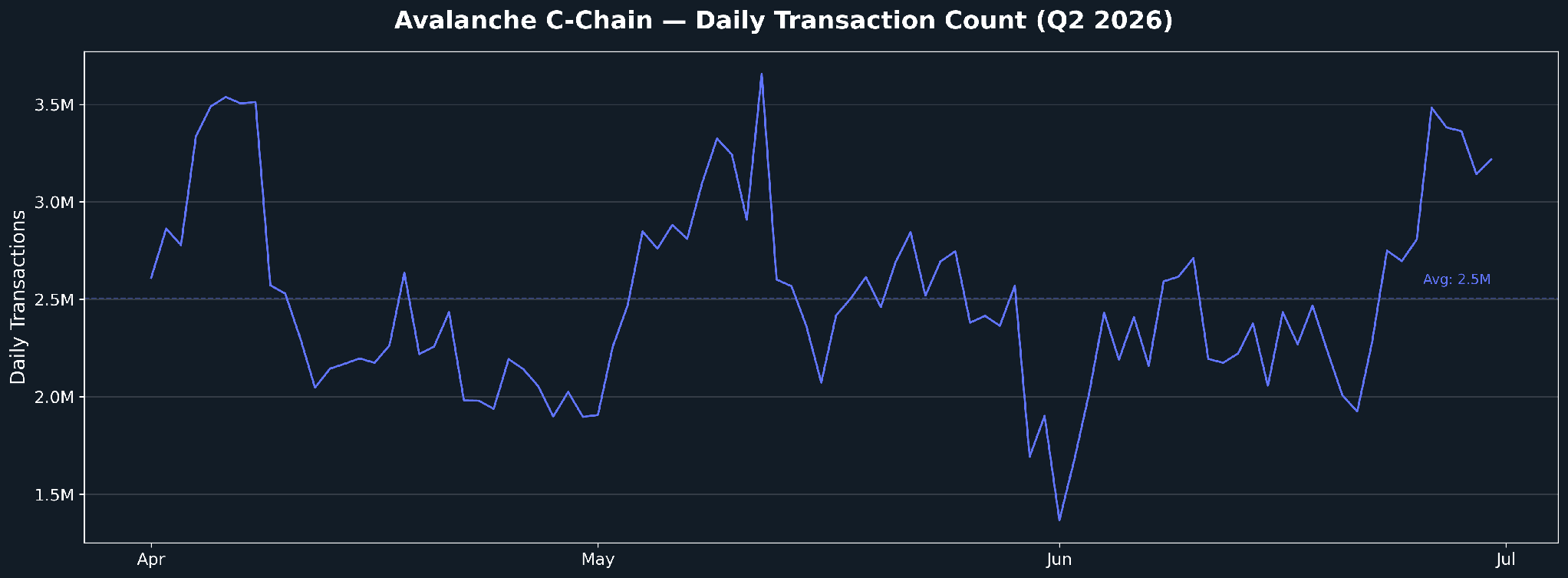
Q2 2026 processed 235.6M transactions for the quarter and is an all-time quarterly high and the seventh consecutive quarter of growth, up from 21.9M in Q4 2024. May's 82.6M was the strongest single month since December 2023, and every month of Q2 exceeded every month of 2025. Avalanche C-Chain averaged approximately 2.5 million daily transactions in Q2 2026, broadly in line with Q1 levels but with significantly higher volatility. The quarter opened with a sharp spike to 3.5 million transactions in early April — coinciding with renewed DeFi activity around Trader Joe and LFJ — before pulling back to a mid-quarter trough near 1.9 million in late April. A second wave of activity in early-to-mid May pushed daily counts above 3.6 million, the highest single-day figure across H1 2026, driven by a surge in DEX and stablecoin settlement volume. June saw a brief dip toward 1.4 million before recovering strongly into the final week, closing the quarter above 3.2 million. The recurring pattern of sharp spikes followed by drawdowns suggests Avalanche C-Chain is increasingly hosting episodic high-throughput events — likely tied to DeFi campaigns, token launches, and institutional settlement flows — layered on top of a stable baseline.
Daily Active Addresses
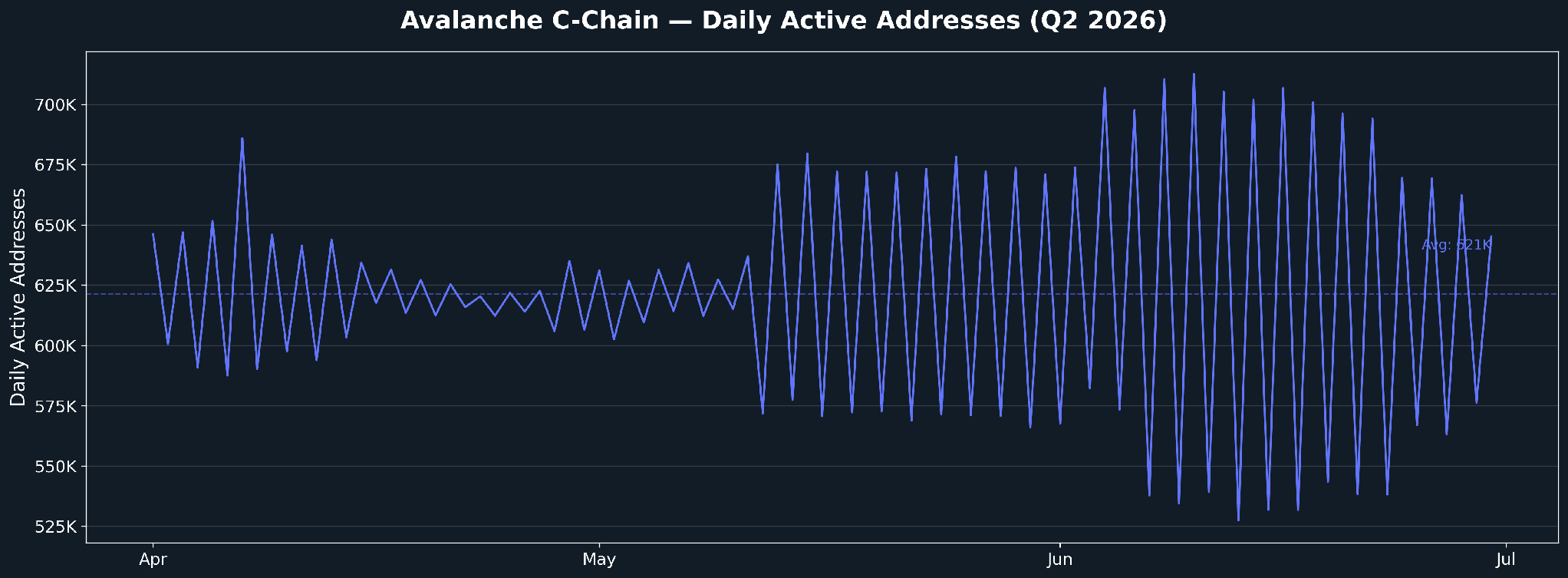
Active addresses on C-Chain averaged roughly 621,000 daily in Q2 2026, following the dramatic ramp-up from under 30,000 in early January to 600K+ by mid-January. An oscillating pattern was visible throughout Q2, with peaks regularly touching 700K and troughs around 530K. Compared to Q1’s growth-driven volatility, Q2 points to a maturing user base, though it’s worth reading the address count alongside the underlying economic activity it represents. The slight uptick in June’s upper range (above 710K on several days) hints at continued growth, though further quarters of data would help confirm the trend.
That activity was backed by substantial economic throughput: stablecoin transfer volume on C-Chain totaled $84.4 billion across Q2. June alone saw 13.7 million stablecoin transfers moving $25.9 billion, with more than 200,000 wallets moving $10 or more, and a median transfer size of about $113.
Top Entities by Transactions

Top Entities by Users
Avalanche C-Chain's entity landscape in Q2 2026 was dominated by stablecoin infrastructure and DEX activity. USDC led transactions at 6.6 million (32.7% of the 20.0 million total), though that is a -89% decline from Q1's elevated levels — likely the normalization of one-time migration or programmatic flows. Behind it sits the DeFi story: LFJ (formerly Trader Joe) accounted for 5.7 million transactions on a combined basis, 28.3% of the network and +270% QoQ. Tether grew a steadier +30% QoQ to 2.2 million.
On DEX volume, Q2's quarterly totals continue to boast impressive numbers. On DEX volume, according to DefiLlama, Pharaoh led Q2 at $2.63B, followed by LFJ at $2.40B and Blackhole at $2.27B. The monthly split adds context to the quarterly totals: Pharaoh launched its DLMM in June and led that month, and by July it accounted for roughly 66% of Avalanche DEX volume share. Q2 captures the period in which Pharaoh moved into the lead.
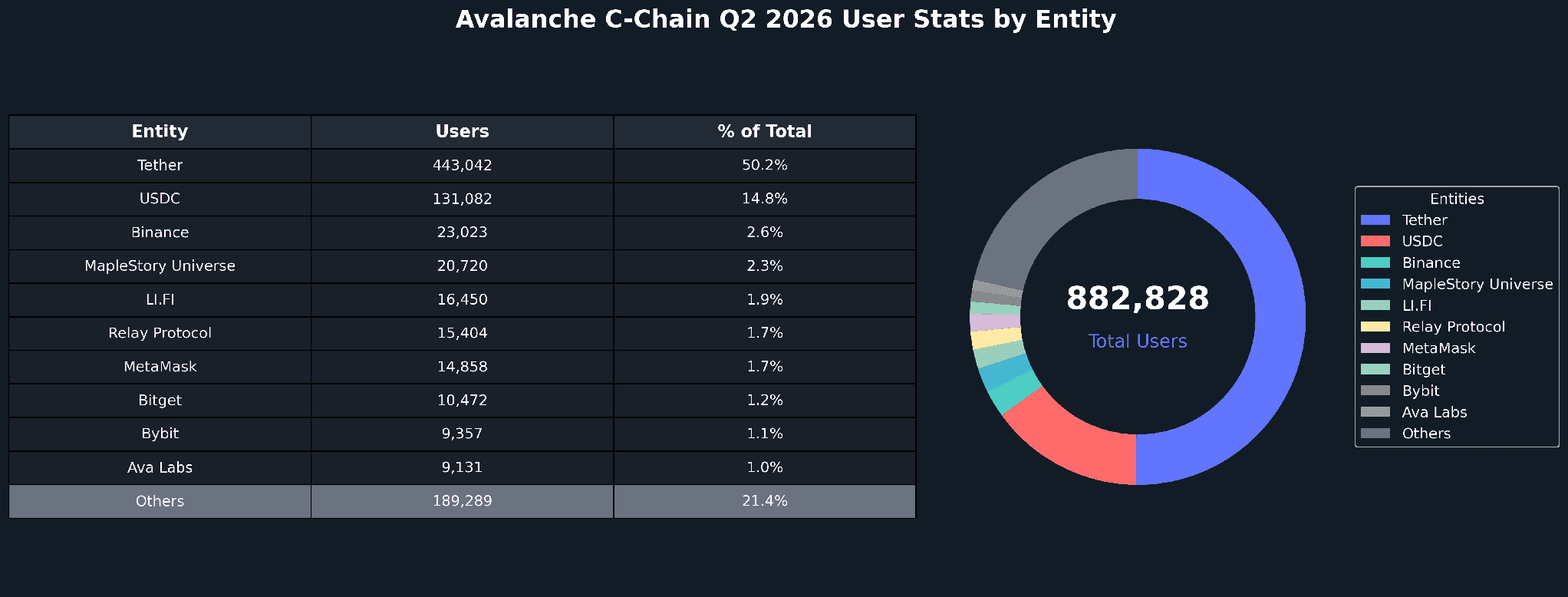
On the user side, Tether dominated with 443,000 unique users (50.2%), up +34% QoQ, reflecting Avalanche’s growing role as a USDT transfer rail. USDC followed at 131,000 users despite its transaction decline, suggesting fewer but larger institutional-grade transfers. Notably, MapleStory Universe processed 18,823,601 transactions during Q2 and 30,353 avg/day for active addresses. CEX representation remained broad, with Binance, Bybit, Bitget, and OKX all appearing in the top ranks — underscoring Avalanche’s deep connectivity with centralized exchange infrastructure.
Closing Thoughts
Q2 2026 reinforced Avalanche’s position as the go-to infrastructure for institutional-grade payments and sovereign blockchain deployments. The formalization of the Payments Collective — backed by 28 organizations covering 150+ countries — marks a shift from individual integrations to a coordinated payment ecosystem, while Tassat’s Lynq migration demonstrates that traditional finance settlement networks can operate at scale on Avalanche L1s. Asia’s multi-country adoption wave across South Korea, Japan, Singapore, and Thailand is particularly notable, as these are not pilots but production deployments processing billions in annual volume.
On C-Chain, the onchain data tells a story of stable maturity: over 600,000 daily active addresses and 2.5 million daily transactions form a reliable baseline, while the resurgence of Trader Joe (+615% QoQ) and LFJ (+183%) signals renewed momentum in Avalanche-native DeFi. The growing diversity of sovereign L1 launches — from AI agent commerce (Kite) to scientific observation (SkyMapper) — demonstrates the flexibility of Avalanche’s multi-chain architecture beyond financial use cases.
Looking ahead, Avalanche’s trajectory will likely depend on whether its institutional RWA growth translates into deeper onchain liquidity and sustained ecosystem activity. Private credit platforms such as Travessia and BlackOpal are expected to bring Latin American yield opportunities into DeFi, while Aave V4’s proposed RWA Liquidity Hub could enable TradFi-issued assets to be used more directly as collateral. This comes as active onchain private credit has surpassed $13B and tokenized equities grew 4.4x across crypto in Q2 to a record $5B.
Payments are another key growth area, with the 28-member Payments Collective advancing production integrations, Korean stablecoin pilots moving closer to launch, and Progmat continuing its $2B migration. Consumer applications including Your Grails and UpTop also provide early evidence that Avalanche can support use cases beyond finance. Alongside refreshed incentives, Team1’s 450-member global community, and proposed changes to staking, gas pricing, and value distribution, Avalanche enters Q3 2026 with strong institutional credibility and several potential paths toward broader adoption and stronger value accrual.


