Avalanche Q1 2026 Report

Written by

Read Time

10 min read

Posted on

Overview

Avalanche is a high-performance Layer-1 blockchain platform designed for speed, low costs, and environmental sustainability. Built by Ava Labs, Avalanche uses a novel consensus protocol that enables sub-second finality and supports the creation of customizable Layer 1 blockchains (formerly called subnets) through AvaCloud. The network’s C-Chain provides EVM compatibility for smart contracts and DeFi, while its multi-chain architecture allows enterprises and institutions to deploy purpose-built networks tailored to their compliance and performance requirements.

Q1 2026 was defined by two major themes for Avalanche: an aggressive push to incentivize builder activity on the C-Chain, and continued institutional adoption of the network for tokenized securities and real-world assets. The Avalanche Foundation launched the Retro9000 C-Chain Round, a new phase of its $40M grant program that rewards builders based on verifiable onchain usage rather than subjective criteria, and complemented it with the $1M Build Games competition to attract new developer talent. On the institutional side, Japan’s largest security token platform Progmat announced a migration of over $2B in tokenized assets to an Avalanche L1, Galaxy tokenized its first CLO on the network with a $50M anchor from Grove, and Fosun Wealth launched an Asian yield-bearing RWA stablecoin. These developments reinforce Avalanche’s positioning as infrastructure for both grassroots builder activity and large-scale institutional finance.

Key Developments: Q1 2026

  • The Avalanche Foundation launched and iterated on the Retro9000 C-Chain Round, a new phase of its up to $40M retroactive grant program. The round shifts evaluation from wallet-based voting to usage-based scoring measured by AVAX burned through gas fees, with the top 40 projects per round eligible for rewards on a public leaderboard. Round 1 went live in March with a 1.5x multiplier for new projects and vertical-specific multipliers for DeFi, Gaming, SocialFi, and more. Round 2 applications opened at the end of March with a 10x multiplier for Build Games Stage 2 MVP projects and a 5x multiplier for new ecosystem entrants. A referral program allows community members to earn up to $3,000 in AVAX per funded referral. Since its inception, Retro9000 has awarded over $1.25M in grants. 

  • KB Kookmin Card, the credit card arm of the largest bank in Korea, KB Kookmin Bank, just announced they are building a stablecoin payment system and a dedicated L1 on Avalanche. South Korea’s KB Kookmin Card is developing a hybrid stablecoin payment system on Avalanche that would let customers pay with stablecoins or credit on a single card.

  • The Avalanche Foundation announced the fourth cohort of Retro9000 L1 & Infrastructure Tooling grantees, selected from a competitive pool of builders innovating across the ecosystem. This cohort was collectively awarded over $160,000 in retroactive funding for projects that have launched impactful Avalanche L1s and infrastructure tooling live on mainnet. The six recipients — ChainArq, Orange, Paradise Tycoon, The Grotto, FanHub, and TURF Network — reflect Retro9000’s design philosophy of rewarding projects that have already delivered meaningful impact rather than funding speculative proposals. The announcement also served as a transition point for the program, noting that as the ecosystem grows the focus shifts from “who built” to “what is being used” — introducing the upcoming C-Chain Round that moves from rewarding foundational tooling to rewarding real onchain activity. 

  • Avalanche launched Build Games, a six-week global online builder competition with a $1M total prize pool described as the first competition of its kind in crypto. The prize structure includes a $100K grand prize, $75K runner-up, $50K third place, plus additional category and miscellaneous prizes, along with ongoing grants and ecosystem support after the event. The competition is intentionally open-ended with no predefined tracks or themes and builders are encouraged to work on ideas they genuinely believe in, whether applications, primitives, tooling, infrastructure, consumer products, or experiments. The program is structured around clear milestones: Stage 1 involves submitting a pitch video evaluated on idea quality, originality, feasibility, and team background; middle stages require a working prototype or MVP with demo and code by week three; and the final stage involves refining the product, outlining a go-to-market plan, and presenting to judges in a live showcase. Throughout the competition, participants have access to workshops, mentors, office hours, and a global builder community. Applications opened January 20 on a rolling basis with limited spots. 

Ecosystem

Institutional Finance & RWAs

  • FinChain, a blockchain finance platform under Fosun Wealth Holdings, launched FUSD, an Asian yield-bearing RWA-backed stablecoin on Avalanche C-Chain. Unlike traditional stablecoins, FUSD offers native yield derived from its underlying reserve assets, which include high-liquidity money market funds from top-tier institutions such as BNY Mellon, ChinaAMC, and Taikang, as well as government bonds. FUSD is specifically designed for institutional investors, family offices, private equity funds, and pension funds, requiring high transparency and rapid settlement. Avalanche C-Chain serves as the primary and native liquidity hub, with FUSD intended as a building block for decentralized lending, trading, and collateral management across DeFi protocols. Beyond FUSD, Fosun Wealth plans to deploy FinChain and the broader FinCoin Protocol on Avalanche for end-to-end issuance of tokenized real-world assets, onchain trading and collateralization of RWAs, and stablecoin creation backed by real-world financial instruments. The launch builds on Avalanche’s growing institutional role across Asia — joining Toyota Blockchain Lab and SMBC Group in Japan, Mirae Asset and Woori Bank in South Korea, and now Fosun Wealth in Hong Kong. 

  • Progmat, Japan’s largest security token (ST) platform, announced a landmark technical migration from Corda to a dedicated Avalanche Layer 1. Through this transition, more than $2B in tokenized real estate assets and corporate bonds will move onto Avalanche infrastructure. Progmat currently accounts for approximately 63% of cumulative issuance volume and 53.8% of total projects in Japan’s national ST market, having facilitated over ¥216.9 billion in tokenized assets to date. The Japanese digital securities sector is expected to exceed ¥1.05 trillion ($7B+) by the end of 2026, driving the need for scalable public blockchain infrastructure. By deploying a dedicated Avalanche L1 through AvaCloud, Progmat gains EVM compatibility enabling composability with the broader public blockchain ecosystem, sub-2-second finality, and application-specific network control tailored to regulated financial entities. The migration places Progmat alongside other major Japanese institutional deployments on Avalanche including TIS Inc. (processing roughly half of Japan’s credit card volume), Toyota Blockchain Lab, Konami’s NFT platform, and Ponta’s loyalty program serving approximately 100 million user accounts via the Mugen Chain. Integration is scheduled for completion by June 2026. 

  • Galaxy closed Galaxy CLO 2025-1, its first-ever collateralized loan obligation issuance with a total size of $75M. The CLO’s debt tranches were issued and tokenized on Avalanche, enabling low-cost seamless trading, and the tokens are listed on INX’s platform for qualified investors. Grove anchored the deal with a $50M allocation, building on its initial $250M deployment into tokenized real-world assets on Avalanche and extending its commitment to operating institutional credit activity on the network. The onchain execution brings private credit onchain with the potential for instant settlement, full structural transparency, improved secondary-market liquidity, and greater collateral efficiency. The asset-backed finance market represents an estimated $6.1 trillion today with a total addressable market projected to exceed $20 trillion. Avalanche’s growing institutional credit presence is highlighted alongside other deployments: Janus Henderson’s Anemoy funds via Centrifuge, Apollo’s tokenized ACRED fund running daily NAV and subscriptions, KKR’s tokenized Health Care Strategic Growth Fund II, and SemiLiquid’s programmable credit workflows. 

  • EVEN (an Avalanche L1) announces multi-year agreement with Universal Music Group to serve as UMG's direct-to-fan platform, enabling superfan experiences, early music access, and artist-led commerce ahead of streaming release

Gaming

  • Blaze posted a breakout Q1, closing the quarter with 202,087 transactions, nearly 17x its Q4 2025 total of 12,022. Activity stepped up in January, peaked at an all-time monthly high of 72,485 in February (+12.7% MoM), and held steady at 65,278 in March.

  • CX Chain launched as a purpose-built Avalanche L1 for verifiably fair, community-owned gaming, starting with Texas Hold ’Em as its flagship product and extending to roulette, dice, and other chance-based games. The platform replaces traditional casino trust models with cryptographic verification — every poker hand shuffle is processed entirely onchain using zero-knowledge proofs, and other games use decentralized randomness that can be independently audited. The traditional operator-owned house is replaced by shared liquidity pools governed by smart contracts, with no more than 5% of total liquidity exposed to any single bet, and participants can contribute capital to these pools and earn from the house edge with revenue distribution enforced transparently onchain. Network validation is secured through capped node licenses that separate infrastructure control from token concentration. CX Chain deployed via AvaCloud to gain independent blockspace with customizable chain parameters, a permissioned validator set for regulatory compliance in online gaming jurisdictions, and sub-second transaction finality for immediate settlement. The global online gambling market exceeds $100 billion annually, and CX Chain positions itself as an alternative where the rules are encoded and outcomes are verifiable rather than relying on operator assurances. 

Onchain Data

Onchain activity continues to remain robust. Below we analyze network activity on Avalanche C-Chain, all of the other network activity across all of its chains can be tracked here.

Daily Transactions

avalanche_q1_2026_transactions_timeseries.png

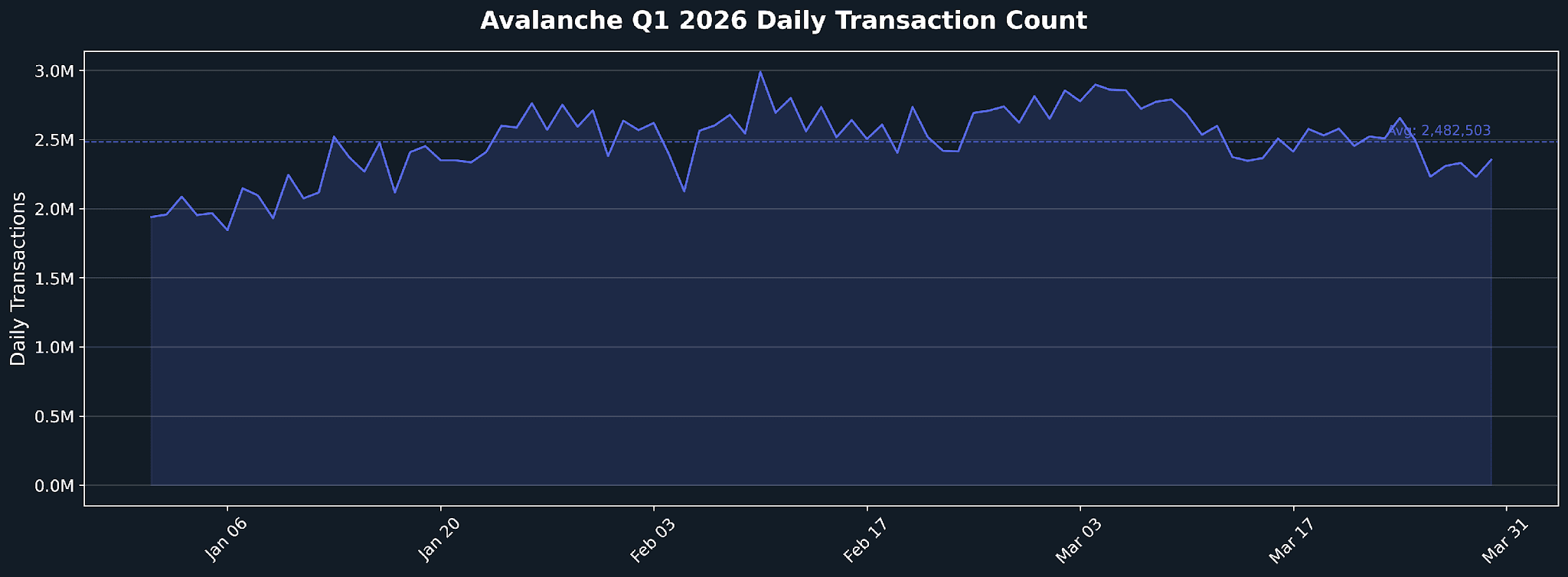
Avalanche C-Chain processed approximately 220.9 million transactions across Q1 2026, averaging roughly 2.48 million transactions per day. The quarter showed a clear upward trajectory: January averaged 2.30M daily transactions, February increased to 2.60M, and March held steady at 2.56M. The network reached its peak on February 10 with nearly 2.99M transactions in a single day. The lowest daily count occurred on January 6 at 1.84M, early in the quarter before ecosystem activity ramped up. From mid-January onward, daily transactions consistently exceeded 2.3M, reflecting broad protocol engagement and growing onchain usage driven by stablecoin activity, DeFi operations, and infrastructure-related transactions.

Daily Active Addresses

avalanche_q1_2026_users_timeseries.png

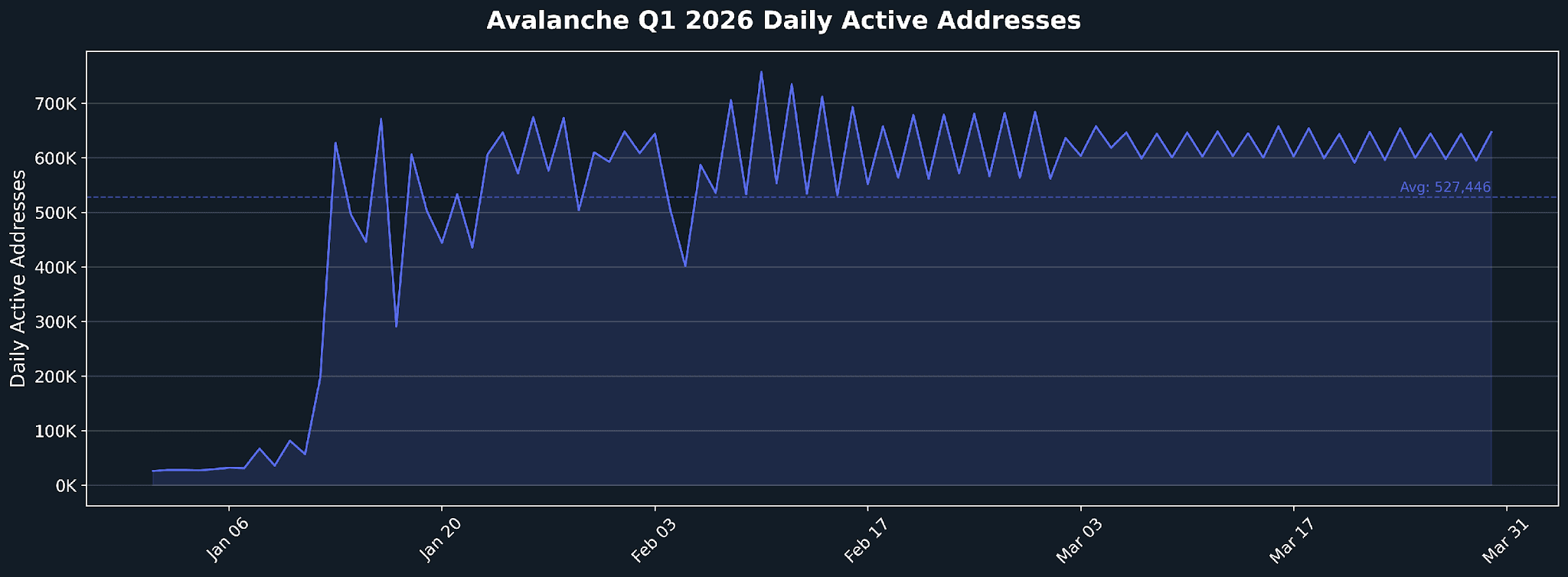
Active addresses on Avalanche C-Chain showed a dramatic growth pattern during Q1 2026, averaging approximately 527,000 daily active addresses across the quarter. The early days of January started with roughly 25,000–30,000 daily active addresses, but a sharp inflection point occurred around January 12–13 when activity surged past 600,000. From mid-January through the end of March, daily active addresses stabilized in the 530,000–750,000 range, with peaks exceeding 700,000 on multiple occasions. February 10 recorded the highest count at approximately 757,000. Monthly averages illustrate the growth arc: January averaged 360K (weighed down by the low early-January baseline), February averaged 611K, and March averaged 623K — indicating sustained engagement rather than a temporary spike.

Top Entities by Users and Transactions
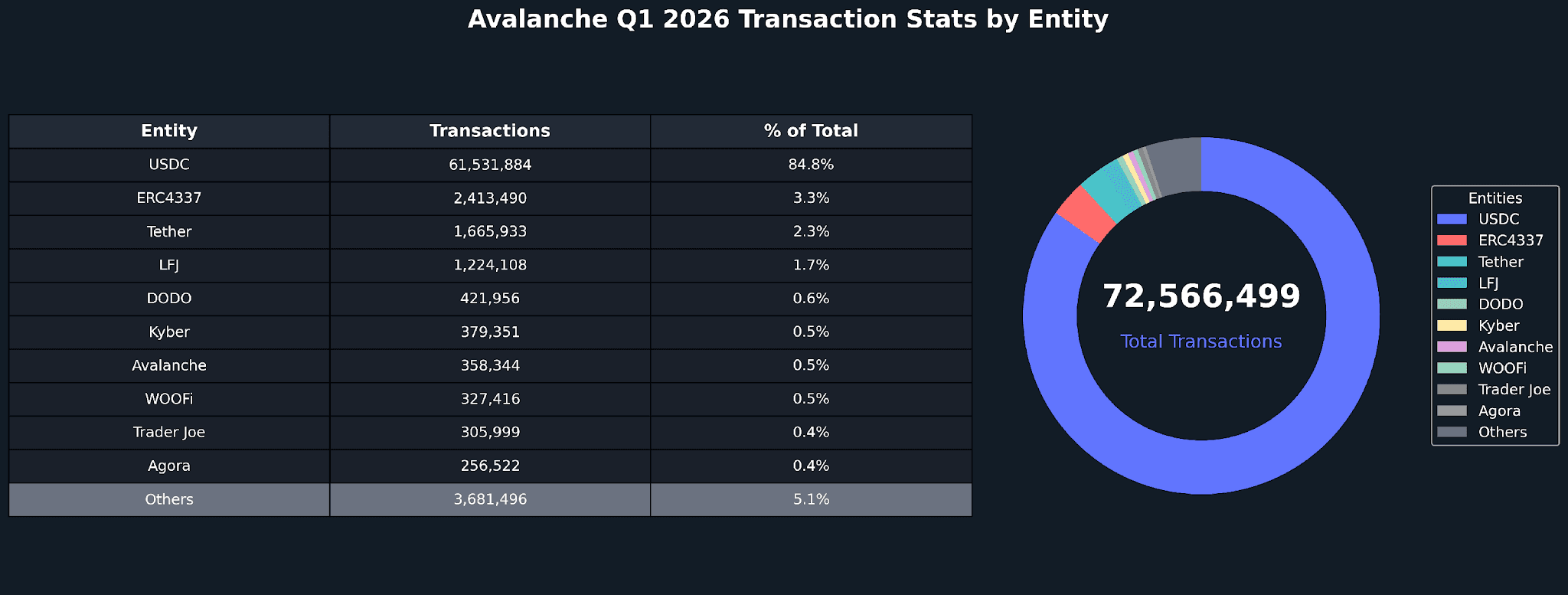

avalanche_q1_2026_transactions_by_entity.png


avalanche_q1_2026_users_by_entity.png

Avalanche’s C-Chain entity landscape in Q1 2026 was dominated by stablecoin activity, with USDC accounting for 61.5M transactions — by far the largest share of onchain volume, though down 20% QoQ from Q4 2025. ERC-4337 (account abstraction) infrastructure saw explosive growth at +347% QoQ in transactions, signaling growing adoption of smart account infrastructure. Tether contributed 1.67M transactions with the largest unique user base at 316K users. Among DeFi protocols, LFJ (formerly Trader Joe’s LFJ) grew 15.5% QoQ in transactions, while Kyber surged 110% QoQ. Aave stood out with a remarkable +496% QoQ increase in users (to 66.9K), reflecting deepening lending activity on the network. On the user side, Tether and USDC led with 316K and 212K unique users respectively, followed by Aave, MapleStory Universe (29K gaming users), and centralized exchanges Coinbase (27K) and Binance (24K). The presence of MapleStory Universe in the top 5 by users highlights gaming’s continued relevance in the Avalanche ecosystem despite a 35% QoQ decline.

Closing Thoughts

Q1 2026 demonstrated Avalanche’s ability to execute on two parallel fronts: fostering grassroots builder activity and attracting high-value institutional deployments. The Retro9000 C-Chain Round introduced a meritocratic incentive model that ties grants directly to verifiable onchain usage, while the $1M Build Games competition created a structured pipeline for new developer talent. Together, these programs signal a maturing ecosystem that rewards execution over speculation.

On the institutional side, Progmat’s $2B+ migration from Corda and Galaxy’s tokenized CLO represent meaningful validation of Avalanche’s multi-chain architecture for regulated financial products. The expansion into Asian institutional finance through Fosun Wealth’s FUSD stablecoin, alongside existing deployments in Japan and South Korea, positions Avalanche as a leading infrastructure layer for real-world asset tokenization across the Asia-Pacific region. Avalanche enters Q2 2026 with strong momentum across both its developer and institutional communities.

Avalanche Q1 2026 Report

Written by

Read Time

10 min read

Posted on

Overview

Avalanche is a high-performance Layer-1 blockchain platform designed for speed, low costs, and environmental sustainability. Built by Ava Labs, Avalanche uses a novel consensus protocol that enables sub-second finality and supports the creation of customizable Layer 1 blockchains (formerly called subnets) through AvaCloud. The network’s C-Chain provides EVM compatibility for smart contracts and DeFi, while its multi-chain architecture allows enterprises and institutions to deploy purpose-built networks tailored to their compliance and performance requirements.

Q1 2026 was defined by two major themes for Avalanche: an aggressive push to incentivize builder activity on the C-Chain, and continued institutional adoption of the network for tokenized securities and real-world assets. The Avalanche Foundation launched the Retro9000 C-Chain Round, a new phase of its $40M grant program that rewards builders based on verifiable onchain usage rather than subjective criteria, and complemented it with the $1M Build Games competition to attract new developer talent. On the institutional side, Japan’s largest security token platform Progmat announced a migration of over $2B in tokenized assets to an Avalanche L1, Galaxy tokenized its first CLO on the network with a $50M anchor from Grove, and Fosun Wealth launched an Asian yield-bearing RWA stablecoin. These developments reinforce Avalanche’s positioning as infrastructure for both grassroots builder activity and large-scale institutional finance.

Key Developments: Q1 2026

  • The Avalanche Foundation launched and iterated on the Retro9000 C-Chain Round, a new phase of its up to $40M retroactive grant program. The round shifts evaluation from wallet-based voting to usage-based scoring measured by AVAX burned through gas fees, with the top 40 projects per round eligible for rewards on a public leaderboard. Round 1 went live in March with a 1.5x multiplier for new projects and vertical-specific multipliers for DeFi, Gaming, SocialFi, and more. Round 2 applications opened at the end of March with a 10x multiplier for Build Games Stage 2 MVP projects and a 5x multiplier for new ecosystem entrants. A referral program allows community members to earn up to $3,000 in AVAX per funded referral. Since its inception, Retro9000 has awarded over $1.25M in grants. 

  • KB Kookmin Card, the credit card arm of the largest bank in Korea, KB Kookmin Bank, just announced they are building a stablecoin payment system and a dedicated L1 on Avalanche. South Korea’s KB Kookmin Card is developing a hybrid stablecoin payment system on Avalanche that would let customers pay with stablecoins or credit on a single card.

  • The Avalanche Foundation announced the fourth cohort of Retro9000 L1 & Infrastructure Tooling grantees, selected from a competitive pool of builders innovating across the ecosystem. This cohort was collectively awarded over $160,000 in retroactive funding for projects that have launched impactful Avalanche L1s and infrastructure tooling live on mainnet. The six recipients — ChainArq, Orange, Paradise Tycoon, The Grotto, FanHub, and TURF Network — reflect Retro9000’s design philosophy of rewarding projects that have already delivered meaningful impact rather than funding speculative proposals. The announcement also served as a transition point for the program, noting that as the ecosystem grows the focus shifts from “who built” to “what is being used” — introducing the upcoming C-Chain Round that moves from rewarding foundational tooling to rewarding real onchain activity. 

  • Avalanche launched Build Games, a six-week global online builder competition with a $1M total prize pool described as the first competition of its kind in crypto. The prize structure includes a $100K grand prize, $75K runner-up, $50K third place, plus additional category and miscellaneous prizes, along with ongoing grants and ecosystem support after the event. The competition is intentionally open-ended with no predefined tracks or themes and builders are encouraged to work on ideas they genuinely believe in, whether applications, primitives, tooling, infrastructure, consumer products, or experiments. The program is structured around clear milestones: Stage 1 involves submitting a pitch video evaluated on idea quality, originality, feasibility, and team background; middle stages require a working prototype or MVP with demo and code by week three; and the final stage involves refining the product, outlining a go-to-market plan, and presenting to judges in a live showcase. Throughout the competition, participants have access to workshops, mentors, office hours, and a global builder community. Applications opened January 20 on a rolling basis with limited spots. 

Ecosystem

Institutional Finance & RWAs

  • FinChain, a blockchain finance platform under Fosun Wealth Holdings, launched FUSD, an Asian yield-bearing RWA-backed stablecoin on Avalanche C-Chain. Unlike traditional stablecoins, FUSD offers native yield derived from its underlying reserve assets, which include high-liquidity money market funds from top-tier institutions such as BNY Mellon, ChinaAMC, and Taikang, as well as government bonds. FUSD is specifically designed for institutional investors, family offices, private equity funds, and pension funds, requiring high transparency and rapid settlement. Avalanche C-Chain serves as the primary and native liquidity hub, with FUSD intended as a building block for decentralized lending, trading, and collateral management across DeFi protocols. Beyond FUSD, Fosun Wealth plans to deploy FinChain and the broader FinCoin Protocol on Avalanche for end-to-end issuance of tokenized real-world assets, onchain trading and collateralization of RWAs, and stablecoin creation backed by real-world financial instruments. The launch builds on Avalanche’s growing institutional role across Asia — joining Toyota Blockchain Lab and SMBC Group in Japan, Mirae Asset and Woori Bank in South Korea, and now Fosun Wealth in Hong Kong. 

  • Progmat, Japan’s largest security token (ST) platform, announced a landmark technical migration from Corda to a dedicated Avalanche Layer 1. Through this transition, more than $2B in tokenized real estate assets and corporate bonds will move onto Avalanche infrastructure. Progmat currently accounts for approximately 63% of cumulative issuance volume and 53.8% of total projects in Japan’s national ST market, having facilitated over ¥216.9 billion in tokenized assets to date. The Japanese digital securities sector is expected to exceed ¥1.05 trillion ($7B+) by the end of 2026, driving the need for scalable public blockchain infrastructure. By deploying a dedicated Avalanche L1 through AvaCloud, Progmat gains EVM compatibility enabling composability with the broader public blockchain ecosystem, sub-2-second finality, and application-specific network control tailored to regulated financial entities. The migration places Progmat alongside other major Japanese institutional deployments on Avalanche including TIS Inc. (processing roughly half of Japan’s credit card volume), Toyota Blockchain Lab, Konami’s NFT platform, and Ponta’s loyalty program serving approximately 100 million user accounts via the Mugen Chain. Integration is scheduled for completion by June 2026. 

  • Galaxy closed Galaxy CLO 2025-1, its first-ever collateralized loan obligation issuance with a total size of $75M. The CLO’s debt tranches were issued and tokenized on Avalanche, enabling low-cost seamless trading, and the tokens are listed on INX’s platform for qualified investors. Grove anchored the deal with a $50M allocation, building on its initial $250M deployment into tokenized real-world assets on Avalanche and extending its commitment to operating institutional credit activity on the network. The onchain execution brings private credit onchain with the potential for instant settlement, full structural transparency, improved secondary-market liquidity, and greater collateral efficiency. The asset-backed finance market represents an estimated $6.1 trillion today with a total addressable market projected to exceed $20 trillion. Avalanche’s growing institutional credit presence is highlighted alongside other deployments: Janus Henderson’s Anemoy funds via Centrifuge, Apollo’s tokenized ACRED fund running daily NAV and subscriptions, KKR’s tokenized Health Care Strategic Growth Fund II, and SemiLiquid’s programmable credit workflows. 

  • EVEN (an Avalanche L1) announces multi-year agreement with Universal Music Group to serve as UMG's direct-to-fan platform, enabling superfan experiences, early music access, and artist-led commerce ahead of streaming release

Gaming

  • Blaze posted a breakout Q1, closing the quarter with 202,087 transactions, nearly 17x its Q4 2025 total of 12,022. Activity stepped up in January, peaked at an all-time monthly high of 72,485 in February (+12.7% MoM), and held steady at 65,278 in March.

  • CX Chain launched as a purpose-built Avalanche L1 for verifiably fair, community-owned gaming, starting with Texas Hold ’Em as its flagship product and extending to roulette, dice, and other chance-based games. The platform replaces traditional casino trust models with cryptographic verification — every poker hand shuffle is processed entirely onchain using zero-knowledge proofs, and other games use decentralized randomness that can be independently audited. The traditional operator-owned house is replaced by shared liquidity pools governed by smart contracts, with no more than 5% of total liquidity exposed to any single bet, and participants can contribute capital to these pools and earn from the house edge with revenue distribution enforced transparently onchain. Network validation is secured through capped node licenses that separate infrastructure control from token concentration. CX Chain deployed via AvaCloud to gain independent blockspace with customizable chain parameters, a permissioned validator set for regulatory compliance in online gaming jurisdictions, and sub-second transaction finality for immediate settlement. The global online gambling market exceeds $100 billion annually, and CX Chain positions itself as an alternative where the rules are encoded and outcomes are verifiable rather than relying on operator assurances. 

Onchain Data

Onchain activity continues to remain robust. Below we analyze network activity on Avalanche C-Chain, all of the other network activity across all of its chains can be tracked here.

Daily Transactions


avalanche_q1_2026_transactions_timeseries.png

Avalanche C-Chain processed approximately 220.9 million transactions across Q1 2026, averaging roughly 2.48 million transactions per day. The quarter showed a clear upward trajectory: January averaged 2.30M daily transactions, February increased to 2.60M, and March held steady at 2.56M. The network reached its peak on February 10 with nearly 2.99M transactions in a single day. The lowest daily count occurred on January 6 at 1.84M, early in the quarter before ecosystem activity ramped up. From mid-January onward, daily transactions consistently exceeded 2.3M, reflecting broad protocol engagement and growing onchain usage driven by stablecoin activity, DeFi operations, and infrastructure-related transactions.

Daily Active Addresses


avalanche_q1_2026_users_timeseries.png

Active addresses on Avalanche C-Chain showed a dramatic growth pattern during Q1 2026, averaging approximately 527,000 daily active addresses across the quarter. The early days of January started with roughly 25,000–30,000 daily active addresses, but a sharp inflection point occurred around January 12–13 when activity surged past 600,000. From mid-January through the end of March, daily active addresses stabilized in the 530,000–750,000 range, with peaks exceeding 700,000 on multiple occasions. February 10 recorded the highest count at approximately 757,000. Monthly averages illustrate the growth arc: January averaged 360K (weighed down by the low early-January baseline), February averaged 611K, and March averaged 623K — indicating sustained engagement rather than a temporary spike.

Top Entities by Users and Transactions
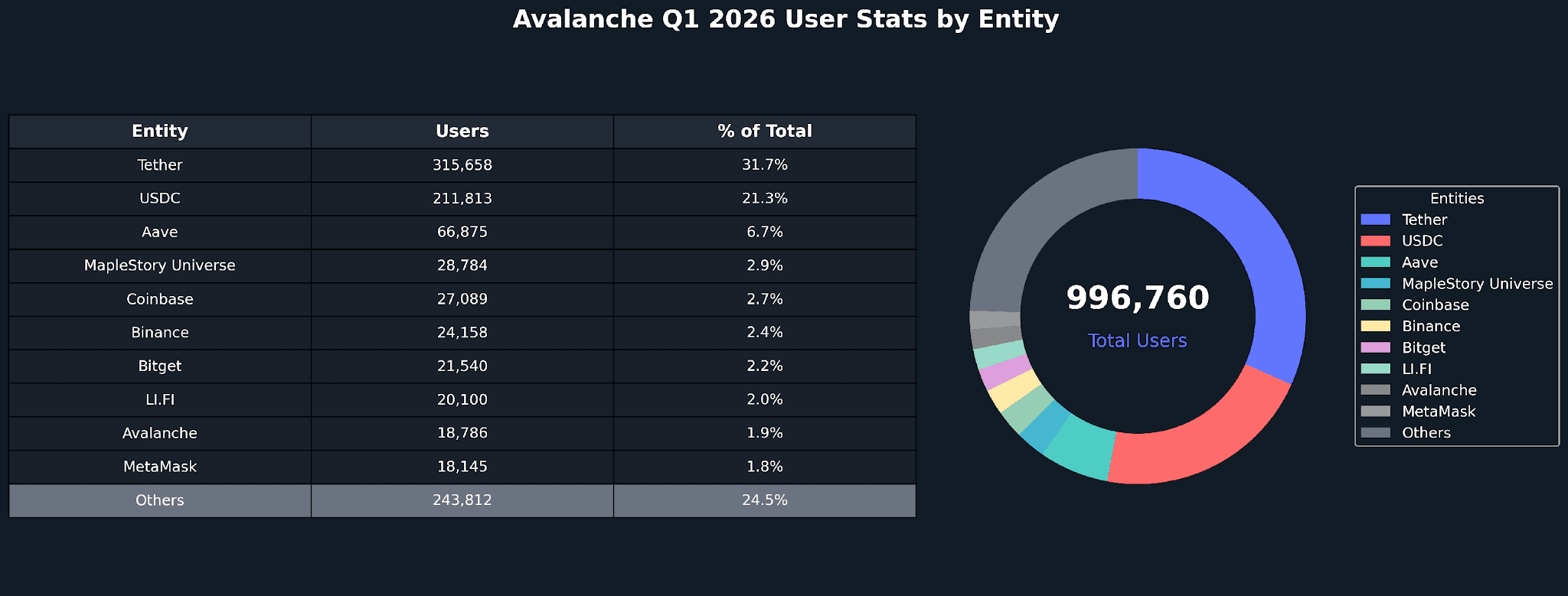

avalanche_q1_2026_transactions_by_entity.png


avalanche_q1_2026_users_by_entity.png

Avalanche’s C-Chain entity landscape in Q1 2026 was dominated by stablecoin activity, with USDC accounting for 61.5M transactions — by far the largest share of onchain volume, though down 20% QoQ from Q4 2025. ERC-4337 (account abstraction) infrastructure saw explosive growth at +347% QoQ in transactions, signaling growing adoption of smart account infrastructure. Tether contributed 1.67M transactions with the largest unique user base at 316K users. Among DeFi protocols, LFJ (formerly Trader Joe’s LFJ) grew 15.5% QoQ in transactions, while Kyber surged 110% QoQ. Aave stood out with a remarkable +496% QoQ increase in users (to 66.9K), reflecting deepening lending activity on the network. On the user side, Tether and USDC led with 316K and 212K unique users respectively, followed by Aave, MapleStory Universe (29K gaming users), and centralized exchanges Coinbase (27K) and Binance (24K). The presence of MapleStory Universe in the top 5 by users highlights gaming’s continued relevance in the Avalanche ecosystem despite a 35% QoQ decline.

Closing Thoughts

Q1 2026 demonstrated Avalanche’s ability to execute on two parallel fronts: fostering grassroots builder activity and attracting high-value institutional deployments. The Retro9000 C-Chain Round introduced a meritocratic incentive model that ties grants directly to verifiable onchain usage, while the $1M Build Games competition created a structured pipeline for new developer talent. Together, these programs signal a maturing ecosystem that rewards execution over speculation.

On the institutional side, Progmat’s $2B+ migration from Corda and Galaxy’s tokenized CLO represent meaningful validation of Avalanche’s multi-chain architecture for regulated financial products. The expansion into Asian institutional finance through Fosun Wealth’s FUSD stablecoin, alongside existing deployments in Japan and South Korea, positions Avalanche as a leading infrastructure layer for real-world asset tokenization across the Asia-Pacific region. Avalanche enters Q2 2026 with strong momentum across both its developer and institutional communities.

About the Author

Visit our socials

You may also like these

Related Posts

Avalanche Q1 2026 Report

Written by

Read Time

10 min read

Posted on

Overview

Avalanche is a high-performance Layer-1 blockchain platform designed for speed, low costs, and environmental sustainability. Built by Ava Labs, Avalanche uses a novel consensus protocol that enables sub-second finality and supports the creation of customizable Layer 1 blockchains (formerly called subnets) through AvaCloud. The network’s C-Chain provides EVM compatibility for smart contracts and DeFi, while its multi-chain architecture allows enterprises and institutions to deploy purpose-built networks tailored to their compliance and performance requirements.

Q1 2026 was defined by two major themes for Avalanche: an aggressive push to incentivize builder activity on the C-Chain, and continued institutional adoption of the network for tokenized securities and real-world assets. The Avalanche Foundation launched the Retro9000 C-Chain Round, a new phase of its $40M grant program that rewards builders based on verifiable onchain usage rather than subjective criteria, and complemented it with the $1M Build Games competition to attract new developer talent. On the institutional side, Japan’s largest security token platform Progmat announced a migration of over $2B in tokenized assets to an Avalanche L1, Galaxy tokenized its first CLO on the network with a $50M anchor from Grove, and Fosun Wealth launched an Asian yield-bearing RWA stablecoin. These developments reinforce Avalanche’s positioning as infrastructure for both grassroots builder activity and large-scale institutional finance.

Key Developments: Q1 2026

  • The Avalanche Foundation launched and iterated on the Retro9000 C-Chain Round, a new phase of its up to $40M retroactive grant program. The round shifts evaluation from wallet-based voting to usage-based scoring measured by AVAX burned through gas fees, with the top 40 projects per round eligible for rewards on a public leaderboard. Round 1 went live in March with a 1.5x multiplier for new projects and vertical-specific multipliers for DeFi, Gaming, SocialFi, and more. Round 2 applications opened at the end of March with a 10x multiplier for Build Games Stage 2 MVP projects and a 5x multiplier for new ecosystem entrants. A referral program allows community members to earn up to $3,000 in AVAX per funded referral. Since its inception, Retro9000 has awarded over $1.25M in grants. 

  • KB Kookmin Card, the credit card arm of the largest bank in Korea, KB Kookmin Bank, just announced they are building a stablecoin payment system and a dedicated L1 on Avalanche. South Korea’s KB Kookmin Card is developing a hybrid stablecoin payment system on Avalanche that would let customers pay with stablecoins or credit on a single card.

  • The Avalanche Foundation announced the fourth cohort of Retro9000 L1 & Infrastructure Tooling grantees, selected from a competitive pool of builders innovating across the ecosystem. This cohort was collectively awarded over $160,000 in retroactive funding for projects that have launched impactful Avalanche L1s and infrastructure tooling live on mainnet. The six recipients — ChainArq, Orange, Paradise Tycoon, The Grotto, FanHub, and TURF Network — reflect Retro9000’s design philosophy of rewarding projects that have already delivered meaningful impact rather than funding speculative proposals. The announcement also served as a transition point for the program, noting that as the ecosystem grows the focus shifts from “who built” to “what is being used” — introducing the upcoming C-Chain Round that moves from rewarding foundational tooling to rewarding real onchain activity. 

  • Avalanche launched Build Games, a six-week global online builder competition with a $1M total prize pool described as the first competition of its kind in crypto. The prize structure includes a $100K grand prize, $75K runner-up, $50K third place, plus additional category and miscellaneous prizes, along with ongoing grants and ecosystem support after the event. The competition is intentionally open-ended with no predefined tracks or themes and builders are encouraged to work on ideas they genuinely believe in, whether applications, primitives, tooling, infrastructure, consumer products, or experiments. The program is structured around clear milestones: Stage 1 involves submitting a pitch video evaluated on idea quality, originality, feasibility, and team background; middle stages require a working prototype or MVP with demo and code by week three; and the final stage involves refining the product, outlining a go-to-market plan, and presenting to judges in a live showcase. Throughout the competition, participants have access to workshops, mentors, office hours, and a global builder community. Applications opened January 20 on a rolling basis with limited spots. 

Ecosystem

Institutional Finance & RWAs

  • FinChain, a blockchain finance platform under Fosun Wealth Holdings, launched FUSD, an Asian yield-bearing RWA-backed stablecoin on Avalanche C-Chain. Unlike traditional stablecoins, FUSD offers native yield derived from its underlying reserve assets, which include high-liquidity money market funds from top-tier institutions such as BNY Mellon, ChinaAMC, and Taikang, as well as government bonds. FUSD is specifically designed for institutional investors, family offices, private equity funds, and pension funds, requiring high transparency and rapid settlement. Avalanche C-Chain serves as the primary and native liquidity hub, with FUSD intended as a building block for decentralized lending, trading, and collateral management across DeFi protocols. Beyond FUSD, Fosun Wealth plans to deploy FinChain and the broader FinCoin Protocol on Avalanche for end-to-end issuance of tokenized real-world assets, onchain trading and collateralization of RWAs, and stablecoin creation backed by real-world financial instruments. The launch builds on Avalanche’s growing institutional role across Asia — joining Toyota Blockchain Lab and SMBC Group in Japan, Mirae Asset and Woori Bank in South Korea, and now Fosun Wealth in Hong Kong. 

  • Progmat, Japan’s largest security token (ST) platform, announced a landmark technical migration from Corda to a dedicated Avalanche Layer 1. Through this transition, more than $2B in tokenized real estate assets and corporate bonds will move onto Avalanche infrastructure. Progmat currently accounts for approximately 63% of cumulative issuance volume and 53.8% of total projects in Japan’s national ST market, having facilitated over ¥216.9 billion in tokenized assets to date. The Japanese digital securities sector is expected to exceed ¥1.05 trillion ($7B+) by the end of 2026, driving the need for scalable public blockchain infrastructure. By deploying a dedicated Avalanche L1 through AvaCloud, Progmat gains EVM compatibility enabling composability with the broader public blockchain ecosystem, sub-2-second finality, and application-specific network control tailored to regulated financial entities. The migration places Progmat alongside other major Japanese institutional deployments on Avalanche including TIS Inc. (processing roughly half of Japan’s credit card volume), Toyota Blockchain Lab, Konami’s NFT platform, and Ponta’s loyalty program serving approximately 100 million user accounts via the Mugen Chain. Integration is scheduled for completion by June 2026. 

  • Galaxy closed Galaxy CLO 2025-1, its first-ever collateralized loan obligation issuance with a total size of $75M. The CLO’s debt tranches were issued and tokenized on Avalanche, enabling low-cost seamless trading, and the tokens are listed on INX’s platform for qualified investors. Grove anchored the deal with a $50M allocation, building on its initial $250M deployment into tokenized real-world assets on Avalanche and extending its commitment to operating institutional credit activity on the network. The onchain execution brings private credit onchain with the potential for instant settlement, full structural transparency, improved secondary-market liquidity, and greater collateral efficiency. The asset-backed finance market represents an estimated $6.1 trillion today with a total addressable market projected to exceed $20 trillion. Avalanche’s growing institutional credit presence is highlighted alongside other deployments: Janus Henderson’s Anemoy funds via Centrifuge, Apollo’s tokenized ACRED fund running daily NAV and subscriptions, KKR’s tokenized Health Care Strategic Growth Fund II, and SemiLiquid’s programmable credit workflows. 

  • EVEN (an Avalanche L1) announces multi-year agreement with Universal Music Group to serve as UMG's direct-to-fan platform, enabling superfan experiences, early music access, and artist-led commerce ahead of streaming release

Gaming

  • Blaze posted a breakout Q1, closing the quarter with 202,087 transactions, nearly 17x its Q4 2025 total of 12,022. Activity stepped up in January, peaked at an all-time monthly high of 72,485 in February (+12.7% MoM), and held steady at 65,278 in March.

  • CX Chain launched as a purpose-built Avalanche L1 for verifiably fair, community-owned gaming, starting with Texas Hold ’Em as its flagship product and extending to roulette, dice, and other chance-based games. The platform replaces traditional casino trust models with cryptographic verification — every poker hand shuffle is processed entirely onchain using zero-knowledge proofs, and other games use decentralized randomness that can be independently audited. The traditional operator-owned house is replaced by shared liquidity pools governed by smart contracts, with no more than 5% of total liquidity exposed to any single bet, and participants can contribute capital to these pools and earn from the house edge with revenue distribution enforced transparently onchain. Network validation is secured through capped node licenses that separate infrastructure control from token concentration. CX Chain deployed via AvaCloud to gain independent blockspace with customizable chain parameters, a permissioned validator set for regulatory compliance in online gaming jurisdictions, and sub-second transaction finality for immediate settlement. The global online gambling market exceeds $100 billion annually, and CX Chain positions itself as an alternative where the rules are encoded and outcomes are verifiable rather than relying on operator assurances. 

Onchain Data

Onchain activity continues to remain robust. Below we analyze network activity on Avalanche C-Chain, all of the other network activity across all of its chains can be tracked here.

Daily Transactions


avalanche_q1_2026_transactions_timeseries.png

Avalanche C-Chain processed approximately 220.9 million transactions across Q1 2026, averaging roughly 2.48 million transactions per day. The quarter showed a clear upward trajectory: January averaged 2.30M daily transactions, February increased to 2.60M, and March held steady at 2.56M. The network reached its peak on February 10 with nearly 2.99M transactions in a single day. The lowest daily count occurred on January 6 at 1.84M, early in the quarter before ecosystem activity ramped up. From mid-January onward, daily transactions consistently exceeded 2.3M, reflecting broad protocol engagement and growing onchain usage driven by stablecoin activity, DeFi operations, and infrastructure-related transactions.

Daily Active Addresses


avalanche_q1_2026_users_timeseries.png

Active addresses on Avalanche C-Chain showed a dramatic growth pattern during Q1 2026, averaging approximately 527,000 daily active addresses across the quarter. The early days of January started with roughly 25,000–30,000 daily active addresses, but a sharp inflection point occurred around January 12–13 when activity surged past 600,000. From mid-January through the end of March, daily active addresses stabilized in the 530,000–750,000 range, with peaks exceeding 700,000 on multiple occasions. February 10 recorded the highest count at approximately 757,000. Monthly averages illustrate the growth arc: January averaged 360K (weighed down by the low early-January baseline), February averaged 611K, and March averaged 623K — indicating sustained engagement rather than a temporary spike.

Top Entities by Users and Transactions


avalanche_q1_2026_transactions_by_entity.png


avalanche_q1_2026_users_by_entity.png

Avalanche’s C-Chain entity landscape in Q1 2026 was dominated by stablecoin activity, with USDC accounting for 61.5M transactions — by far the largest share of onchain volume, though down 20% QoQ from Q4 2025. ERC-4337 (account abstraction) infrastructure saw explosive growth at +347% QoQ in transactions, signaling growing adoption of smart account infrastructure. Tether contributed 1.67M transactions with the largest unique user base at 316K users. Among DeFi protocols, LFJ (formerly Trader Joe’s LFJ) grew 15.5% QoQ in transactions, while Kyber surged 110% QoQ. Aave stood out with a remarkable +496% QoQ increase in users (to 66.9K), reflecting deepening lending activity on the network. On the user side, Tether and USDC led with 316K and 212K unique users respectively, followed by Aave, MapleStory Universe (29K gaming users), and centralized exchanges Coinbase (27K) and Binance (24K). The presence of MapleStory Universe in the top 5 by users highlights gaming’s continued relevance in the Avalanche ecosystem despite a 35% QoQ decline.

Closing Thoughts

Q1 2026 demonstrated Avalanche’s ability to execute on two parallel fronts: fostering grassroots builder activity and attracting high-value institutional deployments. The Retro9000 C-Chain Round introduced a meritocratic incentive model that ties grants directly to verifiable onchain usage, while the $1M Build Games competition created a structured pipeline for new developer talent. Together, these programs signal a maturing ecosystem that rewards execution over speculation.

On the institutional side, Progmat’s $2B+ migration from Corda and Galaxy’s tokenized CLO represent meaningful validation of Avalanche’s multi-chain architecture for regulated financial products. The expansion into Asian institutional finance through Fosun Wealth’s FUSD stablecoin, alongside existing deployments in Japan and South Korea, positions Avalanche as a leading infrastructure layer for real-world asset tokenization across the Asia-Pacific region. Avalanche enters Q2 2026 with strong momentum across both its developer and institutional communities.

About the Author

You may also like these

Related Posts